Homophobia In Twelfth Night At The National Theatre

Twelfth Night, it’s a Shakespeare rom-com classic: twins, ribaldry, much confusion and a bunch of marriages. The National Theatre very kindly shared their brilliant live version online, which I watched again last night. For the second time I was blown away by Tamsin Grieg’s show stopping performance as not Malvolio – the uptight steward – but Malvolia, the female version, who is tricked via a forged letter into believing that her mistress, Countess Olivia, loves her. Malvolia is over the moon, she even starts dancing in a fountain. “I thank my stars,” she shouts grimly, trying to smile, “I am happy.” She’s quick to don yellow, cross-gartered stockings (all things the Countess hates) and it’s not long before Olivia has her locked away only to be further bullied by her tormentors. Thus, thanks to the NT’s gender switch it transpires that the fate of a woman who loves another woman is…torture. Damn.

As Tamsin Grieg said in a recent interview, “I was very nervous of making Malvolio a woman and therefore a lesbian, considering what happens to the character in the play, which is monstrous.” And it’s true. For all Malvolia’s arrogance and her nastiness towards some of the other characters, her fate is one of torture at the hands of a bunch of sadistic homophobes. Grieg also said that, “Malvolia is a deeply wounded human being who becomes OCD and bullies the other people in the household in order to cope.” So we’re also seeing violence towards someone with a mental health condition. It’s no surprise that the play ends with a distraught Malvolia crying bitter tears in the rain swearing revenge on those who have bullied her, while most of the other characters are busily getting married. Damn.

As for the marriages, they need some explaining. Remember the twins – Viola and Sebastian. They were separated in a shipwreck, both thinking the other dead. Viola disguises herself as a man called Cesario and starts working for Duke Orsino who gets her to woe the love of his life Countess Olivia. Trouble is Olivia falls for Cesario/Viola while Viola/Cesario falls for Orsino, who keeps finding himself oddly attracted to Cesario/Viola. And then Sebastian turns up at the end and all manner of confusion/hilarity ensues. Olivia quickly marries Sebastian thinking he’s Cesario while Duke Orsino is over the moon to discover that Cesario is actually a woman, Viola, who he promptly marries. Even Sir Toby Belch and Maria get married (two of the characters instrumental in Malvolia’s torture). As for Antonio the friendly pirate who rescued and fell in love with Sebastian (they even share an early onstage kiss)…he’s left to watch Sebastian get married to Olivia. So it’s happy ends all round for the heterosexuals (who didn’t turn out to be queer after all, phew), while the people who openly love people of the same gender end up bullied and alone. Damn.

So I was left wondering if this was an appropriative queering of a classic by a group of well-meaning (but perhaps slightly ignorant) creative types or if it was a searing indictment of the ridiculousness that is heteronormativity and its associated rituals – I mean, Sebastian marries Olivia within five minutes of meeting her, which is incredibly problematic given she can’t consent to marry Sebastian because she thinks she’s marrying Cesario; Orsino is so utterly repressed he can’t let himself fall in love with a man, inappropriately persuing Olivia instead who has already made her disinterest clear. And there’s the brief scene at The Elephant, a queer-ish bar, with a drag performer who ends up getting punched by Sebastian, along with a number of the other patrons (a needless bit of queer bashing methinks). Not forgetting the queerphobic abuse that poor Malvolia suffers and it’s almost as if the moral of this production is that it’s shit being queer.
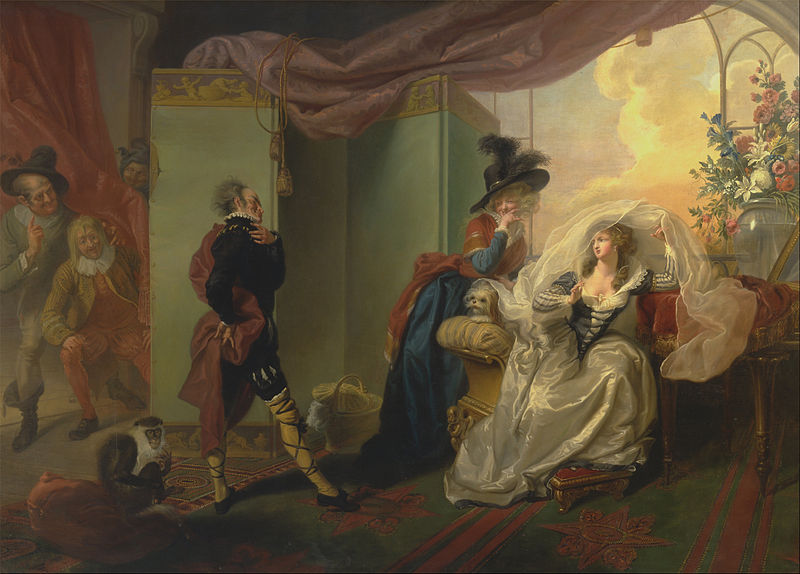
File:Johann Heinrich Ramberg - Olivia, Maria and Malvolio from "Twelfth Night," Act III, Scene iv - Google Art Project.jpg
Check out those yellow, cross-gartered stockings! By Johann Heinrich Ramberg

What Kind Of War Does A Virus Wage?

The world of virology is rife with belligerent metaphors. COVID-19 is a viral invader which attacks and attempts to colonise a host. The host fights against the virus with its own defence systems in the hope of repelling the invader. Meanwhile, the societal fight against COVID-19 is likened to a war effort as the heroes of the NHS support those infected by the virus while the rest of the country contributes to the fight by staying at home and doing all we can to lower the rate of transmission. We have to win this fight after all and it’s a big one, it’s a pandemic.

These metaphors are useful. The former helps describe how viruses exist and how they infect us, while the latter reminds us of the severity of the pandemic and the scale of the response needed to meet it. However, they are both metaphors – “a figure of speech in which a word or phrase is applied to an object or action to which it is not literally applicable” – and just as a virus can’t literally be said to invade a host (although we do talk of a virus spreading) so we can’t really go to war against a virus because a virus, strictly speaking, isn’t an enemy (even though it does very much threaten our lives). Because an enemy is defined as “a person who is actively opposed or hostile to someone or something” and personhood often depends on possessing conscious agency – the ability to desire something and act in a way so as to get it. So, really, when it comes to fighting the war against COVID-19 we aren’t at war with a virus we are at war with one another.

Today we see this war play out in the political decisions those in power make which determine how well (or badly) we will be able to survive this pandemic. The lack of ventilators, the insufficient supply of medical equipment, and the state of the NHS have their origins in politics. As did the decision to bail out the banks after the 2008 crash and foist the debt onto the public via austerity, which further undermined our social fabric. This response based on a long-standing neoliberal capitalist hegemony in the UK (and beyond) which prioritises commerce and capital over community and well-being. This politico-economic regime a logical continuation of our entrenched class system that sees a few (e.g. Kings and capitalists) hoard wealth at the expense of the many (e.g. serfs and workers). And the very wealth of this hierarchical system founded upon many genuine invasions, in which an attacking force attempted to destroy populations and colonise their territories. I am talking of the spread of the British Empire and its genocidal colonisation of so much of the world. If we were to use a viral metaphor the Empire would be the virus.

Many have fought and questioned this system of oppression for centuries and, now, the pandemic is making many more of us question it too. This violent and soul-destroying system can be replaced by ways of life that are more healing, communal and just. Ones which are ultimately founded on love, not hate. For this to happen I think it worthwhile to be able to trace the origins of our political circumstances in their long, bloodied and genocidal history. The pandemic is about so much more than a virus, it is deeply political, and for our politics to change we must understand them from as many different angles as possible including anti-colonial, feminist, queer and intersectional. In the meantime we will continue to fight a war on COVID-19 but who survives it and how depends on the politics we practice and, to date, it is our politicians, not our viruses, that wage war. This can change and we must be the people to change it.