These Are The Christmas Adverts!?

It’s that time of year again, still pretty far away from Christmas but our economy’s on the rocks and we need to get people shopping pronto. The lights are up in the streets, Paris is ordering another giant, green butt-plug and Black Friday is looming. To fuel this pre-Christmas consumption extravaganza the propaganda machines, I mean televisions, are doing their best to spew out an array of emotive adverts to get us racing further into debt. Here are some of the highlights (well, lowlights).

Sainsbury’s and the 4th Industrial Revolution: this Xmas ad is a simple one, an overworked Dad who works in a toy store (as if we have those in Britain anymore) gets worried he won’t be able to spend enough time with his family at home. As stresses mount and this unforgivably long advert unfolds the Dad’s solution is to automate himself, yup, riding the trend of replacing humans with robots he gets a drone to do his shopping, machines to run the factory production lines and a nodding dog to do his ‘yes-manning’. This radical transformation of our society is being heralded by the World Economic Forum (self-important 21st century Adam Smith types) as the 4th Industrial Revolution but to those of us who aren’t super rich and who don’t work in think tanks it heralds loss of jobs and increased social atomisation. Thus, rather than an uplifting advert this is actually a bleak prophecy of things to come, worthy of a Black Mirror episode, but Sainsbury’s do give a great nod to diversity in British society as people of colour and different faiths appear in this advert, of course, the protagonist is still a white guy proving that the supermarket will go some of the way but not all of it.

Lidl/Aldi: Nostalgia and the Dangers of Anthropomorphising Vegetables: at least these ones are short. Lidl’s is called Homecoming (yup, it has a title) and is about a family redecorating their Grandad’s old cottage out in the countryside in time for Christmas day. This is a blatant play on British nostalgia for the countryside and ‘family values’, which today are, of course, being trashed by urbanisation and rural poverty, which are both exacerbated by supermarkets taking jobs away from farmers and forcing them to engage in unsustainable farming methods. This advert is effectively a nostaligc lie about what our past once was but probably actually wasn’t. Meanwhile, Aldi’s advert (Aldi is another German superchain and Lidl’s top competitor) shows a carrot running across a Christmas table laden with food – he runs past the corpses of other carrots, the mashed remains of dead potatoes and even gets the skin of his back grated off – all so he can reach the plate by the fireplace with a mince-pie for Father Christmas on it. The carrot gets its wish and, unlike all his dead and eaten friends, ends up caught in the antlers of a reindeer at the front of Santa’s sled, perhaps a subtle nod to the idea of the carrot and the stick, and this time the carrot is incentivising us all to eat loads and buy even more. Whilst funny this advert does highlight the dangers of anthrompomorphising vegetables because, ultimately, we kill, cook and eat them.

https://www.youtube.com/watch?v=gwh00WnE7EI

M&S Does Sexism: I would mention the Waitrose and John Lewis adverts but their over-reliance on creepy CGI animals and their unrealistic plots really let them down this year (a normal robin would not survive that journey and besides the fact animals don’t use trampolines they also don’t get on that well: the badger would attack the foxes, the foxes would eat the squirrel and the second the hedgehog landed on its back the foxes would be eating that too). Although, this US election result take on the JL advert is inspired and depressing! Instead, it’s M&S, which shows Santa Claus heading off to do the rounds leaving Mrs Claus at home. Not only does she lie to him when he asks if any “last requests” have arrived in the post and she says “no, just bills” – actually, there was a letter addressed to her and unless her bank uses crayons it’s pretty clear it’s not a bill. It turns out a young boy threw his sister’s trainers at a dog and she cried a lot (typical girl, amirite) so could Mrs C sort this out. Sort it out she does: changing into a highly impractical dress given the weather, getting on a jet-ski, into a helicopter and flying half way round the world to add a final present to the pile her husband will have just put under the tree. She even has a cheeky bite of mince pie but not a big one because women have to be dainty in their eating behaviour, amirite! Naturally, the sister is overjoyed because all girls care about is clothes and shoes, amirite! So, not only does Mrs C do the dirty work of a young boy too lazy to buy his sister a present but just before Mr C gets home from his worldwide trip she hides all the evidence: her secret HQ (think bat cave meets festive cheer), her cool dress and even the letters she receives from kids all vanish behind the wall. She even pretends to have fallen asleep whilst reading a book called ‘Fifty Shades of Red’ (because women only care about sex with sociopaths, amirite) and when Mr C asks how her night was she says, “oh, you know, quiet.” Um, not true! So why is she lying? She tells her husband it “wouldn’t be fun if you knew all my secrets” whilst giving the audience a knowing look and she’s basically asking us to collude in patriarchy, where men’s egos are so fragile the thought that a woman can contribute to the working world is just too much. Mrs C would rather weave an incredibly elaborate web of lies and deceit rather than have her husband know quite how resourceful and independent she can be. Talk about #masculinitysofragile. Either that or she’s just very bored of her marriage.
The Trouble With The Gilmore Girls

Only a couple more weeks until the Gilmore Girls return in four brand new episodes on Netflix. But who are the Gilmore Girls, I hear you ask. Well, it’s a popular American dramedy (drama-comedy, yup, that’s a thing) that ran from 2000 to 2007 and now they’re coming back. The ‘girls’ themselves are Lorelai and Rory Gilmore. Lorelai is a single Mum who was shunned by her rich parents when she became pregnant. Rory is her daughter. They live in the kooky town of Stars Hollow where all manner of daily adventures take place. It sounds like a recipe for success – not one but two female protagonists and a supporting cast of likeable, if kooky, characters. Indeed, it was a success, a huge success, and people all over the world enjoyed watching Lorelai and Rory talk at an incredibly fast pace and remain in great health despite diets of takeaway food.

However, scratch beneath the surface and the kookiness takes on a darker hue. For starters, the supporting cast is one of stereotypes – there’s Manuel (correction, his name is Michel, I was mistaking him for the stereotyped waiter in Fawlty Towers and compounding the stereotype – sorry), the one black and homosexual character who is a smörgåsbord of tokenisms; there’s Sookie, Lorelai’s co-worker and the token ‘larger’ character whilst nearly all other characters are slim and conventionally good-looking (she’s also played by the epic Melissa McCarthy who was tragically underused). There’s Kirk the ‘oddball’ character who is frequently mocked for finding it difficult to socialise. There’s Lane, Rory’s nice Asian friend, but never going to be the star of the show. And there’s Lane’s Mum who is all sorts of offensive cultural generalisations. And don’t forget Paris, the ambitious and intelligent one who regularly gets mocked for being ambitious and intelligent, unlike Rory whose achievements come naturally and without fuss. Meanwhile, if you wish to find other diverse characters, e.g. bisexual, lesbian, transgender, ethnicities besides black and asian, non-Christian, this is not the show for you. But this isn’t new, shows like Friends and How I Met Your Mother also fall foul of these tropes.

However, I think the biggest problem is that the Gilmore Girls are presented as normal – Rory and Lorelai are presented as the great bastions of normality around whom all other characters are presented as weird offshoots. Yet these ‘girls’ are not normal. For one Lorelai gets to have her cake and eat it with regards her wealthy background – she simultaneously accepts handouts from her parents whilst decrying said privilege. She hands these views down to Rory who we witness in one episode paying a guy $20 so she can sit under the tree he’s sitting by. There are other trees! Rory also never learns how to do her own laundry, a useful plot device to see her relentlessly driving from Harvard to Stars Hollow to hang out and talk fast with her Mom. The ‘girls’ also enjoy mocking their fellow townspeople, making offhand jokes about genocide and ebola, and generally belittling the lives of others. Yet these ‘girls’ are the moral core of the programme and I think that’s a little problematic.

Other problems include the replacement of plot with endless talking – Rory talks to her current boyfriend, Rory talks to Lorelai about talking to her current boyfriend, Lorelai talks to Sookie about talking with Rory about her talking with her current boyfriend. Of course, what would be interesting if Sookie then talked to the current boyfriend and we discovered they were having an affair together – but that would constitute plot rather than talking. Then there’s the soundtrack, composed of a singer chanting monosyllables like ‘la’ and ‘da’ over and over again as the scenes change. However, the saving grace of the Gilmore Girls is Emily, Lorelai’s mother. She is a rich, snobbish, conservative bigot and regularly complains about other people, who she treats largely  as means to satisfying her various ends. But she is consistent in her views. At least we know where we stand with Emily (ideally, far away), she’ll be rude to her staff and she’ll complain vociferously at restaurants whereas Lorelai and Rory are too busy trying to present as ‘women of the people’ when really they’re more like Emily than they care to acknowledge (I guess Emily would unashamedly vote Trump whilst Rory and Lorelia would vote for Hillary but not necessarily campaign against the structural injustices of neoliberal capitalism).

Now, I realise I might as well stop blogging given that I’ve just criticised one of America’s national treasures but there is something I must admit to – I kinda love the show. I have watched an awful lot of episodes (although not all, which is my disclaimer for this post containing any factual inaccuracise) and seen Rory and Lorelai eat far too many pancakes at Luke’s cafe, go to lots of kooky town events and bicker with various partners. Like erosion, their incessant waves of chatter have gradually worn away at my coastal defenses and for some unknown reason I actually find myself caring about the people of Stars Hollow. So, yeah, I will definitely watch the new episodes and shudder every time a character is tokenised but also cheer when Rory and Lorelai achieve great things. I love those Gilmore Girls…or should that be Gilmore Women?

What Is True Love?

It’s a question on many of our lips as we navigate the marketing campaigns, movies and relentless narratives of heteronormative patriarchy that tell us true love is something to be shared with one other person of the opposite gender for the rest of our lives. True love will involve a white wedding, 2.4 children and a mortgage. True love will look good in public and any problems will be hidden behind closed doors. True love will be shared on Facebook and Instagram whilst the passive aggression happens off camera. Fortunately, P!nk and Lily Allen aren’t buying into this bullsh*t.

Well, ok, I think both Lily Allen and P!nk are married with kids although they probably own their houses outright rather than have mortgages. However, there’s a lot of angst in this song as they complain about how irritating their partners are, how infuriating, how stupid and a whole load of other negative things (there are also quite a lot of domestic abuse references as well as some causal anal sexism, but that will be another post). And at least they’re honest. Love isn’t all roses, doves and honeymoons it can be annoying, smelly and sometimes quite disappointing. But I do like the idea of taking the rough with the smooth and committing to something bigger than  just two (or multiple) people, where 1 + 1 makes more than 2 (or 1 + 1 + 1 etc for those in polyamorous and/or open relationships). I think that’s something worth committing to and not that crass and crushing heteronormative, consumer capitalist version of “true love” created to make us buy more stuff and go to bed feeling guilty and alone. And I don’t think that better kind of true love (maybe just call it love to sound a little less presumptive) has to last forever either, what a sad benchmark for a relationship’s success if it only counts if it ended at death. It also doesn’t need to involve kids and a mortgage, dogs in a housing co-op are ace too. And it certainly isn’t just for straights. Queers welcome.

Now, don’t get me wrong, I am not against people marrying, having 2.4 children and getting mortgages. It’s often a brilliant and inspiring (and very, very difficult) thing to do, hats off to you. But I do mind if that’s all you do, if you’ve just glanced at the ‘true love’ manual (aka watched a few Julia Roberts films and dressed your son in blue and daughter in pink) and taken it at face value. Worse still, not just read the manual but started to recite it as well, as you take for granted that society (and this includes politics, economics and culture) is often weighted in your favour (but only if you’re wealthy enough). I reckon the best thing you can do is acknowledge that space has been made for your type of love, enjoy it, and then set about helping create space so others can enjoy their types of love too. In brief, as with most posts on this blog, check your privilege and don’t be prejudiced. Then we can all have a go at mucking up true love (p.s. and yes, this post was basically an excuse to post that song, it’s just so catchy).

The Chemsex Monologues

Chemsex kinda does what it says on the tin, mixes chemicals and sex. The drugs used can include mephedrone, crystal meth, cocaine and ketamine. Naturally, a whole load of stereotypes get flung at the people and groups who engage in these activities which is why The Chemsex Monologues are so important because they reveal the all too human side behind the prejudiced slurs and sensationalised stories. But before you read my review go book your tickets, it’s on tonight until Saturday at 9.45pm at the King’s Head Theatre in London.

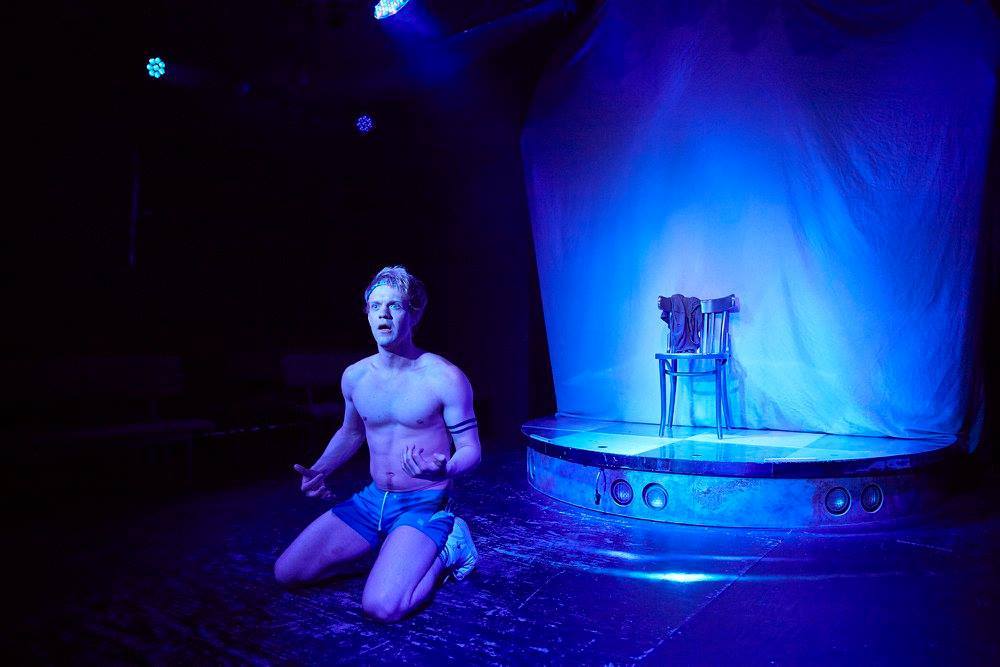
Directed by Luke Davies, written by Patrick Cash and designed by Richard Desmond this was an intense hour-and-a-bit. Through a series of monologues we were introduced to various characters: the narrator, played by Richard Watkins, who falls for that hot boy on the scene with the great abs and the endless energy. Then Denholm Spurr brings that boy to life as Nameless, who gets to live his dream and meet a porn star. Meanwhile, Charly Flyte plays Cath, the ever faithful fag hag who’s getting a little fed up of her so-called fag. And Daniel, the wonderfully upbeat sexual health worker who loves handing out condoms and lube at saunas and brings red wine to a chemsex party rather than chems. All the cast were fantastic, they found the nuances of character and the expressive range to ensure each monologue was delivered as the multi-layered story it was written as. It wasn’t just someone stood up and talking for fifteen minutes instead we were drawn into worlds of sweaty bodies, M&S ready meals and chemically fuelled orgies. That all the monologues wove together to tell a larger, interlinked story and showed the same characters from different angles proved very satisfying but I shan’t spoil anything (but what I will say is that I’m very glad how things turned out with Swallows).

What also worked so well in this production as in Queers (also produced by Dragonflies Theatre), was that thread of emotion that meant the stories told were more than just anecdotes but had real heart. That Cath was so much more than a fag hag but also a loyal friend, a hardworking single mum and an amazing source of positivity. That Nameless was more than the boy in short shorts (and nothing else) but had so much love to give and poetry to share. That both the narrator and Daniel could see the cracks in the facade of this seemingly glamorous world and still be there to offer a hand. I’d also like to add that I sincerely hope Matthew Hodson is as nice in person as the characters he plays are – Daniel was a legend as was the character Hodson played in Queers (no pressure Matthew). However, the niceness of these characters just exacerbates the tragedy that runs throughout the play. There’s a moment when Daniel’s wondering to himself why so many people do mix chems and sex. He thinks back to a GCSE classics class and remembers that the word ecstasy comes from the Greek extasis: a displacement or removal from the proper place. “Why do so many gay men want to be outside themselves?” he wonders and I thought that was a very good question. Is it just for fun or is it that this so-called real world can be so endlessly hostile and unwelcoming, so shaming of minorities yet so quick to tokenise and ridicule them whilst remaining indifferent to their suffering. If this is one of the messages woven into The Chemsex Monologues then it’s a wake up call for so many of us to stop being so indifferent and unfriendly because people like Nameless, Daniel, Cath and whatever-the-narrator’s-actually-called are priceless and should be made to feel at home. Anyways, enough of that, go book your ticket.

ChemSexMs
Denholm Spurr as Nameless in The Chemsex Monologues


I Call Bullshit: Bored Of Being Polite To Bigots

“I call bullshit!” It’s my favourite post-referendum phrase at the moment and basically it’s a catch-all for whenever I hear someone chatting a whole load of bollocks. Whether it’s Theresa May promising greater equality in Britain, or Borish Johnson saying you can contextualise away his many racist and sexist slurs, or anyone saying Britain can be great again without even the semblance of a back-up plan. I call bullshit to all that. But there’s something I call even greater bullshit to and that’s intolerance.

I was brought up to be polite. Very polite. In many ways that’s a good thing, I always got on well with my friends’ parents and I tended not to go around brazenly offending people. On the other hand it did mean I avoided conflict and internalised the majority of slights I suffered only to let them fester and reappear as passive aggressive comments or sudden outbursts of anger, neither of which were particularly helpful. So, I think there’s a balance to be struck between being polite enough – i.e. not being a total wanker to people – and being blunt – i.e. being honest to call out bullshit when you see it. A bit of conflict is healthy after all.

So, this is one for all the casually bigoted people I know – the sort of people who profess to not being racist but crack the odd joke about people of colour; the sort of people who profess to being tolerant but don’t really like Muslims; the sort of people who profess to not being homophobic but call bad stuff ‘gay’; the sort of men who profess to not being sexist but tell women to get back in the kitchen; the sort of Tory voter who genuinely thinks a party wedded to the banks and neoliberal capitalism can get us out of this mess; the sort of Brexiteer who doesn’t like the democratic deficit in the EU but is blind to the democratic deficit in the UK and the sort of privileged cynic who criticises society and the people in it whilst selling out to be a banker. Basically, I call bullshit to any of the crap that undermines equality and diversity in this country.

I believe in a plurality of values: I am happy for people to practice different faiths, I am happy for people to vote for different parties (e.g. between Labour and Green), I am happy for people to have differences of opinion but I am not happy if any of this promotes hostility and hate. For the sake of Britain being great again we must be intolerant of intolerance. It is not true that anything goes and I will fight tooth and nail to combat prejudice. So, yes, I will throw off the shackles of over-politeness and call bullshit to bigotry. Bigots beware (and while you’re at it, just piss off and get a life)!

Keep Calm

Operation Breentry

Why, sometimes I’ve believed as many as six impossible things before breakfast.”

The Red Queen, Alice In Wonderland

If we can put people on the moon, if we can build a world-wide web, if we can invent the Hoover, then we might as well try to keep Britain in the EU. We are caught in a unique period of time and history: the leading parties have no plan for the future and faith in our country and economy is wavering yet the catalyst at the heart of it – the Brexit vote – has not been rendered fact. It is still just a story. It’s a powerful one that many people have accepted and has already had adverse social, political and economic impact but it’s still a story that can be challenged. It’s time for Operation Breentry.

What’s Breentry? It is a movement to stop Britain leaving the EU. It involves emailing MPs asking them to reject the result of the referendum. There’s another initiative to call for a second Referendum and the Parliamentary Petition for that has over 4 million signatures. Meanwhile, people are demonstrating in the street to Remain in the EU and other European leaders like Angela Merkel are advising us to think twice. Unfortunately, many people are already resigned to letting Brexit happen and/or think Breentry could/should never happen. I want to challenge these beliefs.

It’s anti-democratic: To annul a referendum certainly appears anti-democratic but that surely requires living in a functioning democracy. But we don’t. The Leave campaign was anti-democratic – it lied with regards spending on the NHS, it lied with regards limiting immigration (the deals we might do with the EU would involve maintaining freedom of movement anyway) and it was only campaigning against something, it had no plans for after winning. However, even taking the Leave-Remain decision at face value is wrong because the calling for the Referendum itself was anti-democratic. David Cameron, who had entered into Parliament with a slim majority, called it to appease his right-wing back benchers so he could become PM. That is power politics at its worst especially when so many of the electorate did not even vote him in. Remember, our head of state isn’t elected, our House of Lords isn’t elected, our mainstream media is privatised and has a clear agenda and we only vote once very five years. So, yes, Britain is an aspiring democracy but it hasn’t got there yet. All is still to be striven for.

It’s too late: No it’s not. Article 50 has not been signed. We can still petition all MPs and leaders of all parties (the Tories included) to not make one of the worst decisions in recent British history. Furthermore, even if Article 50 were signed we could still challenge it. Or perhaps this isn’t about being late or early at all, if we were on time we would have trialled all war criminals, transcended growth-based consumer capitalism, ended all wars and avoided climate change. Let’s just be pragmatic and do what we can in the time we’ve got.

It would lead to violence and civil war: Breentry would certainly anger voters who wanted to Leave but their actual vote to Leave has acted as a rallying call to violent racists and xenophobes. Police have registered a fivefold increase in race-hate complaints since Brexit. Immigrants have been verbally abused, attacked and fire bombed in the past few days. This proves again how misled and misguided many Leave voters were, that they actually believed Britain might become some free-standing, all-white nation surrounded by high walls. That was never what the Leave vote was offering even if the likes of Nigel Farage might have encouraged it. If people do threaten violence in response to Breentry and we don’t act as a consequence then we are negotiating with terrorists, kowtowing to criminals and appeasing racists. We categorically cannot let the bullies win. As for civil war, well, currently the Tory and Labour parties seem to be hellbent on ripping themselves apart as the vote has unleashed a whole wave of vitriol and back stabbing from the parties. Meanwhile, the Referendum has split families and friends, as people fall out with each other in bitter arguments. And every economic forecast looks bleak. Perhaps we’ve always been at war in Britain, certainly a class war, and the Referendum just proves what has always been true. Hence why we must do all we can on all fronts to heal the many deep wounds in our country rather than stick the knives in further.

The Tories will negotiate a good deal outside the EU: No they won’t. The Tory party is swift revealing it’s inability to steer a post-Brexit course. Gove stabbed Johnson in the back and does not have a plan for a Brexit future despite co-leading the Leave campaign. Theresa May is notoriously anti-immigration and yet might have to be the one negotiating a deal with the EU that involves keeping freedom of movement – that’s like asking a racist to argue for multiculturalism. Meanwhile, Liam Fox is anti-EU (and anti-gay marriage, he said it’s ‘absurd’ and ‘social engineering’). Angela Leadsom loves Europe apparently but says, “What I hate is the EU and the way it is destroying such a fabulous continent” – good luck negotiating with the likes of Angela Merkel and Jean-Claude Juncker then (she also abstained from voting on gay marriage, she believed it didn’t have a mandate). The irony is that the one pro-Remain candidate, Stephen Crabb, will lose support because of that stance, although he only adopted it out of loyalty to David Cameron even though he’s largely anti-EU. He also opposed gay marriage but apparently is OK with it now, phew. None of these people have the country’s best interests at heart or the intelligence to guide this country into recovery. They’re also all pro-austerity, an economic decision that will grind this country down even further and exacerbate the unrest we’re witnessing. I thought the Tories were supposed to oppose Labour but turns out they oppose themselves as well.

Labour could negotiate a deal instead: No it couldn’t. There’s almost more infighting there than in the Tory party. Corbyn is being relentlessly stabbed in the back by Blairite MPs even though he has a huge amount of grassroots support. He was also anti-EU and decidedly quiet on calling for Remain. If he miraculously became PM (which would be no bad thing as he’d challenge austerity and enrich the welfare state) would he really have the best interests of the UK at heart when dealing with EU bureaucrats? Perhaps he’ll wake up to the Breentry call and take us back, although he’ll have a vicious, untrustworthy party behind him that is just waiting for his political demise. I thought Labour was supposed to oppose the Tories but turns out they oppose themselves as well.

The UK is strong, we’ll get what we want in the end, we’ll “take back control”: No we won’t. Nicola Sturgeon is calling for a second Scottish referendum. Leanne Woods, leader of Plaid Cymru, is calling for Welsh independence, “redesigning the current UK is the only option.” There are calls to unite Ireland and even for London to go independent. Turns out it’s not just political parties that don’t get on, countries don’t either. Add to this deepening austerity, companies threatening to leave/leaving the UK, the loss of our triple A credit rating, a rise in racist violence and I’m struggling to see how the UK stays united. That selfish little world of capitalist consumerism and middle-England-ism is imploding and is trying to take its neighbours down with it. This isn’t new – this has been an ongoing problem for decades, Brexit has just exposed it more starkly. Breentry would just be the first step in trying to patch back together the social fabric of the UK.

But migrants are a problem, we need less of them: No. That is taking Tory and Leave propaganda at face value, as well as various Labour views. Stirring up racial hatred and anti-immigration sentiments are a timeless tactic used to distract attention from underlying economic issues which include rising inequality (how come so many people can’t afford their rent whilst so many others have multiple houses around the world) and austerity (we keep forgetting that it was the 2008 financial crash that brought the global economy to its knees not a “bunch of migrants” nor over-generous Labour government spending on the economy, remember, Osborne’s deficit has been so much higher than that of Brown’s). If we scapegoat and abuse migrants and people whose skin isn’t white enough we will set this country back decades and fall into the same bigoted trap of history. We are better than this and we can learn our lesson.

What if we’d voted Remain and the Leave campaign wanted to challenge it: Then they’d have every right to and could use the same arguments that I have. Except many of the Leave camp voted out of protest on the proviso that Britain would take back sovereignty and control, but that was a lie. They voted to get more money spent on the NHS, that was a lie. They voted for less migrants, that was a lie (plus, I don’t negotiate with racists). But even if this scenario were true the state of our country would still be to play for. We’d still be realising, all too late, that whilst political statements seem like irrefutable truths they are in fact stories and agendas that can be challenged, whoever’s side your on. The game is afoot (and always has been but for too long we’ve let others, including elitist, old-Etonians, play it for us).

The EU won’t get any better: I agree that the EU is a problematic institution. The economic bullying of countries like Germany and France against Greece is outrageous. I know my grandparents didn’t risk their lives against the Nazis just so economic powerhouses could drive other countries into recession. However, I do know they risked their lives to stop war on the continent and that worked, for now. With the rise of the extreme right and this includes the neo-Nazis we risk undoing their good work and whilst we might not have a war with trenches and obvious beginning/end points we will witness the rise of extremist terrorism in Europe directed at groups including Muslims, Jews, the Romani, queers and any other convenient scapegoats. The EU, problematic as it is, is a supra-national organisation built to enhance unity and promote peace but this won’t happen by magic and we must challenge and change it from within to ensure peace reigns. My grandparents fought the Nazis, I think I can fight corrupt EU politics. And the latter is itself a victim of globalised, growth-obsessed, consumer capitalism (that’s the real fight, see rest of blog for thoughts on that).

*

There is another way and it’s called Breentry. Email your MP and ask them to vote out the Referendum, sign the petition to call for another one, wear a safety-pin to show support with the immigrant population, challenge hate crime, hug your friends, let yourself cry, howl in anger at the moon, smile at strangers and talk, talk, talk. We must dare to be political and we must dare to call for change. A positive post on Breenty and a possible future will come next but this one is getting far too long. Please do challenge me, this is just my opinion, but please let’s keep talking about this. May the force of Lady Gaga be with you – she’s right, we are on the edge but we don’t have to fall.

And news just in, this hilarious facebook post that sums the situation up perfectly!

Befriending Brexiters

I walked out of Dalston Kingsland overground station on Saturday into a brief spell of sun. Blinking back the glare the first thing I saw was a friendly looking young white man with floppy brown hair offering me a big smile and a red pamphlet reading LEAVE. Yup, a Brexiter, one of those terribly charming and polite people who wants Britain to leave the EU and ‘go it alone’. Here was my moment, I thought, my chance to engage with the ‘enemy’ and convert him to the Remain cause.

We offered one another friendly hellos and I asked him how he was doing. It transpired he was doing well. I thought I’d meet his friendliness with the like and I said that I’d love to hear more about his argument. He told me that his main reason for supporting Leave was financial, he believed we would have a stronger trading position if we left. I nodded and then mentioned Ngaire Woods, the Founding Dean of the Blavatnik School of Government and Professor of Global Economic Governance at the University of Oxford, and what she had said about Britain’s trading position being weaker outside of the EU (see video). He said he hadn’t heard of her.

https://www.youtube.com/watch?v=RHFp3-qE_T8

We carried on in this amicable style for a while as he said one thing, I said something else, then he offered more, and so on and so on until I realised I didn’t stand much of a chance. Not only did I not have enough facts at hand it seemed that for every one I did he had a counter argument. I figured that the likelihood of me convincing him to change his view was low given my limited information and the fact that he was on the street on a Saturday afternoon handing out Leave leaflets – he must be quite committed to the cause.

Instead I told him that I feared leaving the EU would legitimise and worsen the rising levels of violence in the country, violence that stems from extreme, right-wing views about who does and does not deserve freedom from violence. I mentioned the tragic death of Jo Cox at the hands of a man who shouted ‘Britain First’ as he attacked her. I mentioned the rise of the neo-Nazis throughout Europe and how some pro-Brexit people I had spoken to expressed overtly racist views. He looked a little concerned and assured me he wasn’t racist. I believed him. Then his colleague came over carrying yet more LEAVE leaflets and he introduced me to her. We offered one another polite hellos. I told them I had to go, I had a conference to get to, but I said that whilst I would still vote to Remain, whatever the result, it was all of our responsibility to stand up to racism, discrimination and violence. We would have to put aside our political differences (he told me had previously voted for the Lib Dems and later the Tories) and work hard to ensure equality and peace were prioritisied in our country. They both nodded emphatically and as I walked away I heard him say to his colleague that I was “one of the better ones”.

So what had I achieved? Not a lot as I’m sure most of you would observe and you’re right, I hadn’t made them change their minds but maybe I had made them think twice. The task ahead for all of us – peace in our time and peace on earth – is something that transcends political persuasion and that we can all be a part of. And maybe in that brief conversation whilst I hadn’t got them to about turn I might have surprised them, if I was one of the ‘better ones’ I wonder what some of the other Remainers were life. The Referendum, like so much of party politics, is designed to fracture and split but we have to challenge this, we’re humans before we’re Tory, Green or Labour. And if dark times are ahead, which they certainly are, then we’re going to need to make a lot of new friends.

Oxford’s Vigil For Orlando

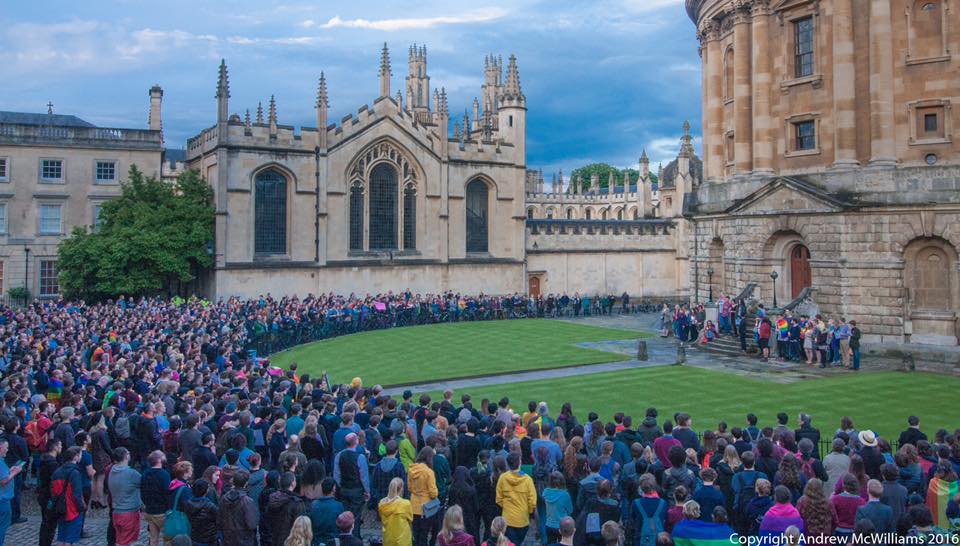
Oxford, England. Thunder boomed, lightning flashed and the rain came tumbling down. The English summer is never one for predictably and climate change just makes that all worse. A brief cycle home and I was drenched, my second shower for the day. It was five o’ clock in the afternoon and there was going to be a vigil in Radcliffe Square for the victims of the homophobic terrorist attack in Orlando. More thunder, more lightning, more rain. The Orlando attack was deeply distressing. It is sad to see people robbed of their lives by atrocious acts of violence and it is sad to see the queer community targeted simply because people want to be free to love whoever they wish. However, I’d seen photos of the vigil in Soho, London, and there had been thousands of people standing in silence, in tears and in solidarity, and this gave me hope.

A few hours later I put my waterproof jacket on, jumped back on my bike and head into town. But the jacket was unnecessary because the clouds were breaking and beyond, even at half past seven, the sun was shining. The view of the changing sky was staggering punctured by the sandstone spires of Oxford University. I arrived at Radcliffe Square where hundreds of people had gathered outside the Radcliffe Camera (the only building in Oxford’s skyline that looks more like a booby than a penis). So many people. Like any community, the queer one can be both brilliant and difficult. Great friendships can be forged but so can cliques. Certain groups come to identify themselves apart from others and ‘politics’ can arise. However, that evening we were gathered for something so much greater than ourselves, we were gathered in solidarity for the victims of Orlando and for queer people all over the world.

Vigil for OrlandoA quote from the facebook event reads as this: “LGBTQ people have long been and continue to be the victims of violence and hatred in the places where we try to seek safety. The fact that this attack happened on Latinx night, and that so many of the victims were Latinx reminds us that queer people of colour are disproportionately at risk of violent hate crimes. On Wednesday evening we will come together outside the Radcliffe Camera to remember the lives of the victims of this attack; we will mourn the violence that seeks to destroy our communities. There is no space at this vigil for Islamophobia or racism. We will not be silent in the face of hatred, we will stand together and support one another as we have always done in times of crisis.”

People gave speeches, the names of the victims were read out and a two-minute silence was held. Someone in front of me began to cry and someone next to them gave them a hug – I don’t think they knew each other. There were families there too and heterosexual people, distressed at the attack and supporting their queer friends. Then a beautifully voiced choir sang Seasons of Love from the musical Rent and Somewhere Over The Rainbow. What ace songs. It’s such a shame that it sometimes takes tragedy to bring us together but those moments of unity are exceptionally powerful, and even though I went by myself to the vigil I did not feel alone. Humans have always lived in difficult times and this remains true today. My hope is that the sentiment of belonging to something so much bigger than ourselves – a community of fighters, lovers, queers and allies that runs back throughout history and will run always into the future – will continue to bring us closer together in a time when division is not an option.

Queer People Need You!

Do you have to be Lesbian, Gay, Bi-Sexual, Transgender, Queer, Intersex or Asexual to care about LGBTQIA issues?

Answer: No!

Now here’s a blog on how to be a queer ally, however straight you are.

But first the word ‘queer’. Why am I using it? Many might know it as a term of offense used to denigrate LGBTQIA people and this is certainly true. As a word it simply means ‘strange, peculiar or eccentric’ from the Old High German twerh ‘oblique’ itself coming from the Proto-Indo-European root *terkw ‘to turn, twist, wind’. By the late 19th century it was being used to describe homosexual people in a pejorative fashion. Fortunately, by the 1980s the word was being reclaimed by queer activists and scholars. And now queer is used as an umbrella term for people who don’t identify as heterosexual and are not cisgender (i.e. do not identify with the sex they were designated at birth). Interestingly, if I tell you I’m queer I’m not actually telling you that I fancy people of the same gender, or of both genders, or identify as the opposite sex. No, those exceptionally personal issues (what I do in my bedroom and how I relate to my own body is my business, not yours!) are not revealed instead I am saying I challenge the binary nature of gender (i.e. male or female) and any essentialisation of people for their sexuality. Of course, the queer community is a large and diverse one and even though I use the term to refer to the LGBTQIA community in general many might not. Many will prefer LGBTQIA and many will use queer to mean something else. However, for the sake of this blog I am using it as the umbrella term described above.

Anyways, in case you missed it, that was lesson one on being a queer ally – understanding the lingo, very important. Lesson two is about using it and this will vary from person to person. I’ll use myself as an example. I’ve often had people try to define my sexuality for me – people would label me with terms I never used to describe myself sometimes because they wanted to understand me, pigeonhole me and/or bully me. When it comes to politics I consider myself queer – I challenge gender and sexuality norms and I advocate for the equality and rights of the LGBTQIA community  – but when it comes to my personal life, am I gay, bi-sexual, queer or something else? None of your business! So please don’t assume you know what my sexuality is because you don’t and don’t ask me either unless you feel it’s appropriate to. If you’re straight the likelihood is you won’t be asked to defend your sexual preferences on a regular basis or even reveal them so please stop asking me what I like to do with my sexual organs! Just be happy with the knowledge that I am Robert and I’m a queer activist. However, I’m just one example, and many people are bisexual, transgender, gay etc and want to be recognised as such – it’s your job to find out what that means to them and to use the appropriate terminology.

Lesson three is about stereotypes. We’ve all got a bunch of them in our heads be they the mincing queen, the butch lesbian, the greedy bisexual, the weird old gay guy etc, and without even thinking about it we project them at other people. One I often get is when I ask to be introduced to other queer men and people immediately assume it’s for sex, I must be one of those “promiscuous gays.” Unfortunately, much of the time I’m just wanting to meet more people from a community I consider myself part of, yet people are still quick to pigeonhole me. Even worse is that if I do ask to be introduced to a man because I’m attracted to him I then conform to the “promiscuous gay” stereotype and just confirm everyone’s prejudices. So I’m screwed either way (although, ironically, maybe not screwed in the way I might want to be!). So those stereotypes you’ve got, whatever they are, just drop them. Even if you think you see someone conforming to a stereotype, they really aren’t because they’re a human and they come with a rich and varied story of their own. It won’t help you or them if you reduce them to a few tokenistic gestures and even if they do like to gesture in that way that doesn’t make them the stereotype. And remember, the more we stereotype minority groups the easier it is to pigeonhole them, to margininalise them, to dehumanise them, to ignore them and to hurt them. So it’s hashtag time, #humansnotstereotypes.

There are so many more lessons to be learned, for all of us, but for now I’ll sign off this post with an ace song from gay twins Tegan and Sara because, surely, even if it’s for sex or just friendship we all would benefit from getting a little closer. And just in case you find the concept of learning lessons about queer people a little patronising then please just see this as a chance to learn more about an awesome bunch of people who can make awesome friends and allies, and who throw pretty epic house parties (oh, and one other thing, never use ‘gay’ as a pejorative adjective. Nope. Don’t want to hear it. Just never. Thanks).

If You’re Not Gay It Does Make A Difference

“The worst mass shooting in modern American history was also a hate crime against the gay community. It’s not the first time LGBT (lesbian, gay, bisexual and transgender) people have been the targets of violence.” BBC News.

For more information on the recent hate crime in Orlando that claimed 50 lives please read this article and then search for more. For this blog, however, I want to focus on the guardian journalist Owen Jones’ appearance on Sky News to discuss the atrocity.

It does not take long for an argument to arise between Jones and Mark Longhurst and Julia Hartley-Brewer. Jones works hard to ensure that all present acknowledge that this is a homophobic hate crime and act of terror. He describes it as “one of the worst atrocities committed against LGBT people in the western world for generations.” This is a statement of fact yet Longhurst and Hartley-Brewer don’t get it. Longhurst tries to ignore the LGBT angle by saying it was a crime carried out against “human beings” and whilst this is, of course, true, the point is that Jones is trying to focus on the homophobia inherent in the crime. Jones repeats his statement but Longhurst nullifies it again by refusing to recognise the anti-LGBT nature of the crime and talks instead of “the freedom of all people to enjoy themselves.” At which point Jones comes out with the zinger, “You don’t understand this because you’re not gay.” Longhurst disagrees vehemently and Hartley-Brewer tells Jones that he does not have “ownership of horror of this crime because [he’s] gay.” These minutes of ignorance and miscommunication are vital in derailing the rest of the press preview as the three continue to argue before Jones becomes largely silent and the conversation moves away from the LGBT community to gun control and the perpetrator, even after Jones said there has been a distinct lack of press coverage on the homophobic nature of the violence.

I hope you, whatever your sexual orientation, can see the problem here. Jones offers the scenario that this attack might have taken place at a Synagogue and if it had done then it would be clear that anti-Semitism was one of the overriding motives for the attack. If then, a Jewish person was discussing how distraught they felt at the attack it would not be for anyone else to tell them that the attack isn’t about Jewish people, it’s about people. This would totally devalue what the other person is saying and, crucially, what they are feeling – that a community they are part of has suffered a dreadful attack. We are all very different people and members of very different communities and the simple point is that whilst we can speak for ourselves and our own experiences of the world we cannot speak for others. It is not for me as someone who is not Jewish to speak on behalf of Jewish people, nor as someone white to speak on behalf of black people, nor as a man to speak for women. Instead, I can try to understand the different trials facing other groups and offer my support.

That is what I attempt to do with some of my posts and whilst I try hard not to speak on behalf of others I realise I might fail but I am always happy to learn how to do it better. Neither Longhurst nor Hartley-Brewer appear to show much sympathy for the LGBT community, they spend more time talking about the perpetrator and gun control, it is only Jones who talks about it. And even though the others both identify as ‘not-gay’ during the preview neither sympathise with what Jones is saying and instead attack and criticise him. They both had an opportunity as presumably straight people to speak and act in solidarity with the LGBT community and they both missed it. And this is a shame for so many reasons not least because the LGBT community needs a lot of solidarity right now.

So yes, it does make a difference if you’re not gay – it means you might never have a same-sex relationship, it means you might never be discriminated against for your sexual preferences, it means the attack in Orlando was not an attack aimed at a community you are part of. But it doesn’t mean you can’t support us. The full acronym I use is LGBTQIA – Lesbian, Gay, Bi-Sexual, Transgender, Intersex, Asexual. However, I think there needs to be another A, an A for Ally.