They say one swallow doesn’t make a summer and the same has to be said for Game of Thrones‘ latest attempt at bridging the gender nudity gap. You might not have heard of GoT but it’s a TV show about monarchs, back stabbing, walls, climatic extremes and sex (contemporary politics basically but with dragons). Something that also features prominently is nudity. Naked women abound in the show, sometimes they’re just hanging out topless at their window, sometimes they’re being stripped in front of the other characters, sometimes they’re stripping, sometimes they’re emerging from flames with no clothes on…you get the gist. However, what is often lacking are naked men…until now (a few spoilers ensue, one involves a penis).
Yup, in a surprise turn of events that has delighted many fans (and infuriated others) we have been shown a close up of a man’s penis (see above but imagine it without the emoji). A few willies have been wangled before on the show (even if one of them was a prosthetic) but this one was up close and personal. The character played by actor Rob Callender is an actor playing another character (it’s all quite boring really) and he gets his dong out to check for genital warts. Turns out he has them. And so GoT did it, it unleashed the penis and we got a face full. The glass ceiling of male nudity has been broken…or has it.
Unfortunately, one penis doesn’t make equality and whilst the odd cock shot does redress the balance it’s about more than just exposure. It’s about a whole culture in which it is normal to regularly see women naked, often objectified and reduced to their genitalia. It is about a culture in which men write the books, direct the shows and get their penises out only once in a while and rarely as sex objects. If we really want “total equality” as actor Emilia Clarke is calling for we’re going to have to do more. But that equality doesn’t have to mean routinely objectifying men as often as women are, in fact, I’d suggest we veer away from routine objectification entirely (you can use google if you really want that). A show like GoT provides interesting characters and their nudity should form part of their role and not be a needless adjunct to please a subset of audience members. Just as Clarke was happy to have her character emerge naked from a fire to show her strength (she has flame resistant skin), let’s have naked men appearing from battle as well and not just checking their members for warts (as important an act as this is). So, yes, a battle has been won, but the war is still waging. Despite winter’s arrival we must call for more men to remove their battle garments whilst encouraging writers and directors to ensure female nudity earns its place on-screen and doesn’t just exacerbate the denigrating and objectifying culture of nakedness within patriarchy. We can reclaim nudity. Equality is coming.
Britain doesn’t strike me as a very happy place at the moment. For example, you might not have read that burger chain Byron regularly employs staff who do not have the correct documentation with regards their migrant status and then recently ran a fake training event at which the same staff were met by immigration officers and deported. It seems Byron is more than happy to have its burger and eat it when it comes to exploiting a cheap and vulnerable workforce and then getting rid of them should the government decide to ‘crack down’. However, what you may have read is that following the deportations a group of activists protested outside Bryon in London and threw cockroaches, locusts and crickets into the restaurant. They apologised for any “irritation” caused but said “we had to act as forced deportations such as this and others are unacceptable, we must defend these people and their families from such dehumanised treatment.”
It’s a funny world when deportations only get news coverage once swarms of locusts are involved but then it’s also a world where we prioritise cheap burgers over human rights. Of course, it’s not actually funny, it’s tragic. The political-economic system we live under, namely consumer capitalism, encourages us to be self-interested and self-absorbed and to spend more time consuming stuff rather than building meaningful relationships. Now, I’m not judging anyone for doing this, I do it all the time and, until recently, was a fan of Byron’s burgers. But what also annoys me is when people try to justify this lifestyle. For example, I’m often told that the system is like this because human nature is inherently selfish. Oh! So suddenly everyone is an expert in psychology and knows the fundamental motivations of the human being? Actually no, human nature is not merely one thing but a diversity of drives, motivations, conditions, genes, hormones etc, many of which we know nothing or little about. I’d say if anything were inherently selfish it’s capitalism – I mean, Diet Coke or Coke Zero is presented as a dilemma whilst trampling on someone’s human rights isn’t.
It doesn’t even look that good.
So, yeah, of course it’s annoying to have a whole bunch of crickets hopping over your chips but what’s worse is how we treat each other so the food can get on the table in the first place (and even if Bryon are being honest, which I doubt, when they say the relevant members of staff used forged documentation, they are still very much part of the exploitative system). Our everyday world of consumerism is completely untenable – it is built on historic and present legacies of exploitation and abuse, and it’s undermining the future. It is unjustifiable however we try to rationalise it. But I’m not writing this to try to make you feel guilty. I regularly consume but one thing I don’t do is pretend I can justify it. Of course, in an ideal world, I’d be a vegan human rights activist and I hope one day I get there but in the meantime I would urge us to reprioritise. I dare you to forego that burger and go join that protest instead. I dare you to step outside of your usual social groups and make some new friends. I dare you to get beyond the repressive and limited conditioning of our society and explore more of your human nature. And you can do that tonight at 6.30pm outside the Byron at Holborn. Facebook event details here!
“I call bullshit!” It’s my favourite post-referendum phrase at the moment and basically it’s a catch-all for whenever I hear someone chatting a whole load of bollocks. Whether it’s Theresa May promising greater equality in Britain, or Borish Johnson saying you can contextualise away his many racist and sexist slurs, or anyone saying Britain can be great again without even the semblance of a back-up plan. I call bullshit to all that. But there’s something I call even greater bullshit to and that’s intolerance.
I was brought up to be polite. Very polite. In many ways that’s a good thing, I always got on well with my friends’ parents and I tended not to go around brazenly offending people. On the other hand it did mean I avoided conflict and internalised the majority of slights I suffered only to let them fester and reappear as passive aggressive comments or sudden outbursts of anger, neither of which were particularly helpful. So, I think there’s a balance to be struck between being polite enough – i.e. not being a total wanker to people – and being blunt – i.e. being honest to call out bullshit when you see it. A bit of conflict is healthy after all.
So, this is one for all the casually bigoted people I know – the sort of people who profess to not being racist but crack the odd joke about people of colour; the sort of people who profess to being tolerant but don’t really like Muslims; the sort of people who profess to not being homophobic but call bad stuff ‘gay’; the sort of men who profess to not being sexist but tell women to get back in the kitchen; the sort of Tory voter who genuinely thinks a party wedded to the banks and neoliberal capitalism can get us out of this mess; the sort of Brexiteer who doesn’t like the democratic deficit in the EU but is blind to the democratic deficit in the UK and the sort of privileged cynic who criticises society and the people in it whilst selling out to be a banker. Basically, I call bullshit to any of the crap that undermines equality and diversity in this country.
I believe in a plurality of values: I am happy for people to practice different faiths, I am happy for people to vote for different parties (e.g. between Labour and Green), I am happy for people to have differences of opinion but I am not happy if any of this promotes hostility and hate. For the sake of Britain being great again we must be intolerant of intolerance. It is not true that anything goes and I will fight tooth and nail to combat prejudice. So, yes, I will throw off the shackles of over-politeness and call bullshit to bigotry. Bigots beware (and while you’re at it, just piss off and get a life)!
“Why, sometimes I’ve believed as many as six impossible things before breakfast.”
The Red Queen, Alice In Wonderland
If we can put people on the moon, if we can build a world-wide web, if we can invent the Hoover, then we might as well try to keep Britain in the EU. We are caught in a unique period of time and history: the leading parties have no plan for the future and faith in our country and economy is wavering yet the catalyst at the heart of it – the Brexit vote – has not been rendered fact. It is still just a story. It’s a powerful one that many people have accepted and has already had adverse social, political and economic impact but it’s still a story that can be challenged. It’s time for Operation Breentry.
What’s Breentry? It is a movement to stop Britain leaving the EU. It involves emailing MPs asking them to reject the result of the referendum. There’s another initiative to call for a second Referendum and the Parliamentary Petition for that has over 4 million signatures. Meanwhile, people are demonstrating in the street to Remain in the EU and other European leaders like Angela Merkel are advising us to think twice. Unfortunately, many people are already resigned to letting Brexit happen and/or think Breentry could/should never happen. I want to challenge these beliefs.
It’s anti-democratic: To annul a referendum certainly appears anti-democratic but that surely requires living in a functioning democracy. But we don’t. The Leave campaign was anti-democratic – it lied with regards spending on the NHS, it lied with regards limiting immigration (the deals we might do with the EU would involve maintaining freedom of movement anyway) and it was only campaigning against something, it had no plans for after winning. However, even taking the Leave-Remain decision at face value is wrong because the calling for the Referendum itself was anti-democratic. David Cameron, who had entered into Parliament with a slim majority, called it to appease his right-wing back benchers so he could become PM. That is power politics at its worst especially when so many of the electorate did not even vote him in. Remember, our head of state isn’t elected, our House of Lords isn’t elected, our mainstream media is privatised and has a clear agenda and we only vote once very five years. So, yes, Britain is an aspiring democracy but it hasn’t got there yet. All is still to be striven for.
It’s too late: No it’s not. Article 50 has not been signed. We can still petition all MPs and leaders of all parties (the Tories included) to not make one of the worst decisions in recent British history. Furthermore, even if Article 50 were signed we could still challenge it. Or perhaps this isn’t about being late or early at all, if we were on time we would have trialled all war criminals, transcended growth-based consumer capitalism, ended all wars and avoided climate change. Let’s just be pragmatic and do what we can in the time we’ve got.
It would lead to violence and civil war: Breentry would certainly anger voters who wanted to Leave but their actual vote to Leave has acted as a rallying call to violent racists and xenophobes. Police have registered a fivefold increase in race-hate complaints since Brexit. Immigrants have been verbally abused, attacked and fire bombed in the past few days. This proves again how misled and misguided many Leave voters were, that they actually believed Britain might become some free-standing, all-white nation surrounded by high walls. That was never what the Leave vote was offering even if the likes of Nigel Farage might have encouraged it. If people do threaten violence in response to Breentry and we don’t act as a consequence then we are negotiating with terrorists, kowtowing to criminals and appeasing racists. We categorically cannot let the bullies win. As for civil war, well, currently the Tory and Labour parties seem to be hellbent on ripping themselves apart as the vote has unleashed a whole wave of vitriol and back stabbing from the parties. Meanwhile, the Referendum has split families and friends, as people fall out with each other in bitter arguments. And every economic forecast looks bleak. Perhaps we’ve always been at war in Britain, certainly a class war, and the Referendum just proves what has always been true. Hence why we must do all we can on all fronts to heal the many deep wounds in our country rather than stick the knives in further.
The Tories will negotiate a good deal outside the EU: No they won’t. The Tory party is swift revealing it’s inability to steer a post-Brexit course. Gove stabbed Johnson in the back and does not have a plan for a Brexit future despite co-leading the Leave campaign. Theresa May is notoriously anti-immigration and yet might have to be the one negotiating a deal with the EU that involves keeping freedom of movement – that’s like asking a racist to argue for multiculturalism. Meanwhile, Liam Fox is anti-EU (and anti-gay marriage, he said it’s ‘absurd’ and ‘social engineering’). Angela Leadsom loves Europe apparently but says, “What I hate is the EU and the way it is destroying such a fabulous continent” – good luck negotiating with the likes of Angela Merkel and Jean-Claude Juncker then (she also abstained from voting on gay marriage, she believed it didn’t have a mandate). The irony is that the one pro-Remain candidate, Stephen Crabb, will lose support because of that stance, although he only adopted it out of loyalty to David Cameron even though he’s largely anti-EU. He also opposed gay marriage but apparently is OK with it now, phew. None of these people have the country’s best interests at heart or the intelligence to guide this country into recovery. They’re also all pro-austerity, an economic decision that will grind this country down even further and exacerbate the unrest we’re witnessing. I thought the Tories were supposed to oppose Labour but turns out they oppose themselves as well.
Labour could negotiate a deal instead: No it couldn’t. There’s almost more infighting there than in the Tory party. Corbyn is being relentlessly stabbed in the back by Blairite MPs even though he has a huge amount of grassroots support. He was also anti-EU and decidedly quiet on calling for Remain. If he miraculously became PM (which would be no bad thing as he’d challenge austerity and enrich the welfare state) would he really have the best interests of the UK at heart when dealing with EU bureaucrats? Perhaps he’ll wake up to the Breentry call and take us back, although he’ll have a vicious, untrustworthy party behind him that is just waiting for his political demise. I thought Labour was supposed to oppose the Tories but turns out they oppose themselves as well.
The UK is strong, we’ll get what we want in the end, we’ll “take back control”: No we won’t. Nicola Sturgeon is calling for a second Scottish referendum. Leanne Woods, leader of Plaid Cymru, is calling for Welsh independence, “redesigning the current UK is the only option.” There are calls to unite Ireland and even for London to go independent. Turns out it’s not just political parties that don’t get on, countries don’t either. Add to this deepening austerity, companies threatening to leave/leaving the UK, the loss of our triple A credit rating, a rise in racist violence and I’m struggling to see how the UK stays united. That selfish little world of capitalist consumerism and middle-England-ism is imploding and is trying to take its neighbours down with it. This isn’t new – this has been an ongoing problem for decades, Brexit has just exposed it more starkly. Breentry would just be the first step in trying to patch back together the social fabric of the UK.
But migrants are a problem, we need less of them: No. That is taking Tory and Leave propaganda at face value, as well as various Labour views. Stirring up racial hatred and anti-immigration sentiments are a timeless tactic used to distract attention from underlying economic issues which include rising inequality (how come so many people can’t afford their rent whilst so many others have multiple houses around the world) and austerity (we keep forgetting that it was the 2008 financial crash that brought the global economy to its knees not a “bunch of migrants” nor over-generous Labour government spending on the economy, remember, Osborne’s deficit has been so much higher than that of Brown’s). If we scapegoat and abuse migrants and people whose skin isn’t white enough we will set this country back decades and fall into the same bigoted trap of history. We are better than this and we can learn our lesson.
What if we’d voted Remain and the Leave campaign wanted to challenge it: Then they’d have every right to and could use the same arguments that I have. Except many of the Leave camp voted out of protest on the proviso that Britain would take back sovereignty and control, but that was a lie. They voted to get more money spent on the NHS, that was a lie. They voted for less migrants, that was a lie (plus, I don’t negotiate with racists). But even if this scenario were true the state of our country would still be to play for. We’d still be realising, all too late, that whilst political statements seem like irrefutable truths they are in fact stories and agendas that can be challenged, whoever’s side your on. The game is afoot (and always has been but for too long we’ve let others, including elitist, old-Etonians, play it for us).
The EU won’t get any better: I agree that the EU is a problematic institution. The economic bullying of countries like Germany and France against Greece is outrageous. I know my grandparents didn’t risk their lives against the Nazis just so economic powerhouses could drive other countries into recession. However, I do know they risked their lives to stop war on the continent and that worked, for now. With the rise of the extreme right and this includes the neo-Nazis we risk undoing their good work and whilst we might not have a war with trenches and obvious beginning/end points we will witness the rise of extremist terrorism in Europe directed at groups including Muslims, Jews, the Romani, queers and any other convenient scapegoats. The EU, problematic as it is, is a supra-national organisation built to enhance unity and promote peace but this won’t happen by magic and we must challenge and change it from within to ensure peace reigns. My grandparents fought the Nazis, I think I can fight corrupt EU politics. And the latter is itself a victim of globalised, growth-obsessed, consumer capitalism (that’s the real fight, see rest of blog for thoughts on that).
*
There is another way and it’s called Breentry.Email your MP and ask them to vote out the Referendum, sign the petition to call for another one, wear a safety-pin to show support with the immigrant population, challenge hate crime, hug your friends, let yourself cry, howl in anger at the moon, smile at strangers and talk, talk, talk. We must dare to be political and we must dare to call for change. A positive post on Breenty and a possible future will come next but this one is getting far too long. Please do challenge me, this is just my opinion, but please let’s keep talking about this. May the force of Lady Gaga be with you – she’s right, we are on the edge but we don’t have to fall.
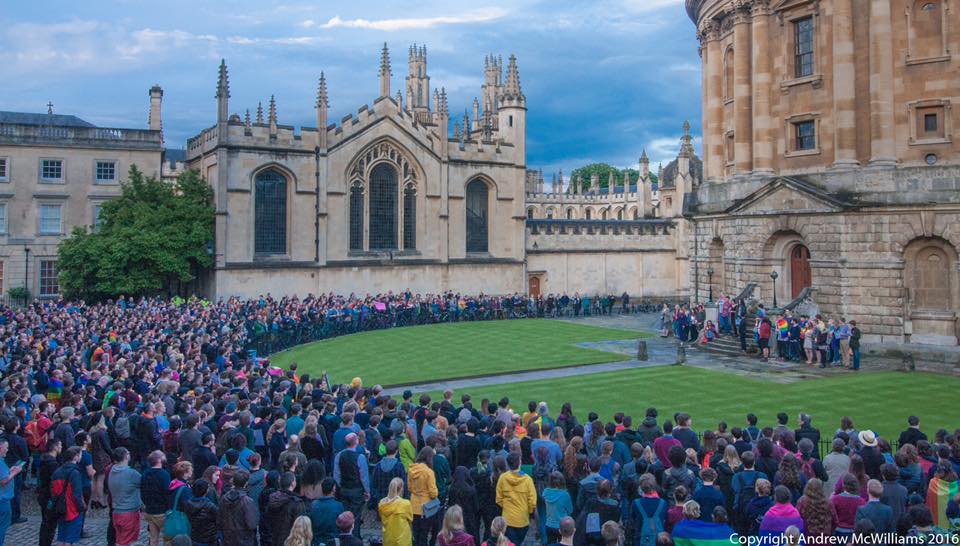
Oxford, England. Thunder boomed, lightning flashed and the rain came tumbling down. The English summer is never one for predictably and climate change just makes that all worse. A brief cycle home and I was drenched, my second shower for the day. It was five o’ clock in the afternoon and there was going to be a vigil in Radcliffe Square for the victims of the homophobic terrorist attack in Orlando. More thunder, more lightning, more rain. The Orlando attack was deeply distressing. It is sad to see people robbed of their lives by atrocious acts of violence and it is sad to see the queer community targeted simply because people want to be free to love whoever they wish. However, I’d seen photos of the vigil in Soho, London, and there had been thousands of people standing in silence, in tears and in solidarity, and this gave me hope.
A few hours later I put my waterproof jacket on, jumped back on my bike and head into town. But the jacket was unnecessary because the clouds were breaking and beyond, even at half past seven, the sun was shining. The view of the changing sky was staggering punctured by the sandstone spires of Oxford University. I arrived at Radcliffe Square where hundreds of people had gathered outside the Radcliffe Camera (the only building in Oxford’s skyline that looks more like a booby than a penis). So many people. Like any community, the queer one can be both brilliant and difficult. Great friendships can be forged but so can cliques. Certain groups come to identify themselves apart from others and ‘politics’ can arise. However, that evening we were gathered for something so much greater than ourselves, we were gathered in solidarity for the victims of Orlando and for queer people all over the world.
A quote from the facebook event reads as this: “LGBTQ people have long been and continue to be the victims of violence and hatred in the places where we try to seek safety. The fact that this attack happened on Latinx night, and that so many of the victims were Latinx reminds us that queer people of colour are disproportionately at risk of violent hate crimes. On Wednesday evening we will come together outside the Radcliffe Camera to remember the lives of the victims of this attack; we will mourn the violence that seeks to destroy our communities. There is no space at this vigil for Islamophobia or racism. We will not be silent in the face of hatred, we will stand together and support one another as we have always done in times of crisis.”
People gave speeches, the names of the victims were read out and a two-minute silence was held. Someone in front of me began to cry and someone next to them gave them a hug – I don’t think they knew each other. There were families there too and heterosexual people, distressed at the attack and supporting their queer friends. Then a beautifully voiced choir sang Seasons of Love from the musical Rent and Somewhere Over The Rainbow. What ace songs. It’s such a shame that it sometimes takes tragedy to bring us together but those moments of unity are exceptionally powerful, and even though I went by myself to the vigil I did not feel alone. Humans have always lived in difficult times and this remains true today. My hope is that the sentiment of belonging to something so much bigger than ourselves – a community of fighters, lovers, queers and allies that runs back throughout history and will run always into the future – will continue to bring us closer together in a time when division is not an option.
Do you have to be Lesbian, Gay, Bi-Sexual, Transgender, Queer, Intersex or Asexual to care about LGBTQIA issues?
Answer: No!
Now here’s a blog on how to be a queer ally, however straight you are.
But first the word ‘queer’. Why am I using it? Many might know it as a term of offense used to denigrate LGBTQIA people and this is certainly true. As a word it simply means ‘strange, peculiar or eccentric’ from the Old High German twerh ‘oblique’ itself coming from the Proto-Indo-European root *terkw ‘to turn, twist, wind’. By the late 19th century it was being used to describe homosexual people in a pejorative fashion. Fortunately, by the 1980s the word was being reclaimed by queer activists and scholars. And now queer is used as an umbrella term for people who don’t identify as heterosexual and are not cisgender (i.e. do not identify with the sex they were designated at birth). Interestingly, if I tell you I’m queer I’m not actually telling you that I fancy people of the same gender, or of both genders, or identify as the opposite sex. No, those exceptionally personal issues (what I do in my bedroom and how I relate to my own body is my business, not yours!) are not revealed instead I am saying I challenge the binary nature of gender (i.e. male or female) and any essentialisation of people for their sexuality. Of course, the queer community is a large and diverse one and even though I use the term to refer to the LGBTQIA community in general many might not. Many will prefer LGBTQIA and many will use queer to mean something else. However, for the sake of this blog I am using it as the umbrella term described above.
Anyways, in case you missed it, that was lesson one on being a queer ally – understanding the lingo, very important. Lesson two is about using it and this will vary from person to person. I’ll use myself as an example. I’ve often had people try to define my sexuality for me – people would label me with terms I never used to describe myself sometimes because they wanted to understand me, pigeonhole me and/or bully me. When it comes to politics I consider myself queer – I challenge gender and sexuality norms and I advocate for the equality and rights of the LGBTQIA community – but when it comes to my personal life, am I gay, bi-sexual, queer or something else? None of your business! So please don’t assume you know what my sexuality is because you don’t and don’t ask me either unless you feel it’s appropriate to. If you’re straight the likelihood is you won’t be asked to defend your sexual preferences on a regular basis or even reveal them so please stop asking me what I like to do with my sexual organs! Just be happy with the knowledge that I am Robert and I’m a queer activist. However, I’m just one example, and many people are bisexual, transgender, gay etc and want to be recognised as such – it’s your job to find out what that means to them and to use the appropriate terminology.
Lesson three is about stereotypes. We’ve all got a bunch of them in our heads be they the mincing queen, the butch lesbian, the greedy bisexual, the weird old gay guy etc, and without even thinking about it we project them at other people. One I often get is when I ask to be introduced to other queer men and people immediately assume it’s for sex, I must be one of those “promiscuous gays.” Unfortunately, much of the time I’m just wanting to meet more people from a community I consider myself part of, yet people are still quick to pigeonhole me. Even worse is that if I do ask to be introduced to a man because I’m attracted to him I then conform to the “promiscuous gay” stereotype and just confirm everyone’s prejudices. So I’m screwed either way (although, ironically, maybe not screwed in the way I might want to be!). So those stereotypes you’ve got, whatever they are, just drop them. Even if you think you see someone conforming to a stereotype, they really aren’t because they’re a human and they come with a rich and varied story of their own. It won’t help you or them if you reduce them to a few tokenistic gestures and even if they do like to gesture in that way that doesn’t make them the stereotype. And remember, the more we stereotype minority groups the easier it is to pigeonhole them, to margininalise them, to dehumanise them, to ignore them and to hurt them. So it’s hashtag time, #humansnotstereotypes.
There are so many more lessons to be learned, for all of us, but for now I’ll sign off this post with an ace song from gay twins Tegan and Sara because, surely, even if it’s for sex or just friendship we all would benefit from getting a little closer. And just in case you find the concept of learning lessons about queer people a little patronising then please just see this as a chance to learn more about an awesome bunch of people who can make awesome friends and allies, and who throw pretty epic house parties (oh, and one other thing, never use ‘gay’ as a pejorative adjective. Nope. Don’t want to hear it. Just never. Thanks).
Debt and money, two mainstays of human economies for many hundreds of years. Even without money people can still get in debt: with debt creating a two (or more) way relationship between a debtor and creditor, between the person owing something and the person who leant it. Without cash people might end up paying off their debt by giving hours of their labour, their property or their body. Money just facilitates this process, whether it’s cash in hand or digits on a screen. Because money and debt have been instrumental in human societies for so long it’s hardly surprising that their impacts have stretched far beyond the economic realm. They are also interwoven in our language and relationships.
Take the word ‘should’ for instance. “I really should go to the gym today,” “You really should be nicer to people,” etc. It’s used to indicate obligation, duty or correctness, often in moral situations which concern how we treat other people but also in more mundane situations like getting fit and eating less junk food. Etymologically speaking it relates to the Old English scyld which means ‘guilt’, the German schuld which means ‘guilt‘ and ‘debt’, and the Lithuanian skeleit ‘to be guilty’ and skilti ‘to get into debt’. Thus, a simple word such as should has origins in both finance and morality, in both debt and guilt. Similarly for the verb to owe which we use both financially (“you owe me £5”) and personally (“you owe me a favour”), its history can be found in the Sanskirt ise ‘he owns’ and isah ‘owner, lord, ruler’, and the Old English phrase agan to geldanne ‘to own to yield’ (or ‘to have to repay’). These are two instances of the fusion of the financial and personal. It seems money and relationships go hand in hand.
In a previous post I commented on the book Debt by David Graeber – he highlights the history of debt and also the violence that goes with it. In many instances debt is a threat because those who don’t pay their debts are threatened with so much, e.g. a jail sentence, physical violence, being shunned. Graeber also traces the history to some of the ultimate debtor/creditor relationships, namely masters and slaves, in which the latter owed everything to the former – namely, their lives. This is hardly a happy history and certainly not a peaceful one, and it continues today. Slavery might be abolished (yet still practiced widely) but we still have to give up our time to get money from people with much more of it than us so we can afford life’s necessities. Worse still, because wages can be so bad we often have to take out loans and get in debt to banks to actually be able to buy these things. And when the system stumbles (as it does at every economic crash) the bailiffs come knocking and the reckoning is upon us – we have to pay off our debts one way or another or face the consequences. Jessie J knows all about this as is evidenced in her song Price Tag
“Seems like everyone’s got a price” she sings, in a world where “the sale comes first and the truth comes second.” And isn’t that a shame, that even in non-economic spheres of life, such as friendships, relationships, socialising etc, the ‘logic’ and discourse of money are still so powerful, even though one hopes that these spheres shouldn’t be predicated on the implied threat of violence. Jessie J hopes for something different, a world that’s “not all about the money.” She thinks it’s high time money and economics were put back in their place – an ambitious stance given we have a lot of reconceputalising to do, what with the money discourse being everywhere. But she knows we can do it and she knows that our relationships will be better off for it. “Forget about the price tags,” she sings: “We’ll pay ’em with love tonight.” And I wonder what an economy of love would look like…tbc.
Today is International Women’s Day. Now, I get it, women are half the world’s population and they give birth to the whole of it. And sure, they’ve done some important things. Apparently they’ve contributed to science (something about X-Rays and DNA), a couple of them run businesses, some female poets are OK, I think there are some female playwrights, some of them save rain forests, some led armies, there have been a few alright Queens I suppose, others got into politics whilst others didn’t get into politics but still stood up for social justice, I think there was even a woman who is famous for taking a seat on a bus (is that really newsworthy?), some are quite good at sports and there’s the odd, alright female singer. One even got famous for writing about wizards. So, sure, a day to celebrate women is alright I suppose but…what about men?
Men do important things too. They’ve mastered the art of whistling at women in the streets, whistling is actually really hard. They send dick pics, lots of ’em, and photography is an art form. They get jobs their Dad’s used to do which they then pass on to their sons, men know how to look out for each other. Men are confident and independent whilst women are just bossy and high-maintenance. They’re full of great sartorial and dietary advice for women, yeah, you could do with losing a few pounds. And most of us are really nice guys, we’re so nice, we behave like gentlemen – opening doors for hot birds, only looking briefly at cleavages. Chivalry is not dead and all we ask in return is that women return the favour and act more ladylike. And, unlike, feminists who all hate men we have a lot of time for the opposite sex, we really like women, especially when they’re fit and do what we tell them to.
So, I think guys are pretty great, which is why I’m starting an Avaaz petition to establish an International Men’s Day to remind the world of the glory of man. I mean a patriarchal system designed by and for men predicated on the abuse and denigration of half the world’s population isn’t enough. Nor is the ability to ride on the wave of centuries of unquestioned privilege whilst assuming we are entitled to the power that is arbitrarily given to us. Nor is the systematic undermining of female advancement in professions across the sectors. Nor is a culture that glorifies the objectification of women and trivialises rape and abuse. This isn’t enough, we’ve still got a long way to go. So guys you know what to do. Man up.
Back in the 1810s a group of skilled self-employed weavers bandied together to take a stand against the new wave of weaving technologies that was being introduced. These included the power-loom and the spinning frame and all would require less-skilled labour to be used. The self-employed weavers were worried they would be out of a job. So they got to breaking these technologies in calculated acts of protest and called themselves the Luddites – arguably a reference to Ned Ludd who smashed some stocking frames back in 1779. And now, hundreds of years later, it’s not a power-loom that will force many people into unemployment, it’s robots.
Drones will deliver post, robots will run warehouses, automated check-outs will bleat at you to ‘insert your card’, Excel will do your accounting, a new piece of software might even paint a picture for you and cars will drive themselves. And what for the people who used to do these blue and white-collar jobs – they’ll have nothing to do. Some call them ‘pointless’ or ‘useless’ people, which is a glib way of acknowledging that history appears to be an endless case of efficiency taking precedence over people. But there’s nothing efficient about a society full of unemployed and unhappy people, the sort of people who might take arms against robots and start smashing.
Meanwhile, those with vested interests will laud the oncoming industrial revolution saying it’s the greatest opportunity humankind has ever had for advancement. I imagine similar things were said about nuclear energy. The zealots of this movement will barely be able to contain themselves knowing that their latest Amazon package will be flown to them via drone or they’ll be able to upload their memories into a robot (yup, Ray Kurzweil would love this). It’s worth remembering that these people will probably be rich and very far removed from the worries and realities of poverty and unemployment. They might also have not have asked if there are actually enough resources on earth to robotise everything.
So, what to do? Firstly, don’t take any of these stories at face values whatever the predictions – nothing goes as planned. Secondly, if the elites get what they want and society becomes increasingly automated (as it already has done) we must ask what it means to have a world without labour (or, at least, human labour) – what does this mean for feelings of self-worth considering they are so often tied to the work we do and what does this mean for the Labour party itself, founded on the rise of the working classes? Thirdly, this isn’t really about machines and robots, this is about power, people and how we treat each other. A Universal Basic Income is just one way of ensuring everyone gets paid even if they don’t work. Although the right wing, if they were to implement something like this, would probably use it as yet another excuse to strip back the state and weaken public services but what’s the point of a UBI if you can’t afford medical care and other necessities?
So the future is still there to be fought for. It’s not a foregone conclusion and the stories the vested interests weave don’t have to become self-fulfilling prophecies. We can challenge power, as hard as it is, and create a fairer world for all, with or without robots. Basically, it doesn’t have to end up becoming like this…
Little Mix are at it again – using catchy pop songs to relay important political messages and this time it’s all about holding hands.
For some holding hands is a simple act done on a regular basis. A guy and a gal just holding hands as they reveal their love to the world and walk to Sainsbury’s to get some snacks. Inside the shop he might put his hand around her waist and even tap her bum. Outside, snacks now bought and waiting in their bag-for-life, they might hug and briefly lock lips. Do you do this? Are you in an opposite-sex relationship where you both feel comfortable to express your affection in public? Well, if so, count your fricking blessings, because for many people holding hands, let alone snogging, could land them with a punch in the face, at the very least.
It’s different for same-sex couples. The Sexual Offences Act of 1967 decriminalised homosexual acts in private between two men, both above the age of 21. That was only fifty years ago and it applied only to men. It was in 2000 that the age of consent for homosexual couples was reduced to 16 years, so only sixteen years ago that gay couples achieved parity with straights. And in the Sexual Offences Act of 2003 was sexual activity between more than two men no longer a criminal offence across the entirety of the UK – yup, fourteen years ago and a threesome+ would have been illegal. What this brief political history demonstrates is that the law can be absolutely ridiculous, focussed often not on upholding justice and equality but enforcing prejudice and discrimination. That’s nothing new but it’s worth repeating.
Of course, it’s one thing for laws to change, quite another for culture. And for this reason same-sex couples holding hands in public is still a political act. There’s still so much hostility and discrimination out there that it makes hand holding dangerous. And even if the passersby aren’t homophobes they may still offer a good stare just because it ‘fascinates’ them to see these exotic queer people demonstrating affection. Whereas, straight couples usually don’t get stared at or if they do it’s because they are swapping way too much saliva. So thank god for this song by the wonderful Little Mix, which speaks directly to this issue. The video below is for Secret Love Song Part 2 as Jason Derulo was involved in Part 1 and he (or his producers) ensured it was decidedly straighter than originally intended. So here’s the better more political version. Thanks for singing out Little Mix!


 humanconditioned