Queer People Need You!

Do you have to be Lesbian, Gay, Bi-Sexual, Transgender, Queer, Intersex or Asexual to care about LGBTQIA issues?

Answer: No!

Now here’s a blog on how to be a queer ally, however straight you are.

But first the word ‘queer’. Why am I using it? Many might know it as a term of offense used to denigrate LGBTQIA people and this is certainly true. As a word it simply means ‘strange, peculiar or eccentric’ from the Old High German twerh ‘oblique’ itself coming from the Proto-Indo-European root *terkw ‘to turn, twist, wind’. By the late 19th century it was being used to describe homosexual people in a pejorative fashion. Fortunately, by the 1980s the word was being reclaimed by queer activists and scholars. And now queer is used as an umbrella term for people who don’t identify as heterosexual and are not cisgender (i.e. do not identify with the sex they were designated at birth). Interestingly, if I tell you I’m queer I’m not actually telling you that I fancy people of the same gender, or of both genders, or identify as the opposite sex. No, those exceptionally personal issues (what I do in my bedroom and how I relate to my own body is my business, not yours!) are not revealed instead I am saying I challenge the binary nature of gender (i.e. male or female) and any essentialisation of people for their sexuality. Of course, the queer community is a large and diverse one and even though I use the term to refer to the LGBTQIA community in general many might not. Many will prefer LGBTQIA and many will use queer to mean something else. However, for the sake of this blog I am using it as the umbrella term described above.

Anyways, in case you missed it, that was lesson one on being a queer ally – understanding the lingo, very important. Lesson two is about using it and this will vary from person to person. I’ll use myself as an example. I’ve often had people try to define my sexuality for me – people would label me with terms I never used to describe myself sometimes because they wanted to understand me, pigeonhole me and/or bully me. When it comes to politics I consider myself queer – I challenge gender and sexuality norms and I advocate for the equality and rights of the LGBTQIA community  – but when it comes to my personal life, am I gay, bi-sexual, queer or something else? None of your business! So please don’t assume you know what my sexuality is because you don’t and don’t ask me either unless you feel it’s appropriate to. If you’re straight the likelihood is you won’t be asked to defend your sexual preferences on a regular basis or even reveal them so please stop asking me what I like to do with my sexual organs! Just be happy with the knowledge that I am Robert and I’m a queer activist. However, I’m just one example, and many people are bisexual, transgender, gay etc and want to be recognised as such – it’s your job to find out what that means to them and to use the appropriate terminology.

Lesson three is about stereotypes. We’ve all got a bunch of them in our heads be they the mincing queen, the butch lesbian, the greedy bisexual, the weird old gay guy etc, and without even thinking about it we project them at other people. One I often get is when I ask to be introduced to other queer men and people immediately assume it’s for sex, I must be one of those “promiscuous gays.” Unfortunately, much of the time I’m just wanting to meet more people from a community I consider myself part of, yet people are still quick to pigeonhole me. Even worse is that if I do ask to be introduced to a man because I’m attracted to him I then conform to the “promiscuous gay” stereotype and just confirm everyone’s prejudices. So I’m screwed either way (although, ironically, maybe not screwed in the way I might want to be!). So those stereotypes you’ve got, whatever they are, just drop them. Even if you think you see someone conforming to a stereotype, they really aren’t because they’re a human and they come with a rich and varied story of their own. It won’t help you or them if you reduce them to a few tokenistic gestures and even if they do like to gesture in that way that doesn’t make them the stereotype. And remember, the more we stereotype minority groups the easier it is to pigeonhole them, to margininalise them, to dehumanise them, to ignore them and to hurt them. So it’s hashtag time, #humansnotstereotypes.

There are so many more lessons to be learned, for all of us, but for now I’ll sign off this post with an ace song from gay twins Tegan and Sara because, surely, even if it’s for sex or just friendship we all would benefit from getting a little closer. And just in case you find the concept of learning lessons about queer people a little patronising then please just see this as a chance to learn more about an awesome bunch of people who can make awesome friends and allies, and who throw pretty epic house parties (oh, and one other thing, never use ‘gay’ as a pejorative adjective. Nope. Don’t want to hear it. Just never. Thanks).

If You’re Not Gay It Does Make A Difference

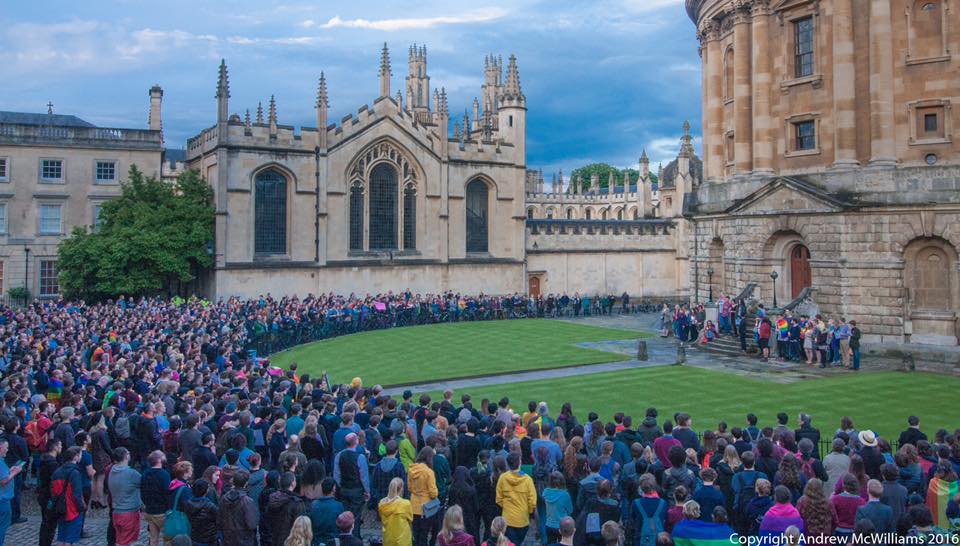
“The worst mass shooting in modern American history was also a hate crime against the gay community. It’s not the first time LGBT (lesbian, gay, bisexual and transgender) people have been the targets of violence.” BBC News.

For more information on the recent hate crime in Orlando that claimed 50 lives please read this article and then search for more. For this blog, however, I want to focus on the guardian journalist Owen Jones’ appearance on Sky News to discuss the atrocity.

It does not take long for an argument to arise between Jones and Mark Longhurst and Julia Hartley-Brewer. Jones works hard to ensure that all present acknowledge that this is a homophobic hate crime and act of terror. He describes it as “one of the worst atrocities committed against LGBT people in the western world for generations.” This is a statement of fact yet Longhurst and Hartley-Brewer don’t get it. Longhurst tries to ignore the LGBT angle by saying it was a crime carried out against “human beings” and whilst this is, of course, true, the point is that Jones is trying to focus on the homophobia inherent in the crime. Jones repeats his statement but Longhurst nullifies it again by refusing to recognise the anti-LGBT nature of the crime and talks instead of “the freedom of all people to enjoy themselves.” At which point Jones comes out with the zinger, “You don’t understand this because you’re not gay.” Longhurst disagrees vehemently and Hartley-Brewer tells Jones that he does not have “ownership of horror of this crime because [he’s] gay.” These minutes of ignorance and miscommunication are vital in derailing the rest of the press preview as the three continue to argue before Jones becomes largely silent and the conversation moves away from the LGBT community to gun control and the perpetrator, even after Jones said there has been a distinct lack of press coverage on the homophobic nature of the violence.

I hope you, whatever your sexual orientation, can see the problem here. Jones offers the scenario that this attack might have taken place at a Synagogue and if it had done then it would be clear that anti-Semitism was one of the overriding motives for the attack. If then, a Jewish person was discussing how distraught they felt at the attack it would not be for anyone else to tell them that the attack isn’t about Jewish people, it’s about people. This would totally devalue what the other person is saying and, crucially, what they are feeling – that a community they are part of has suffered a dreadful attack. We are all very different people and members of very different communities and the simple point is that whilst we can speak for ourselves and our own experiences of the world we cannot speak for others. It is not for me as someone who is not Jewish to speak on behalf of Jewish people, nor as someone white to speak on behalf of black people, nor as a man to speak for women. Instead, I can try to understand the different trials facing other groups and offer my support.

That is what I attempt to do with some of my posts and whilst I try hard not to speak on behalf of others I realise I might fail but I am always happy to learn how to do it better. Neither Longhurst nor Hartley-Brewer appear to show much sympathy for the LGBT community, they spend more time talking about the perpetrator and gun control, it is only Jones who talks about it. And even though the others both identify as ‘not-gay’ during the preview neither sympathise with what Jones is saying and instead attack and criticise him. They both had an opportunity as presumably straight people to speak and act in solidarity with the LGBT community and they both missed it. And this is a shame for so many reasons not least because the LGBT community needs a lot of solidarity right now.

So yes, it does make a difference if you’re not gay – it means you might never have a same-sex relationship, it means you might never be discriminated against for your sexual preferences, it means the attack in Orlando was not an attack aimed at a community you are part of. But it doesn’t mean you can’t support us. The full acronym I use is LGBTQIA – Lesbian, Gay, Bi-Sexual, Transgender, Intersex, Asexual. However, I think there needs to be another A, an A for Ally.