As we bid a fond farewell to our dear David Cameron let us remember a few of the highlights. He measured our happiness. He did, honest! Back in 2010 he launched the UK’s Measuring Well-being Initiative, how marvellous and how happy we all must be now. Boris Johnson. He imposed austerity, sadly not quite such a happiness-inducing policy. He appointed George Osborne to oversee this process with promises of cutting the deficit, he did no such thing. Michael Gove. He aired his party’s dirty laundry in public by promising the electorate a referendum. Theresa May. He oversaw sweeping cuts to many of our public services making it harder for disabled people, kids, migrants and mothers. The bedroom tax. He also backtracked on his second general election promise to not cut the NHS. His government failed to tackle the housing crisis and that ‘big society’ he promised us, that ‘compassionate conservatism’ he promised us seemed to vanish. Then, when the referendum result came in and the public voted in a way he hadn’t expected, he resigned, whilst saying the vote had nothing to do with the economy. A paragon of public schoolboy courage, intelligence and honesty. Here’s to you, David, master of the house. Consider this a song in tribute to your legacy and I hope you enjoy a happy retirement in the Cotswolds.
Operation Breentry
“Why, sometimes I’ve believed as many as six impossible things before breakfast.”
The Red Queen, Alice In Wonderland
If we can put people on the moon, if we can build a world-wide web, if we can invent the Hoover, then we might as well try to keep Britain in the EU. We are caught in a unique period of time and history: the leading parties have no plan for the future and faith in our country and economy is wavering yet the catalyst at the heart of it – the Brexit vote – has not been rendered fact. It is still just a story. It’s a powerful one that many people have accepted and has already had adverse social, political and economic impact but it’s still a story that can be challenged. It’s time for Operation Breentry.
What’s Breentry? It is a movement to stop Britain leaving the EU. It involves emailing MPs asking them to reject the result of the referendum. There’s another initiative to call for a second Referendum and the Parliamentary Petition for that has over 4 million signatures. Meanwhile, people are demonstrating in the street to Remain in the EU and other European leaders like Angela Merkel are advising us to think twice. Unfortunately, many people are already resigned to letting Brexit happen and/or think Breentry could/should never happen. I want to challenge these beliefs.
It’s anti-democratic: To annul a referendum certainly appears anti-democratic but that surely requires living in a functioning democracy. But we don’t. The Leave campaign was anti-democratic – it lied with regards spending on the NHS, it lied with regards limiting immigration (the deals we might do with the EU would involve maintaining freedom of movement anyway) and it was only campaigning against something, it had no plans for after winning. However, even taking the Leave-Remain decision at face value is wrong because the calling for the Referendum itself was anti-democratic. David Cameron, who had entered into Parliament with a slim majority, called it to appease his right-wing back benchers so he could become PM. That is power politics at its worst especially when so many of the electorate did not even vote him in. Remember, our head of state isn’t elected, our House of Lords isn’t elected, our mainstream media is privatised and has a clear agenda and we only vote once very five years. So, yes, Britain is an aspiring democracy but it hasn’t got there yet. All is still to be striven for.
It’s too late: No it’s not. Article 50 has not been signed. We can still petition all MPs and leaders of all parties (the Tories included) to not make one of the worst decisions in recent British history. Furthermore, even if Article 50 were signed we could still challenge it. Or perhaps this isn’t about being late or early at all, if we were on time we would have trialled all war criminals, transcended growth-based consumer capitalism, ended all wars and avoided climate change. Let’s just be pragmatic and do what we can in the time we’ve got.
It would lead to violence and civil war: Breentry would certainly anger voters who wanted to Leave but their actual vote to Leave has acted as a rallying call to violent racists and xenophobes. Police have registered a fivefold increase in race-hate complaints since Brexit. Immigrants have been verbally abused, attacked and fire bombed in the past few days. This proves again how misled and misguided many Leave voters were, that they actually believed Britain might become some free-standing, all-white nation surrounded by high walls. That was never what the Leave vote was offering even if the likes of Nigel Farage might have encouraged it. If people do threaten violence in response to Breentry and we don’t act as a consequence then we are negotiating with terrorists, kowtowing to criminals and appeasing racists. We categorically cannot let the bullies win. As for civil war, well, currently the Tory and Labour parties seem to be hellbent on ripping themselves apart as the vote has unleashed a whole wave of vitriol and back stabbing from the parties. Meanwhile, the Referendum has split families and friends, as people fall out with each other in bitter arguments. And every economic forecast looks bleak. Perhaps we’ve always been at war in Britain, certainly a class war, and the Referendum just proves what has always been true. Hence why we must do all we can on all fronts to heal the many deep wounds in our country rather than stick the knives in further.
The Tories will negotiate a good deal outside the EU: No they won’t. The Tory party is swift revealing it’s inability to steer a post-Brexit course. Gove stabbed Johnson in the back and does not have a plan for a Brexit future despite co-leading the Leave campaign. Theresa May is notoriously anti-immigration and yet might have to be the one negotiating a deal with the EU that involves keeping freedom of movement – that’s like asking a racist to argue for multiculturalism. Meanwhile, Liam Fox is anti-EU (and anti-gay marriage, he said it’s ‘absurd’ and ‘social engineering’). Angela Leadsom loves Europe apparently but says, “What I hate is the EU and the way it is destroying such a fabulous continent” – good luck negotiating with the likes of Angela Merkel and Jean-Claude Juncker then (she also abstained from voting on gay marriage, she believed it didn’t have a mandate). The irony is that the one pro-Remain candidate, Stephen Crabb, will lose support because of that stance, although he only adopted it out of loyalty to David Cameron even though he’s largely anti-EU. He also opposed gay marriage but apparently is OK with it now, phew. None of these people have the country’s best interests at heart or the intelligence to guide this country into recovery. They’re also all pro-austerity, an economic decision that will grind this country down even further and exacerbate the unrest we’re witnessing. I thought the Tories were supposed to oppose Labour but turns out they oppose themselves as well.
Labour could negotiate a deal instead: No it couldn’t. There’s almost more infighting there than in the Tory party. Corbyn is being relentlessly stabbed in the back by Blairite MPs even though he has a huge amount of grassroots support. He was also anti-EU and decidedly quiet on calling for Remain. If he miraculously became PM (which would be no bad thing as he’d challenge austerity and enrich the welfare state) would he really have the best interests of the UK at heart when dealing with EU bureaucrats? Perhaps he’ll wake up to the Breentry call and take us back, although he’ll have a vicious, untrustworthy party behind him that is just waiting for his political demise. I thought Labour was supposed to oppose the Tories but turns out they oppose themselves as well.
The UK is strong, we’ll get what we want in the end, we’ll “take back control”: No we won’t. Nicola Sturgeon is calling for a second Scottish referendum. Leanne Woods, leader of Plaid Cymru, is calling for Welsh independence, “redesigning the current UK is the only option.” There are calls to unite Ireland and even for London to go independent. Turns out it’s not just political parties that don’t get on, countries don’t either. Add to this deepening austerity, companies threatening to leave/leaving the UK, the loss of our triple A credit rating, a rise in racist violence and I’m struggling to see how the UK stays united. That selfish little world of capitalist consumerism and middle-England-ism is imploding and is trying to take its neighbours down with it. This isn’t new – this has been an ongoing problem for decades, Brexit has just exposed it more starkly. Breentry would just be the first step in trying to patch back together the social fabric of the UK.
But migrants are a problem, we need less of them: No. That is taking Tory and Leave propaganda at face value, as well as various Labour views. Stirring up racial hatred and anti-immigration sentiments are a timeless tactic used to distract attention from underlying economic issues which include rising inequality (how come so many people can’t afford their rent whilst so many others have multiple houses around the world) and austerity (we keep forgetting that it was the 2008 financial crash that brought the global economy to its knees not a “bunch of migrants” nor over-generous Labour government spending on the economy, remember, Osborne’s deficit has been so much higher than that of Brown’s). If we scapegoat and abuse migrants and people whose skin isn’t white enough we will set this country back decades and fall into the same bigoted trap of history. We are better than this and we can learn our lesson.
What if we’d voted Remain and the Leave campaign wanted to challenge it: Then they’d have every right to and could use the same arguments that I have. Except many of the Leave camp voted out of protest on the proviso that Britain would take back sovereignty and control, but that was a lie. They voted to get more money spent on the NHS, that was a lie. They voted for less migrants, that was a lie (plus, I don’t negotiate with racists). But even if this scenario were true the state of our country would still be to play for. We’d still be realising, all too late, that whilst political statements seem like irrefutable truths they are in fact stories and agendas that can be challenged, whoever’s side your on. The game is afoot (and always has been but for too long we’ve let others, including elitist, old-Etonians, play it for us).
The EU won’t get any better: I agree that the EU is a problematic institution. The economic bullying of countries like Germany and France against Greece is outrageous. I know my grandparents didn’t risk their lives against the Nazis just so economic powerhouses could drive other countries into recession. However, I do know they risked their lives to stop war on the continent and that worked, for now. With the rise of the extreme right and this includes the neo-Nazis we risk undoing their good work and whilst we might not have a war with trenches and obvious beginning/end points we will witness the rise of extremist terrorism in Europe directed at groups including Muslims, Jews, the Romani, queers and any other convenient scapegoats. The EU, problematic as it is, is a supra-national organisation built to enhance unity and promote peace but this won’t happen by magic and we must challenge and change it from within to ensure peace reigns. My grandparents fought the Nazis, I think I can fight corrupt EU politics. And the latter is itself a victim of globalised, growth-obsessed, consumer capitalism (that’s the real fight, see rest of blog for thoughts on that).
*
There is another way and it’s called Breentry. Email your MP and ask them to vote out the Referendum, sign the petition to call for another one, wear a safety-pin to show support with the immigrant population, challenge hate crime, hug your friends, let yourself cry, howl in anger at the moon, smile at strangers and talk, talk, talk. We must dare to be political and we must dare to call for change. A positive post on Breenty and a possible future will come next but this one is getting far too long. Please do challenge me, this is just my opinion, but please let’s keep talking about this. May the force of Lady Gaga be with you – she’s right, we are on the edge but we don’t have to fall.
And news just in, this hilarious facebook post that sums the situation up perfectly!
Britain Has Feelings Too
We British are renowned for our politeness. We doff our caps to strangers, we wait for others to get on the tube before we get off and we drink endless cups of tea, sometimes with our little fingers raised. We may grumble through hard times but only very quietly. We complain but never loudly or crassly. We are a proud folk for in the face of a crisis we always keep calm and carry on. We have the stiffest of upper lips and save our tears for the Queen’s birthday. We don’t like public displays of emotion but we will smile at strangers, although we’ll never grin or laugh out loud in front of them. We are essentially a polite race. But something happened last Friday, Britain changed and that facade of politeness fell as our feelings were unleashed.
And it turns out that British people do have emotions after all. People have been in tears and in despair over the call for Brexit (still not a reality – it’s not legally binding and Parliament have made no decisions, time for Breentry): many are sad about the future they see being dismantled, many are sad about the past they see being ignored and many are sad about the volatile present that we’re living through. Others are in fear and pain as they experience the fists, insults and petrol bombs of racial abuse and violence. Many are angry for many different reasons: because they think the majority of people are idiots, because they think it’s time immigrants went home, because they think they’ve been lied to by the press and the establishment. Even the people of power are expressing emotions: David Cameron shed a tear which may even have been genuine (maybe he realised the enormity of the mistake he made) whilst Boris Johnson has gone quiet, which is most unlike him.
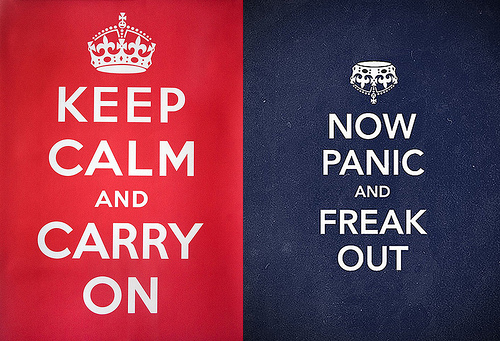
So, yes, British people do have emotions after all – some inspiring and some scary – and over the past few days we’ve been expressing them over and over again. This has been a long time coming – keeping calm and carrying on, grumbling under our breath and being oh so polite are just ways of suppressing our feelings without ever having to address them. But you can’t hide emotions forever. Yet there are ways to vent anger and ways to direct frustration which don’t have to destroy and denigrate and there are ways to express sadness and grief that don’t have to lead to despair, yet we are a vastly emotionally unintelligent country because we’ve never been given the education for it. We have a lot to learn in a very short space of time but perhaps what is happening now is a sharp wake up call: our feelings are powerful, dangerous and transformative. We must acquaint ourselves with them and use them as a force for good.
The Referendum Wasn’t Real
This is my 100th post and I’d planned the title to be “what’s the point of this blog?” and given the UK’s decision to leave the EU I think my comments on that might answer the question anyway. But, first things first, the Referendum wasn’t real, what’s that all about? OK. It was real, devastatingly so. It is already having vast emotional, social and economic ramifications. As Britain ‘goes it alone’ the pound has plummeted in value, the economy is wobbling and a shift to the right in mainstream politics is underway with the likes of Boris Johnson and Michael Gove vying for power. Extremist right-wing parties like Ukip and their European counterparts are claiming this as a victory for xenophobia and hate. We’ve even recently witnessed one act of right-wing terrorism claim a life, that of Jo Cox. Uncertainty is rising as hope takes a blow to the chest. Yet, for all this, how can I claim the Referendum wasn’t real?
Because from the outset it was a farce. Firstly, democracy was boiled down to a single multiple choice question with only two answers, In or Out, that few people had actually wanted to be put to the public. This doesn’t respect the multi-faceted and multi-partied nature of our democracy it just promotes further divide and hostility as friends and families suddenly found themselves forced to pick a side. And asides for a select few bureaucrats in Brussels and maybe one or two British politicians no one, absolutely no one (myself very much included) could vote with a sufficient degree of knowledge – there are documents of tens of thousands of pages outlying all the treaties and clauses amassed over the decades Britain has been part of the EU and I certainly haven’t read them all. It’s funny that people were suddenly and arbitrarily forced to get knowledgeable and passionate about something they had not seemed to care that much about before.
Meanwhile, people who’ve lived in this country and contributed to its economy for longer than I’ve been alive weren’t allowed to vote. Teenagers weren’t allowed to vote even though they have more future to lose than the rest of us voters. Both campaigns used tactics of fear, hate and misinformation (aka lies) to cajole and manipulate. We’ve already seen Nigel Farage swiftly distance himself from the Leave pledge of £350 million to the NHS (but did we really think neoliberal parties would do an about turn on their views of the welfare state?). There were campaign posters that bore too much resemblance to ones used by Nazis and the media played on xenophobia, fear and outdated nationalistic sentiments to make people think that voting in the referendum was the equivalent to taking some sort of significant stand (it wasn’t, it just makes it easier for the rich to get richer whilst deepening austerity and rolling back the welfare state). Somehow the woes of neoliberal, consumer capitalism (see the rest of this blog for criticisms on that) were landed on the heads of some of the most powerless, namely refugees and immigrants, and a bunch of pro-establishment, old-Eatonians managed to dupe large chunks of the country into thinking voting Leave would lead us into a wonderful British revolution rather than entrenching inequality and recession. That being said, lots of utopic left wingers were somehow led to believe Brexit would yield a land of milk, honey and socialism (my fingers are still crossed). And let’s not forget why this referendum even happened in the first place: because David Cameron wanted to be Prime Minister and he needed the support of his more right-wing back benchers to get it, so he promised them a referendum to appease them rather than having the courage to say ‘no’ (he put it on our heads instead). That’s not democracy, that’s cynical party politics at the public’s expense.
So, yes, the referendum is real and it has happened and this is a rallying call for anyone of whatever political persuasion and however they voted in the referendum to choose peace and oppose the rise of extremism and the violence that goes with it. But, no, the origins of this referendum were neither hopeful nor fair nor democratic. So whatever people say, this was not a victory for the British and the public have not spoken because there was only 1% in it. Like austerity, the referendum is a story wrapped around an agenda. Many desperately believe in it, many just cynically use it to get more power, many misguidedly want it to become true in ways it never will but it is not ‘the truth and nothing but the truth’ it is just one story among many. Unfortunately, it is a very powerful story and its repercussions will prove fatal for many. But Britain has survived two world wars and I think we can survive this too. Now here’s Lady Gaga because why not 😉
Does The Thought Of Anal Sex Disgust You?
Not wanting to write about the Referendum again and inspired by fellow blogger Freakypeach’s great post on anal sex, I thought I’d put my head above the parapet and put a good word in for the bum. I want to write this because I know a lot of very nice people who do lots of nice things, however, when the topic of anal intercourse is breached their niceness slightly slips. Some make faces of disgust, some shudder, some don’t want to talk about it, some imply it’s just a little too deviant, whilst others brush it off as ‘unhygienic’ and then start talking about the weather. So consider this post my attempt to counter the stigma attached to anal sex and if, at the end of it, you’re still not convinced then please just remain quiet on the matter and support those friends of yours who want to engage in whatever consenting forms of sex they wish.

“But it’s the bum!” I have heard many anti-anal-sex folk cry. “We poo out of it.” And their knowledge of human anatomy is spot on as, I imagine, is that of those who’ve had anal sex. And yes, whilst we do poo out our bums like many other things the bum can be cleaned. Douches, flannels, bidets, showerheads…there are an awful lot of ways to keep one’s back passage clean, advisable for all of us, not just those wishing to use our bottoms for sexual gratification. So yes, like the penis, vagina and any other part of the body, the bum can be dirty but it can also be clean. “But it’s poo, I mean, poo!” Yes, I heard you the first time and maybe this is just about your own lack of anal hygiene that you’re assuming everyone else suffers from. If you really can’t get over this hurdle then please just skip to the last paragraph.
So, with a nice and clean bum (or not, whatever works for you) we can now engage in some anal intercourse and guess what, it can be extremely pleasurable. People of all genders enjoy it and many folk even have prostate glands up their back passages and that can enhance the pleasure. To be quite honest there’s a world of experiences to be had up there whether you’re doing it with your fingers, a dildo, butt plug, vibrator or someone else (or a number of people for that matter). Of course, if you don’t want to have anal sex that’s absolutely fine and I hope no one ever makes you feel bad for not doing it but this post is about the people who do want to do it. Please don’t negate, trivialise, ridicule and/or discriminate against their desire to do whatever they like with their bottoms.
In essence, this boils down to stigma. As a male member of the queer community (although these facts don’t tell you whether I’ve had anal sex, want to or even fancy people of my own gender, that’s still none of your business) I’ve witnessed and experienced a certain sort of prejudice: if I got a quid every time I’ve had to watch ‘straight lads’ faux bumming each other because that’s the height of humour (and they’re too repressed and insecure about their sexualities to actually get down to it and shag their mates) I would be rich. Or every time people I like have warned me against the dangers and the lack of hygiene as if I haven’t considered these things for myself. Or people proclaiming “but we poo out the bum” as if that ends the debate. Or been told that what queer men do to each other is deviant. Or read about queer people being beaten up and killed for liking anal sex. The list goes on. If you have nothing positive to say about the joy that is anal sex then please say nothing. Please just support your friends in their adult decisions to have sex however they like. Here’s to the bum!
Befriending Brexiters
I walked out of Dalston Kingsland overground station on Saturday into a brief spell of sun. Blinking back the glare the first thing I saw was a friendly looking young white man with floppy brown hair offering me a big smile and a red pamphlet reading LEAVE. Yup, a Brexiter, one of those terribly charming and polite people who wants Britain to leave the EU and ‘go it alone’. Here was my moment, I thought, my chance to engage with the ‘enemy’ and convert him to the Remain cause.
We offered one another friendly hellos and I asked him how he was doing. It transpired he was doing well. I thought I’d meet his friendliness with the like and I said that I’d love to hear more about his argument. He told me that his main reason for supporting Leave was financial, he believed we would have a stronger trading position if we left. I nodded and then mentioned Ngaire Woods, the Founding Dean of the Blavatnik School of Government and Professor of Global Economic Governance at the University of Oxford, and what she had said about Britain’s trading position being weaker outside of the EU (see video). He said he hadn’t heard of her.
We carried on in this amicable style for a while as he said one thing, I said something else, then he offered more, and so on and so on until I realised I didn’t stand much of a chance. Not only did I not have enough facts at hand it seemed that for every one I did he had a counter argument. I figured that the likelihood of me convincing him to change his view was low given my limited information and the fact that he was on the street on a Saturday afternoon handing out Leave leaflets – he must be quite committed to the cause.
Instead I told him that I feared leaving the EU would legitimise and worsen the rising levels of violence in the country, violence that stems from extreme, right-wing views about who does and does not deserve freedom from violence. I mentioned the tragic death of Jo Cox at the hands of a man who shouted ‘Britain First’ as he attacked her. I mentioned the rise of the neo-Nazis throughout Europe and how some pro-Brexit people I had spoken to expressed overtly racist views. He looked a little concerned and assured me he wasn’t racist. I believed him. Then his colleague came over carrying yet more LEAVE leaflets and he introduced me to her. We offered one another polite hellos. I told them I had to go, I had a conference to get to, but I said that whilst I would still vote to Remain, whatever the result, it was all of our responsibility to stand up to racism, discrimination and violence. We would have to put aside our political differences (he told me had previously voted for the Lib Dems and later the Tories) and work hard to ensure equality and peace were prioritisied in our country. They both nodded emphatically and as I walked away I heard him say to his colleague that I was “one of the better ones”.
So what had I achieved? Not a lot as I’m sure most of you would observe and you’re right, I hadn’t made them change their minds but maybe I had made them think twice. The task ahead for all of us – peace in our time and peace on earth – is something that transcends political persuasion and that we can all be a part of. And maybe in that brief conversation whilst I hadn’t got them to about turn I might have surprised them, if I was one of the ‘better ones’ I wonder what some of the other Remainers were life. The Referendum, like so much of party politics, is designed to fracture and split but we have to challenge this, we’re humans before we’re Tory, Green or Labour. And if dark times are ahead, which they certainly are, then we’re going to need to make a lot of new friends.
Oxford’s Vigil For Orlando
Oxford, England. Thunder boomed, lightning flashed and the rain came tumbling down. The English summer is never one for predictably and climate change just makes that all worse. A brief cycle home and I was drenched, my second shower for the day. It was five o’ clock in the afternoon and there was going to be a vigil in Radcliffe Square for the victims of the homophobic terrorist attack in Orlando. More thunder, more lightning, more rain. The Orlando attack was deeply distressing. It is sad to see people robbed of their lives by atrocious acts of violence and it is sad to see the queer community targeted simply because people want to be free to love whoever they wish. However, I’d seen photos of the vigil in Soho, London, and there had been thousands of people standing in silence, in tears and in solidarity, and this gave me hope.
A few hours later I put my waterproof jacket on, jumped back on my bike and head into town. But the jacket was unnecessary because the clouds were breaking and beyond, even at half past seven, the sun was shining. The view of the changing sky was staggering punctured by the sandstone spires of Oxford University. I arrived at Radcliffe Square where hundreds of people had gathered outside the Radcliffe Camera (the only building in Oxford’s skyline that looks more like a booby than a penis). So many people. Like any community, the queer one can be both brilliant and difficult. Great friendships can be forged but so can cliques. Certain groups come to identify themselves apart from others and ‘politics’ can arise. However, that evening we were gathered for something so much greater than ourselves, we were gathered in solidarity for the victims of Orlando and for queer people all over the world.
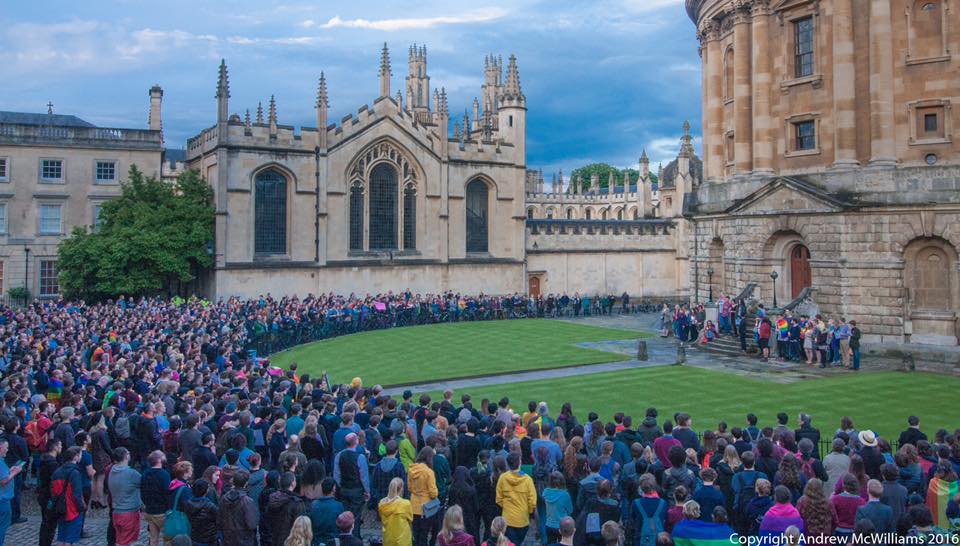 A quote from the facebook event reads as this: “LGBTQ people have long been and continue to be the victims of violence and hatred in the places where we try to seek safety. The fact that this attack happened on Latinx night, and that so many of the victims were Latinx reminds us that queer people of colour are disproportionately at risk of violent hate crimes. On Wednesday evening we will come together outside the Radcliffe Camera to remember the lives of the victims of this attack; we will mourn the violence that seeks to destroy our communities. There is no space at this vigil for Islamophobia or racism. We will not be silent in the face of hatred, we will stand together and support one another as we have always done in times of crisis.”
People gave speeches, the names of the victims were read out and a two-minute silence was held. Someone in front of me began to cry and someone next to them gave them a hug – I don’t think they knew each other. There were families there too and heterosexual people, distressed at the attack and supporting their queer friends. Then a beautifully voiced choir sang Seasons of Love from the musical Rent and Somewhere Over The Rainbow. What ace songs. It’s such a shame that it sometimes takes tragedy to bring us together but those moments of unity are exceptionally powerful, and even though I went by myself to the vigil I did not feel alone. Humans have always lived in difficult times and this remains true today. My hope is that the sentiment of belonging to something so much bigger than ourselves – a community of fighters, lovers, queers and allies that runs back throughout history and will run always into the future – will continue to bring us closer together in a time when division is not an option.
Queer People Need You!
Do you have to be Lesbian, Gay, Bi-Sexual, Transgender, Queer, Intersex or Asexual to care about LGBTQIA issues?
Answer: No!
Now here’s a blog on how to be a queer ally, however straight you are.
But first the word ‘queer’. Why am I using it? Many might know it as a term of offense used to denigrate LGBTQIA people and this is certainly true. As a word it simply means ‘strange, peculiar or eccentric’ from the Old High German twerh ‘oblique’ itself coming from the Proto-Indo-European root *terkw ‘to turn, twist, wind’. By the late 19th century it was being used to describe homosexual people in a pejorative fashion. Fortunately, by the 1980s the word was being reclaimed by queer activists and scholars. And now queer is used as an umbrella term for people who don’t identify as heterosexual and are not cisgender (i.e. do not identify with the sex they were designated at birth). Interestingly, if I tell you I’m queer I’m not actually telling you that I fancy people of the same gender, or of both genders, or identify as the opposite sex. No, those exceptionally personal issues (what I do in my bedroom and how I relate to my own body is my business, not yours!) are not revealed instead I am saying I challenge the binary nature of gender (i.e. male or female) and any essentialisation of people for their sexuality. Of course, the queer community is a large and diverse one and even though I use the term to refer to the LGBTQIA community in general many might not. Many will prefer LGBTQIA and many will use queer to mean something else. However, for the sake of this blog I am using it as the umbrella term described above.
Anyways, in case you missed it, that was lesson one on being a queer ally – understanding the lingo, very important. Lesson two is about using it and this will vary from person to person. I’ll use myself as an example. I’ve often had people try to define my sexuality for me – people would label me with terms I never used to describe myself sometimes because they wanted to understand me, pigeonhole me and/or bully me. When it comes to politics I consider myself queer – I challenge gender and sexuality norms and I advocate for the equality and rights of the LGBTQIA community – but when it comes to my personal life, am I gay, bi-sexual, queer or something else? None of your business! So please don’t assume you know what my sexuality is because you don’t and don’t ask me either unless you feel it’s appropriate to. If you’re straight the likelihood is you won’t be asked to defend your sexual preferences on a regular basis or even reveal them so please stop asking me what I like to do with my sexual organs! Just be happy with the knowledge that I am Robert and I’m a queer activist. However, I’m just one example, and many people are bisexual, transgender, gay etc and want to be recognised as such – it’s your job to find out what that means to them and to use the appropriate terminology.
Lesson three is about stereotypes. We’ve all got a bunch of them in our heads be they the mincing queen, the butch lesbian, the greedy bisexual, the weird old gay guy etc, and without even thinking about it we project them at other people. One I often get is when I ask to be introduced to other queer men and people immediately assume it’s for sex, I must be one of those “promiscuous gays.” Unfortunately, much of the time I’m just wanting to meet more people from a community I consider myself part of, yet people are still quick to pigeonhole me. Even worse is that if I do ask to be introduced to a man because I’m attracted to him I then conform to the “promiscuous gay” stereotype and just confirm everyone’s prejudices. So I’m screwed either way (although, ironically, maybe not screwed in the way I might want to be!). So those stereotypes you’ve got, whatever they are, just drop them. Even if you think you see someone conforming to a stereotype, they really aren’t because they’re a human and they come with a rich and varied story of their own. It won’t help you or them if you reduce them to a few tokenistic gestures and even if they do like to gesture in that way that doesn’t make them the stereotype. And remember, the more we stereotype minority groups the easier it is to pigeonhole them, to margininalise them, to dehumanise them, to ignore them and to hurt them. So it’s hashtag time, #humansnotstereotypes.
There are so many more lessons to be learned, for all of us, but for now I’ll sign off this post with an ace song from gay twins Tegan and Sara because, surely, even if it’s for sex or just friendship we all would benefit from getting a little closer. And just in case you find the concept of learning lessons about queer people a little patronising then please just see this as a chance to learn more about an awesome bunch of people who can make awesome friends and allies, and who throw pretty epic house parties (oh, and one other thing, never use ‘gay’ as a pejorative adjective. Nope. Don’t want to hear it. Just never. Thanks).
If You’re Not Gay It Does Make A Difference
“The worst mass shooting in modern American history was also a hate crime against the gay community. It’s not the first time LGBT (lesbian, gay, bisexual and transgender) people have been the targets of violence.” BBC News.
For more information on the recent hate crime in Orlando that claimed 50 lives please read this article and then search for more. For this blog, however, I want to focus on the guardian journalist Owen Jones’ appearance on Sky News to discuss the atrocity.
It does not take long for an argument to arise between Jones and Mark Longhurst and Julia Hartley-Brewer. Jones works hard to ensure that all present acknowledge that this is a homophobic hate crime and act of terror. He describes it as “one of the worst atrocities committed against LGBT people in the western world for generations.” This is a statement of fact yet Longhurst and Hartley-Brewer don’t get it. Longhurst tries to ignore the LGBT angle by saying it was a crime carried out against “human beings” and whilst this is, of course, true, the point is that Jones is trying to focus on the homophobia inherent in the crime. Jones repeats his statement but Longhurst nullifies it again by refusing to recognise the anti-LGBT nature of the crime and talks instead of “the freedom of all people to enjoy themselves.” At which point Jones comes out with the zinger, “You don’t understand this because you’re not gay.” Longhurst disagrees vehemently and Hartley-Brewer tells Jones that he does not have “ownership of horror of this crime because [he’s] gay.” These minutes of ignorance and miscommunication are vital in derailing the rest of the press preview as the three continue to argue before Jones becomes largely silent and the conversation moves away from the LGBT community to gun control and the perpetrator, even after Jones said there has been a distinct lack of press coverage on the homophobic nature of the violence.
I hope you, whatever your sexual orientation, can see the problem here. Jones offers the scenario that this attack might have taken place at a Synagogue and if it had done then it would be clear that anti-Semitism was one of the overriding motives for the attack. If then, a Jewish person was discussing how distraught they felt at the attack it would not be for anyone else to tell them that the attack isn’t about Jewish people, it’s about people. This would totally devalue what the other person is saying and, crucially, what they are feeling – that a community they are part of has suffered a dreadful attack. We are all very different people and members of very different communities and the simple point is that whilst we can speak for ourselves and our own experiences of the world we cannot speak for others. It is not for me as someone who is not Jewish to speak on behalf of Jewish people, nor as someone white to speak on behalf of black people, nor as a man to speak for women. Instead, I can try to understand the different trials facing other groups and offer my support.
That is what I attempt to do with some of my posts and whilst I try hard not to speak on behalf of others I realise I might fail but I am always happy to learn how to do it better. Neither Longhurst nor Hartley-Brewer appear to show much sympathy for the LGBT community, they spend more time talking about the perpetrator and gun control, it is only Jones who talks about it. And even though the others both identify as ‘not-gay’ during the preview neither sympathise with what Jones is saying and instead attack and criticise him. They both had an opportunity as presumably straight people to speak and act in solidarity with the LGBT community and they both missed it. And this is a shame for so many reasons not least because the LGBT community needs a lot of solidarity right now.
So yes, it does make a difference if you’re not gay – it means you might never have a same-sex relationship, it means you might never be discriminated against for your sexual preferences, it means the attack in Orlando was not an attack aimed at a community you are part of. But it doesn’t mean you can’t support us. The full acronym I use is LGBTQIA – Lesbian, Gay, Bi-Sexual, Transgender, Intersex, Asexual. However, I think there needs to be another A, an A for Ally.
Is The Flaccid Penis A Joke?
A NSFW post and if you’re a younger reader maybe best to ask a parent or guardian before you carry on reading!
*
This question came up at the pub recently: is the flaccid penis a thing of beauty or a joke? The responses were many and varied, and it got me thinking about the male member. On the one hand a dangling willy can look quite silly but does this mean men should feel ashamed of what is between their legs or can they reclaim their manhood?
On the side of the penis-as-joke there were multiple arguments. The simplest was the aesthetic one, that it just looks silly. Now, this of course depends on your taste but I can’t help but feel that if we’re telling men that their tackle is basically one of evolution’s (or God’s) punchlines then we’re going to create a lot of insecure men. ‘Man up’ one might say to this and just get used to the fact that the meat and two veg look ridiculous. A further argument is that a floppy penis is pointless, surely it’s just a dormant erection. This is interesting because it completely instrumentalises the penis, implying it is only of use when it is hard (presumably for sex rather than an object of greater aesthetic worth). The implication here is that the soft penis, in and of itself, is pointless. It’s only useful when it’s doing something else. Curiously, the curators of a recent Madrid fashion show might disagree as they’re clearly using the non-erection to help sell handbags (video very much NSFW).
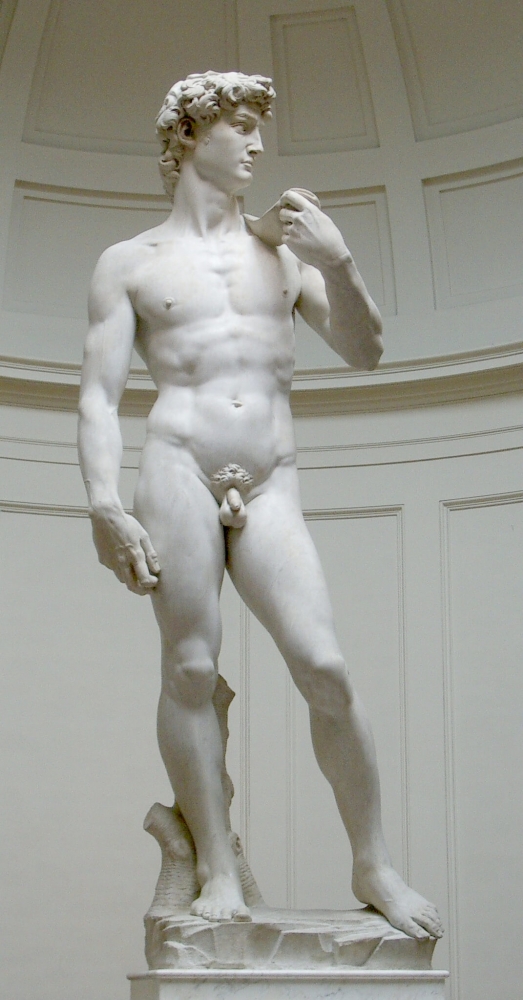
On the other hand, penis-as-thing-of-beauty, we still find ourselves battling pervasive tastes. If the majority of people have been conditioned to see the flaccid penis as a joke then how do we undo that conditioning so they can come to see it as something beautiful or, if not beautiful, at least as something that isn’t stupid? One possible answer is to continue to create great art (like Michelangelo’s David) that elevates the willy from the ridiculous to the sublime. At least then men, ashamed of what’s between their legs, can see the penis reclaimed and begin to undo the narratives that pervade their own minds telling them their tackle doesn’t amount to much. Of course, we might never reach a place where everyone admires the soft willy but there might be a day where people at least take it seriously.
Now, feminists amongst the readership might be asking why I should bother with a post on the penis. It’s a good question, surely there’s enough phallocentrism out there already, surely most buildings have been designed in the patriarch’s image, and didn’t Freud write enough on penis envy? Whilst this is all true the political is still deeply personal and this includes body image. And sure, focusing on the flaccid penis might come across as a little trivial (but I must confess the tone of this piece isn’t entirely serious) or maybe that’s just because the willy is used to derision but men do care about their manhood. Men who may well be riding off the back of much privilege but who may also feel disenfranchised. Thus, perhaps if we shift the narrative slightly and reclaim the flaccid penis then men will have one less thing to worry about and can get back to the task of challenging male privilege and being awesome feminists.
Anyways, whatever your view on the male member here are some rowers from Warwick college getting their dongs out for a good cause – tackling homophobia in sport. Now that’s an innovative use of the flaccid penis!
 humanconditioned