Bake Off: Our Damnation And Salvation

Spoilers ahead if you didn’t catch this week’s episode of Great British Bake Off – think Game of Thrones meets the Home Counties by way of the Hummingbird Bakery. And this week was a corker – broken eggs, soggy bottoms, tarts galore and Mary Berry even cracked a joke. However, two things really struck me, one concerns filo pastry and the other concerns our dearly departed Val.

Kinda half way through the programme Mel or Sue (the comedy commentators who keep the whole thing together) go off on a tangent to reveal a bit of the history of baking. This week was Baklava. Back in the 13th century Ottoman Empire the Sultan was getting a bit peckish, so his royal chefs invented filo pastry. It’s a tricky process that involves finely rolling numerous sheets of pastry, so fine that you can read a book through them (or a bottle of alcohol as contestant Jane did, ahem). The process required such skill that, back in the day, the number of sheets within the filo pastry was used as a signifier of wealth. Rich households would demand a minimum of 100 layers. Wait a second. Number of sheets in filo pastry as a sign of wealth. What the actual f*ck?! I mean, come on people, let’s get a grip. But it was then, as I watched Mel bite into a tasty morsel of pistachio filled Baklava, that I realised we’re doomed. Humans are actually doomed. We prioritise the number of layers in filo pastry over things like lessening hunger in the world, tackling climate change and redistributing wealth. And things haven’t changed that much since then except it’s less about filo pastry and more about number of yachts, houses and watches. The irony is that once a year the Sultan would host a great Baklava ceremony and the servants of his Empire would be given some of the stuff as a token of gratitude in return for their unending service. After that it was back to a life of gruelling slavery. Humans. We’re the worst.

As you can imagine I was in despair and then Val was outed from the Bake Off tent. She’d had a bad week but when the camera turned to her these were her parting words: “When you bake you always bake for a reason, you’re giving it to people, so you make it the best you can and you make it with love. And whenever I make anything I stir love into it, I knead love into it, so when I present it, it’s special. I’m not unhappy, I’ve had a great time with some great people and, phwoar, I didn’t expect it, I didn’t expect to ever get here, never mind be honoured.” And those words speak for themselves. What a woman and what an inspiration to us all – so positive, so grateful and just so darn nice. All the other characters (I mean contestants) spoke so highly of her positive personality and even judge Paul Hollywood had a good word for her. And what a world we might live in if we didn’t prioritise the number of layers in our filo pastry but prioritised love instead. It sounds cheesy but it tastes great.

What Is True Love?

It’s a question on many of our lips as we navigate the marketing campaigns, movies and relentless narratives of heteronormative patriarchy that tell us true love is something to be shared with one other person of the opposite gender for the rest of our lives. True love will involve a white wedding, 2.4 children and a mortgage. True love will look good in public and any problems will be hidden behind closed doors. True love will be shared on Facebook and Instagram whilst the passive aggression happens off camera. Fortunately, P!nk and Lily Allen aren’t buying into this bullsh*t.

Well, ok, I think both Lily Allen and P!nk are married with kids although they probably own their houses outright rather than have mortgages. However, there’s a lot of angst in this song as they complain about how irritating their partners are, how infuriating, how stupid and a whole load of other negative things (there are also quite a lot of domestic abuse references as well as some causal anal sexism, but that will be another post). And at least they’re honest. Love isn’t all roses, doves and honeymoons it can be annoying, smelly and sometimes quite disappointing. But I do like the idea of taking the rough with the smooth and committing to something bigger than  just two (or multiple) people, where 1 + 1 makes more than 2 (or 1 + 1 + 1 etc for those in polyamorous and/or open relationships). I think that’s something worth committing to and not that crass and crushing heteronormative, consumer capitalist version of “true love” created to make us buy more stuff and go to bed feeling guilty and alone. And I don’t think that better kind of true love (maybe just call it love to sound a little less presumptive) has to last forever either, what a sad benchmark for a relationship’s success if it only counts if it ended at death. It also doesn’t need to involve kids and a mortgage, dogs in a housing co-op are ace too. And it certainly isn’t just for straights. Queers welcome.

Now, don’t get me wrong, I am not against people marrying, having 2.4 children and getting mortgages. It’s often a brilliant and inspiring (and very, very difficult) thing to do, hats off to you. But I do mind if that’s all you do, if you’ve just glanced at the ‘true love’ manual (aka watched a few Julia Roberts films and dressed your son in blue and daughter in pink) and taken it at face value. Worse still, not just read the manual but started to recite it as well, as you take for granted that society (and this includes politics, economics and culture) is often weighted in your favour (but only if you’re wealthy enough). I reckon the best thing you can do is acknowledge that space has been made for your type of love, enjoy it, and then set about helping create space so others can enjoy their types of love too. In brief, as with most posts on this blog, check your privilege and don’t be prejudiced. Then we can all have a go at mucking up true love (p.s. and yes, this post was basically an excuse to post that song, it’s just so catchy).

Does The Thought Of Anal Sex Disgust You?

Not wanting to write about the Referendum again and inspired by fellow blogger Freakypeach’s great post on anal sex, I thought I’d put my head above the parapet and put a good word in for the bum. I want to write this because I know a lot of very nice people who do lots of nice things, however, when the topic of anal intercourse is breached their niceness slightly slips. Some make faces of disgust, some shudder, some don’t want to talk about it, some imply it’s just a little too deviant, whilst others brush it off as ‘unhygienic’ and then start talking about the weather. So consider this post my attempt to counter the stigma attached to anal sex and if, at the end of it, you’re still not convinced then please just remain quiet on the matter and support those friends of yours who want to engage in whatever consenting forms of sex they wish.

https://i0.wp.com/www.travelphotolenses.com/wp-content/uploads/2016/01/DavidBum_WM.png

“But it’s the bum!” I have heard many anti-anal-sex folk cry. “We poo out of it.” And their knowledge of human anatomy is spot on as, I imagine, is that of those who’ve had anal sex. And yes, whilst we do poo out our bums like many other things the bum can be cleaned. Douches, flannels, bidets, showerheads…there are an awful lot of ways to keep one’s back passage clean, advisable for all of us, not just those wishing to use our bottoms for sexual gratification. So yes, like the penis, vagina and any other part of the body, the bum can be dirty but it can also be clean. “But it’s poo, I mean, poo!” Yes, I heard you the first time and maybe this is just about your own lack of anal hygiene that you’re assuming everyone else suffers from. If you really can’t get over this hurdle then please just skip to the last paragraph.

So, with a nice and clean bum (or not, whatever works for you) we can now engage in some anal intercourse and guess what, it can be extremely pleasurable. People of all genders enjoy it and many folk even have prostate glands up their back passages and that can enhance the pleasure. To be quite honest there’s a world of experiences to be had up there whether you’re doing it with your fingers, a dildo, butt plug, vibrator or someone else (or a number of people for that matter). Of course, if you don’t want to have anal sex that’s absolutely fine and I hope no one ever makes you feel bad for not doing it but this post is about the people who do want to do it. Please don’t negate, trivialise, ridicule and/or discriminate against their desire to do whatever they like with their bottoms.

In essence, this boils down to stigma. As a male member of the queer community (although these facts don’t tell you whether I’ve had anal sex, want to or even fancy people of my own gender, that’s still none of your business) I’ve witnessed and experienced a certain sort of prejudice: if I got a quid every time I’ve had to watch ‘straight lads’ faux bumming each other because that’s the height of humour (and they’re too repressed and insecure about their sexualities to actually get down to it and shag their mates) I would be rich. Or every time people I like have warned me against the dangers and the lack of hygiene as if I haven’t considered these things for myself. Or people proclaiming “but we poo out the bum” as if that ends the debate. Or been told that what queer men do to each other is deviant. Or read about queer people being beaten up and killed for liking anal sex. The list goes on. If you have nothing positive to say about the joy that is anal sex then please say nothing. Please just support your friends in their adult decisions to have sex however they like. Here’s to the bum!

Oxford’s Vigil For Orlando

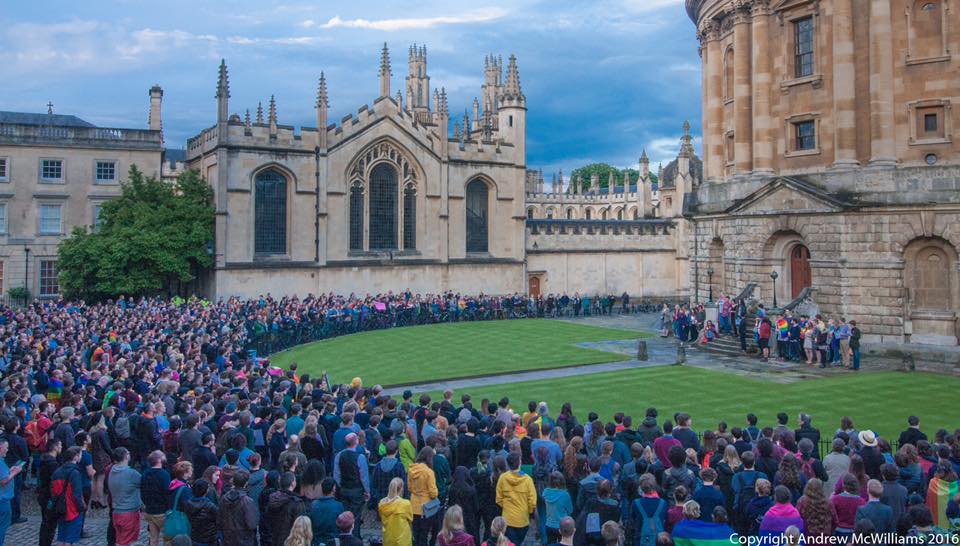
Oxford, England. Thunder boomed, lightning flashed and the rain came tumbling down. The English summer is never one for predictably and climate change just makes that all worse. A brief cycle home and I was drenched, my second shower for the day. It was five o’ clock in the afternoon and there was going to be a vigil in Radcliffe Square for the victims of the homophobic terrorist attack in Orlando. More thunder, more lightning, more rain. The Orlando attack was deeply distressing. It is sad to see people robbed of their lives by atrocious acts of violence and it is sad to see the queer community targeted simply because people want to be free to love whoever they wish. However, I’d seen photos of the vigil in Soho, London, and there had been thousands of people standing in silence, in tears and in solidarity, and this gave me hope.

A few hours later I put my waterproof jacket on, jumped back on my bike and head into town. But the jacket was unnecessary because the clouds were breaking and beyond, even at half past seven, the sun was shining. The view of the changing sky was staggering punctured by the sandstone spires of Oxford University. I arrived at Radcliffe Square where hundreds of people had gathered outside the Radcliffe Camera (the only building in Oxford’s skyline that looks more like a booby than a penis). So many people. Like any community, the queer one can be both brilliant and difficult. Great friendships can be forged but so can cliques. Certain groups come to identify themselves apart from others and ‘politics’ can arise. However, that evening we were gathered for something so much greater than ourselves, we were gathered in solidarity for the victims of Orlando and for queer people all over the world.

Vigil for OrlandoA quote from the facebook event reads as this: “LGBTQ people have long been and continue to be the victims of violence and hatred in the places where we try to seek safety. The fact that this attack happened on Latinx night, and that so many of the victims were Latinx reminds us that queer people of colour are disproportionately at risk of violent hate crimes. On Wednesday evening we will come together outside the Radcliffe Camera to remember the lives of the victims of this attack; we will mourn the violence that seeks to destroy our communities. There is no space at this vigil for Islamophobia or racism. We will not be silent in the face of hatred, we will stand together and support one another as we have always done in times of crisis.”

People gave speeches, the names of the victims were read out and a two-minute silence was held. Someone in front of me began to cry and someone next to them gave them a hug – I don’t think they knew each other. There were families there too and heterosexual people, distressed at the attack and supporting their queer friends. Then a beautifully voiced choir sang Seasons of Love from the musical Rent and Somewhere Over The Rainbow. What ace songs. It’s such a shame that it sometimes takes tragedy to bring us together but those moments of unity are exceptionally powerful, and even though I went by myself to the vigil I did not feel alone. Humans have always lived in difficult times and this remains true today. My hope is that the sentiment of belonging to something so much bigger than ourselves – a community of fighters, lovers, queers and allies that runs back throughout history and will run always into the future – will continue to bring us closer together in a time when division is not an option.

Oprah Winfrey And Brené Brown Are Not Cool

And the funny thing is, they are totally fine with it. So, we all know Oprah – famous, American talk show host, but we might not be as clued up on who Brené Brown is. Well, she’s got a doctorate in social science and a few years ago blasted the world with a great TED talk on vulnerability and has an ace RSA short on empathy – how the ability to feel with people is hugely empowering for both the person in need of support and the one providing it. And now she’s telling us not to be cool. Why?

Because cool “is the biggest armo[u]r ever. It’s almost like disengagement is cool now. You’re not supposed to care.” And she’s right. Cynicism is pretty fashionable nowadays whilst actually trying to care about something is decidedly uncool. But the sad thing is that being cynical about the world and expecting the worst of people doesn’t actually make us right. Cynicism is a defense mechanism not an opinion. It stops us having to engage with the really terrible stuff that is happening in the world because that can be overwhelming and devastating. So we build walls around ourselves to stop the world getting in. But a further irony is that this cynicism distances us from others by making it harder to connect. We become more isolated and in turn get lonelier and sadder. And to protect ourselves further we get more cynical and we fortify those walls.

However, the tougher thing, as Brown would say, is daring to be vulnerable. Admitting that something makes us sad or that a certain state of affairs isn’t okay even if there’s not a huge amount we can do about it. So a crack appears in our armour and through that the world might get in. Unfortunately, it will hurt because there’s a lot of pain out there, as well as in ourselves, but we will also have access to other more positive feelings like joy and happiness. And now I realise I’m sounding like a self-help guru and you’ve probably clicked onto a different blog. But I’ll end with this. Being cynical and being cool do not equate to being strong. We can be vulnerable to our pain and the pain of others and still be strong because that strength will come from resilience (rather than sceptical resistance) which is an organic and human form of armour not an artifice of indifference. Of course it’s not easy and, if you’re cynically inclined, you’ll probably retch at the video below but surely what we need now are people who are uncool enough to care. Equally, we can just redefine cool to include being vulnerable because, hey, I have no intention of joining Brown and Winfrey on the uncool sofa.

Love (Is) Actually (For Rich White Men)

I sat down to watch Love Actually last night, one of my favourite Christmas movies – y’know, the one where Hugh Grant plays the bumbly prime minister, Colin Firth plays some bumbly writer, Keira Knightley smiles a lot and a whole host of other famous British actors don’t deviate from their usual type-castings. All wholesome, British fun. At least that’s what I used to think but since then I’ve read Judith Butler and generally become more aware of the gross inequality in this country and the many problems of patriarchy. So, this year, I saw Love Actually a little differently and came to realise that it’s basically about rich, white men getting what they want. Spoilers ensue.

For starters, three of the central relationships are about middle-aged men with power (i.e. with important jobs – Alan Rickman (aka Snape) plays the CEO of a charity, Hugh Grant the PM and Colin Firth a wealthy writer) who attract much younger, women of ‘lower status’ – Snape’s secretary, the PM’s Cockney, ‘salt-of-the-earth’ type maid (played by Martine McCutcheon) and Firth’s Portuguese cleaner. The women go out of their way to attract the men whilst the guys just bumble around getting what they want without even trying. As for woman of power in the film…well, there aren’t m/any. Sure, there are plenty of female secretaries, there’s a put-upon wife (played magnificently by Emma Thompson), there’s a dead wife, there’s a nasty, younger wife who cheats on her husband (boo, we’re not supposed to like her), and a blushing bride (Knightley) but there aren’t many inspiring roles for women in this film. Add to that the often abysmal script that many brilliant female actors are forced to speak – Snape’s secretary tempts him to cheat on his wife with her saying cringe-worthy things about “dark corners” as she spreads her legs. She’s also forced to wear devil horns to the office party as women are literally demonised in this film. At least Emma Thompson gets to speak up for herself at the end after a bit of Oscar-worthy acting to the tunes of Joni Mitchell (see below) but I still feel Snape’s apology isn’t sincere enough.

Then there are the people of colour in the film, or lack of them. We’ve got a black DJ (who’s a joke), a not particularly nice black secretary (who is also forced to serve Grant’s PM), a black best friend (who gets the odd token line and manages to defy the laws of physics by being in two places at once) and a black husband (who plays second fiddle to Keira Knightley and that random, white guy from Teachers who is secretly in love with her, cue that awful scene in which it takes Knightley’s character far too long to figure out the Teachers guy is some weirdo who fantasises about her a little too much). But is any substantial role given to a person of colour…no. As for trans and queer characters – well, Emma Thompson makes a joke about a Barbie doll that looks like a transvestite and a few people are asked if they’re gay but then quickly and vehemently deny it. So zero points on the queer front.

And then there’s Colin Frissell – a young, bumbly white guy who never has much luck with the ladies. Perhaps because he calls women he doesn’t know beautiful and is generally inappropriate in the way he talks with women. We’re supposed to like him and his goofy antics but really his attitudes and behaviour are dire. But then he flies off to America and ends up with not one but three (maybe even four) busty American women who, thanks to the stellar script, are complete idiots. So, if at first you don’t succeed lads, just keep going until women relent. Oh, and there’s that plot line about Bilbo Baggins doing nude scenes with Tracey of Gavin & Tracey fame and naturally we get to see her breasts a lot but do we get to see his penis as a bit of nudity parity…nope. I’ve always wondered what a hobbit penis would look like.

As for the other plot lines, there’s one about a father (Liam Neeson) and son which would have been better if Neeson got to shoot some people; a nice enough bromance between an aging, male rock star and his male manager; and quite a sad office romance between an American woman and some French male model. And after all that what’s the moral of this heartwarming Yuletide story – if you want to live in London and fall in love you basically have to be rich, white and male. Happy Christmas.

My favourite scene…Emma Thompson capturing the MAMMOTH emotional repression and inability to communicate of the upper middle classes perfectly. She thought he was going to get her a necklace but he gave that to the nasty, devil secretary instead. Just watch as she tries to hold back those tears and maintain a stiff upper lip in front of the kids!

What Morse And Lewis Teach Us About Love (Spoilers)

After ten years the ITV murder mystery series Lewis finally came to an end and it has an important lesson to teach us about love. But to understand this we must go back to 1987 when the Inspector Morse series began.

Morse was a grumpy old man who liked classical music and alcohol, Lewis was his Geordie side kick who liked technology and his family. They worked at the Thames Valley Police and went around Oxford solving odd and overly academic murders. The relationship was often fraught but they always managed to catch the killer. This went on for 18 years until Morse died in the very final episode, The Remoserful Day. He’d suffered a huge heart attack and on his hospital deathbed he passed away. His final words to his boss, Chief Superintendent Strange, were “thank Lewis for me.” And so, after all that time, after all the arguments, the casual insults and the impatience it turns out that Morse was hugely indebted to his sidekick. Morse’s final moment captured his curmudgeonly character perfectly, the sort of man who could never quite admit to vulnerability or love, not even to those closest to him, and so he died without really having had the chance to thank those closest to him.

Five years later the Lewis series began. By this time Lewis had tragically lost his wife in a hit and run accident making him far grumpier and lonelier (like Morse). He also managed to lose his tech savinness (a little inconsistency of plot here perhaps). Fortunately though when it came to Lewis’ ending this year his was not quite as fatal as Morse’s. Instead he was faced with a choice: go on a six month trip to new Zealand with his new partner Laura Hobson (a pathologist who after many series Lewis finally hooked up with) or stay in Oxford working for the police to prevent them forgetting him and not renewing his contract. Lewis, after much agonising, opted for the latter. He feared losing purpose without a life dedicated to policing and would prefer to die on the job, much like his previous boss. However, he was forced to reconsider when his sidekick, Hathaway (now a Detective Inspector) said this:

“Do you love Laura? [dramatic pause] Then go. Show her that you love her, don’t assume that she knows. People make that assumption and it’s a mistake. Still, your decision.”

And so Lewis rethinks and decides to go abroad with the love of his life (and it turns out that he doesn’t have to worry about losing his job because Chief Superintendent Moody is very impressed at Lewis’ solving of the final case – something highly forgettable about parcel bombs, mercury and not particularly credible motives). So what does this teach us? That words and deeds are funny things. In Morse’s dying words he revealed something he had never really said before, that he cared deeply for Lewis. Whereas, it’s not words that prove Lewis loves Hobson, it’s his decision to go away with her. And we need both – we need both words and deeds to prove to those we love that indeed we love them. Sometimes actions, even though they’re enacted, need words to make them explicit, and sometimes words, however passionately said, need actions too. And the final lesson is that life is short, especially if you live in Oxford where people are grueseomely murdered on a regular basis. So don’t make Morse’s mistake and learn from Lewis instead – tell those you love that you love them and show ’em too. Cue cheesy but heartful Lewis theme song:

The Play: It’s Complete Anarchy

It’s show time for Universally Speaking! Opening night is tomorrow at the Bread & Roses Theatre, Clapham, and it runs each night until Saturday (7.30 – 9pm). The actors have learnt their lines, the final props have been bought (including a 6 pack of ready salted and three mini primroses) and the tickets are selling. I’ve been doing my bit as producer and I can safely say that the process has been utter chaos. Yup, complete anarchy of the best variety…here’s why.

Prince Peter Kropotkin (1842 – 1921), a famous activist, philosopher and geographer defined anarchism as “a principle or theory of life and conduct under which society is conceived without government – harmony in such a society being obtained, not by submission to law, or by obedience to any authority, but by free agreements concluded between the various groups, territorial and professional…for the satisfaction of the infinite variety of needs and aspirations of a civilized being” (and if you’re interested in etymology it’s roots stem from the Greek anarkhos, from an- ‘without’ + arkhos ‘chief, ruler’).

No boss, a lack of hierarchy and lots of good will: yup, that sums up the production process for Universally Speaking. Whilst we’ve taken on different roles: Simon Jay directing, me co-producing, the actors acting, technicians teching, the writers writing and so on, there hasn’t been a ‘top dog’ telling us all what to do. We’ve taken responsibility for our own roles and brought our expertise to the table. We’ve formed an “interwoven network” and worked together to bring a piece of theatre to life. Kropotkin likens anarchistic organisations to organic life, “harmony would result from an ever-changing adjustment and readjustment of equilibrium between the multitudes of forces and influences”. And so the show has organically developed, often taking on quite a surprising life of its own (you’ll have to see for yourself).

Now, in an ideal anarchistic state (little ‘s’) there would be no money but sadly we haven’t managed to be that savvy. Instead, over 50 people donated to our indiegogo fundraising campaign and we raised £920. This is testimony to how great and generous people are. Kropotkin talks of mutual aid – “a voluntary reciprocal exchange of resources and services for mutual benefit” – and its a nice counterbalance to Darwin’s relentlessly selfish natural selection predicated on greed and constant competition (not that Darwin really described it like that). And the level of support we’ve had putting together the play has been heartblowing. Alongside the financial aid we’ve had people offer to promote the play and help with the lighting and sound. Meanwhile, the cast and director have given so much of their time just so they can make new theatre and the writers have waived their fees from their pieces.  However, because we don’t yet live in Anartopia of the £920 raised £100 will go to each actor and to the technician (the rest will cover marketing costs and props) as an exceptionally small thank you for their hard work. We’re splitting tickets sales 50/50 with the theatre and any profits we make will go to charity – the UNHCR and Mind, the mental health charity. As for The Bread & Roses, they’ve been great and it’s fantastic to have theatres so supportive of new writing.

Another important guiding principle of anarchy is love. And that’s why we’ve all been working so hard to ensure Universally Speaking is a great night out. We all love the arts and the different elements of theatre – acting, directing, producing, writing, teching, staging – and are under no illusions that we’ll be quitting our day jobs any time soon. As for the final piece of the jigsaw, it’s you – the culture hungry audience members who have already bought a load of tickets! It’s only £10 for an incredibly fun night (cheaper if you book online). So I do hope you’ll come along to enjoy this theatrical slice of anarchy and unlike in a competitive, hierarchical capitalist system this really can be a win-win for all. Prince Kropotkin might just be proud. See you there!

https://www.youtube.com/watch?v=GxgAuYJwugs

How To Do Heartbreak With Regina Spektor

Have you ever been in love? Have you ever fallen for someone so hard that they’re all you can think about? You see their face in every flower, their eyes in stars above, and all sorts of other overblown romantic things. But then has this wonderful experience been marred by heartbreak? That horrible time after the affair when those loveable things they do – like leave the toilet seat up, leave the sponge in days old washing up water, make endless snarky comments at your expense whilst forgetting to praise you – just stop being loveable. Heart break can be tough especially when you’ve really loved someone but I think wonderful, singer-songwriter Regina Spektor has some great tips on getting over that ex-love of your life. Here’s How…

It’s clear Regina was deeply in love with whoever she’s no longer going out with: “How can I forget your love, How can I never see you again…How can I begin again, How can I try to love someone new?” Yup, I think smitten is an understatement. All she does is think about them to the point that she can’t imagine ever dating someone else. It’s a sad song with a haunting melody and whilst it’s clear a part of Spektor wants to meet this person again, perhaps with the intention of rekindling their affair, there’s also a part of her that wants to move on.

“Time can come and take away the pain but I just want my memories to remain.” Like the best of agony aunts she recognises that time really is the best healer and the more temporally distant we are from someone we’ve cared for the easier it is for our hearts to heal. And the second bit is really fascinating – she’s not saying she wants to forget, she’s saying she wants to keep the memories of her past lover. Now, this could be her desperate attempt to not let go – maybe she checks their facebook profile regularly when really she should have defriended them long ago, or maybe she listens to their songs online (assuming they’re a singer like Spektor). This is something so many of us do as we try to hold on to things that have passed and social media makes doing it way too easy. However, there is an alternative interpretation. Her not wanting to forget could be an acknowledgement that a love as powerful as theirs won’t simply just go away. Our memories of places, faces, smells and sounds are deeply interwoven with our feelings and emotions. Emotionally intense experiences, good or bad, are more memorable than that average burger you ate last week or that mediocre movie you saw a while ago. So maybe Spektor recognises that an experience as emotionally charged as true love is bound to leave a deep impression on her neural networks – maybe she’s not in denial because she can’t deny the potency of the experience.

“There’s not one moment I’d erase,” she sings, “You are a guest here now.” And this is the bit I really like and the bit that helps me live with my own heart breaks. Rather than try to force her ex-love from her mind, rather than live in denial and pretend this stuff never happened, Spektor lets them stay in her memory and her heart. Not necessarily in a desperate, clingy sort of way but in a way that acknowledges the huge role they played in her life. So, they’re a guest, not unwelcome but not given the best room either. And perhaps, slowly over time Spektor can move on…until the next guest turns up unannounced. Date, anyone?