Jurassic Out-Of-This World

All willing disbelief suspended, all fond memories of the original shelved and all expenses paid for an average seat at the Odeon – yup, time for Jurassic World. And my Gobisaurus, there was not a lot that film didn’t do – a blazing example of anti-capitalist, Marxist, feminist critique. Here are a few of the highlights.

Jurassic World

Consumerism Will Destroy Us: So, the two young white male protagonists arrive at Jurassic World, twenty-two years after lots of people got killed at Jurassic Park, and it’s basically a giant zoo. Screaming kids are riding baby Triceratops, screaming crowds are watching great white sharks being fed to Mosasaurus and profits are screaming (in delight) as the park rolls out its latest asset – a genetically engineered new dinosaur, the Indominus Rex. The film paints a pretty grim picture of humans as greedy, selfish consumers. Meanwhile, it swiftly becomes apparent that the money behind the park is corporate, so much so that the companies want their brands to form part of the dinosaurs’ names – the Nokiasaurus, iRex etc. The dinosaurs are also referred to as ‘assets’ and seen as profit-making objects rather than real living creatures. Put this alongside the film’s own product placement, what with Mercedes, Coca-Cola and Samsung all getting an appearance, and there’s a pretty strong anti-consumer capitalism message going on here. Not to mention that the entire park actually forms part of an elaborate military project to breed dinosaurs as weapons – so it’s not just the greedy business types pulling the strings it’s also the war generals, quite the military-industrial complex going on here.

Of course, this would not be part of the Jurassic Park franchise if the dinosaurs did not escape and kill lots of people – which they do. We see one woman get chomped by the Mosasaurus, multiple people get flayed by Pterodactyls and the Indominus Rex goes on a feeding frenzy.  The moral of this story: consumerism will destroy us – in a wonderful irony, befitting of even the most esoteric of French philosophers, the very products of consumerism (namely, genetically modified dinos) will turn on those that consume them by…consuming them. Ouch.

Nature Does Not Exist: First there was the earth – a barren lump of rock, then there was nature – trees, rivers, animals etc, then there were humans. We labour under the belief that humans are not part of nature, hence our endless quest to reveal nature’s secrets and dominate it. Simultaneously, we idolise the time of pre-human nature and in Jurassic World they try to recreate it by breeding extinct dinosaurs. However, as one of the chief scientists in the film reminds us, “nothing in this park is natural” because the humans have been tinkering with the dino DNA right from the start. But that still begs the question “what is natural?”

That’s an incredibly difficult question to answer if we still believe in the binary of pristine, nonhuman nature versus dirty, human artifice. We can never win if humans are the ones that render everything unnatural simply by existing. So, I suggest we give up this confused notion of nature and accept that that sort of nature never existed. Instead we can place humans alongside animals, rivers, plants etc, in a broader understanding of the natural world. This can also include all the mechanical and technological contraptions that humans like to create. Thus, rather than having degrees of ‘natural’ we could have degrees of ‘engineered-by-humans’ – i.e. a rock-as-hammer being a less engineered human technology than, say, a car. Of course, this says nothing for how humans treat the world they form part of, pretty badly basically.

White Men And Families Will Save Us: Jurassic World is a 12A, it’s a film for all the family. Thus, it’s only right that Bryce Dallas Howard’s character, Claire Dearing – the park’s white, single, overly organised, female stereotype operations manager, ends up with Owen Grady (played by Chris Pratt), the white, rugged, dino fighting, sexist, male stereotype Indiana Jones knock off. Meanwhile, Zach and Gray (yes, he is called a colour) the two white, siblings who start the film squabbling end up fulfilling male and fraternal stereotypes thanks to numerous near death experiences with dinosaurs. Also, the implication at the end of the film is that their possibly-divorcing parents will stay together now the dinosauar attacks have put everything in perspective.

Indeed, the majority of characters that do positive things in this film are white, whilst the evil scientist is of Chinese descent and the dubious billionaire that owns the park is Indian. However, there is one white baddy – a gun-toting  military man who wants to use the dinosaurs as weapons, he ends up getting eaten by a Velociraptor. At least the film passes the Bechdel test as Claire talks with her sister, Karen (the mum of Zach and Gray), about something other than men…how to raise children.

In brief, the moral of this story is that it helps to be white, male, heterosexual and part of an atomic family, or planning to start one. That’s how to survive the dinosaur apocalypse.

Redemption: Just when we thought all was lost and the Indominus Rex was about to eat everyone the T-Rex, Velociraptor and Mosasaurus all come to the rescue and render the Indominus Rex very much dead. So, there is a happy ending of sorts as the friendly dinosaurs  help the white, heteronormative humans restore some form of order. It’s a confused message perhaps but it does imply globalised consumer capitalism does not have to spell the end of humankind. There may well be hope for us yet, thank you dinosaurs.

Our Love Affair With The Rich

The Tories have long been considered the party of the rich and, now they have power, they’re doing an awful lot to help their rich chums – repealing the fox-hunting ban (a sport only really enjoyed by a few), reducing union and employment rights (so big business owners won’t face as much threat from their workers) and continuing to turn a blind eye to tax avoidance (a pursuit the wealthy enjoy even more than hunting). With poverty, inequality and income disparity on the rise it really does seem as if all the rich are doing is getting richer.

However, despite this depressing trend it still seems as if we are enamoured of the rich – why else would we spend so much time watching them. They’re on television – Downton Abbey, Mr Selfridge, 90210, Gossip Girl, RevengeThe Kardashians, Made in Chelsea, they’re in film – A Little Chaos, The Great Gatsby, Match Point, The Aviator, The Riot ClubThe Queen, they’re in books – Brideshead Revisited, The Great GatsbyThe Wolf of Wall Street and they’re on stage – Arcadia, Hay Fever, Posh, The Audience. It seems that despite the rich undermining the social fabric of our society by putting wealth before morality we do quite enjoy watching them do it.

This contradictory and voyeuristic behaviour is easily explained. On the one hand the rich tend to bank roll culture – they’re the ones that can afford West End ticket prices and they like nothing better than having themselves portrayed on stage. The plays may well be a little satirical but they are always disappointingly harmless as tools for social change, here may I refer you to Acykborn, Bennett, Stoppard and the like. Also, the rhetoric of social advancement is deeply embedded in British society. There is a steady stream of messaging that vilifies working class people and people on low-income – Benefit Streets, Little Britain, the Conservative Party election campaign to name but a few. We’re encouraged to despise and ridicule ‘chavs’ and do all that we can to ascend the social ranks. Of course, what they don’t tell you is that there are limited seats at top table and however hard one aspires the likelihood of becoming one of the ‘rich’ is slim.

So, as desperate as we are to get rich the reality is that this is very hard and it’s far easier just to watch them on telly. There’s something quite fascinating in watching the lives of those who live without consequences, where money really is no object.  To be able to eat baby octopi off a bed of diamonds whilst blowing up yachts off the coast of Barbados – why not. It’s an odd social contract but so long as money is king, and it will be until we better understand how to take the -ism out of capitalism, we will have to settle for being rich vicariously.

My addition to this rich tradition of richness is The Wellington Boot Club – a murder mystery comedy showing at the Burton Taylor Studio in Oxford from 26th – 30th May, 7.30pm. Get your tickets here! A whodunnit that sees Esther Jones, a psychology student at Oxford University, turn detective when one of the members of The Wellington Boot Club – an all male drinking society – is bashed to death during an initiation ceremony. The play explores the ‘laddish’ and misogynistic drinking culture at Oxford University that can often result in criminal behaviour. So expect another play that pokes at the rich and tries to baffle the audience with a slew of red herrings.

It’s obvious what we need to do – we need to stop encouraging the rich and stop watching them. We don’t need to constantly compare ourselves because there will always be someone wealthier and our lives are important and meaningful without bottomless bank accounts. The trouble is the rich are very reliable for behaving ridiculously (they can afford to) which makes them sitting ducks for parody. So it looks like we’re caught somewhere between a trust fund and an offshore bank account.

The Wellington Boot Club

History Repeating

Shirley Bassey said it best, whatever innovations and revolutions are promised, it usually just turns out to be a little bit of history repeating. The same is true for British politics. David Cameron can walk triumphantly (and smugly) back into Number 10 whilst Ed Miliband hangs his head in shame and exits stage left but underneath the trials and tribulations of party politics history will just keep repeating. It is a history of capitalism in the UK and before we can change it we must have the courage to critique it.

What we have seen is a failure of politics, a failure of democracy at a cultural level, part of a larger story playing out across the struggling countries of the post-industrial west.” These words are taken from Dougald Hine’s exemplary blog, a philosopher who understands the underlying tectonics of politics and economics. Using some of his blog as inspiration I will analyse why contemporary politics are caught in the endless repetition of history.

*

Tories: the Tories think they have won and, for now, they have. They quite marvellously (and maybe even unintentionally) weakened their political rival the Labour Party. The Tories successfully made people believe that Britain’s economic woes were the result of Labour’s over-spending and conveniently forgot to mention that the actual cause was the unregulated banking sector capitalising on the housing market and using too-good-to-be-true sub-prime mortgages to profit from toxic assets. The public bailout of the banks nationalised a private debt to the tune of billions that has still not been paid back. Yet the Tories have done next to nothing to try to re-regulate the banks thereby increasing the likelihood of another recession all too soon.

They tried to scare people into voting for them – it’s either our ‘sensible’ economic plan or ‘chaos’ – and it worked. Unfortunately, capitalism churns on unchallenged and booms and busts will continue to affect Britain. Yet, the Tories are unashamed in their imposition of austerity – a policy that will exacerbate inequality, weaken the working and middle classes and actually undermine Britain’s economic recovery. Even the IMF has advised against such a plan but George Osborne has ignored it. They got votes by promising people houses and security. But the middle classes will not be safe from the Tory cuts – austerity will undermine public services that middle class people rely on and increased inequality will cause greater social discord, discord that will reach the doorstep of middle class houses.

Meanwhile, with no serious redress of the housing crisis and no attempt to curb ruthless profiteering in the housing market, prices will continue to rise and people will find themselves trapped in unaffordable mortgages or conned into suspiciously affordable mortgages born on an ongoing housing bubble. The Tories are signing their own death warrant. They’ll take as much credit as possible for any minor growth in the economy and then squirm if/when the next bubble bursts and the economy dips. They told us that voting for Ed Miliband would result in ‘economic chaos’. That chaos is going to unravel anyway and this time it will be on the Tory watch and they won’t be able to scapegoat Labour anymore.

Labour: is trying to figure out how to rebrand themselves. Some think it best to become a New-New Labour type party, whilst others think they need to appeal more to the working classes. Going right for Labour means trying to play the Tories at their own game – using the defunct discourse of class politics to convince people that they can rise up through the social ranks and embed themselves comfortably in the land of the middle class. Heading this direction affirms the view that Labour have now shifted right of centre, a process initiated by Tony Blair as he embraced the precepts of neoliberalism (he was, after all, Margaret Thatcher’s self-professed “greatest legacy”).

Going left for Labour means trying to appeal more to the working classes but in a post-industrial society the working classes are not what they used to be. Firstly, Margaret Thatcher effectively won the class war when she crippled the mining communities and their means of representation in politics, i.e. the unions (it’s also worth bearing in mind that basing one’s community around the extraction of a finite resource, i.e. coal, is always going to ensure a limited shelf life). Secondly, in our post-industrial economy many of the industries we have now revolve around 0 hour contracts, call centres and other service sector jobs – it is very hard to imagine flourishing and cohesive communities forming around these sorts of work. We have also outsourced so much of our labour to countries like China that we have far less of a working class anyway. So if Labour do go left they won’t be able to rely on their old industrial working class style rhetoric.

Ukip: will do what they do best – completely ignore the larger macro-economic issues and scapegoat immigrants for the inevitable loss of jobs following a recession. A tried and tested approach, remember Enoch Powell.

*

The Next Five Years: sadly things won’t magically get better. Unless the ruling government addresses the economic instabilities built into the British capitalist system then history will keep repeating – we’ll have more recessions which will result in people losing jobs, even more jobs will be lost as labour is taken on by machines and the sectors in which new jobs are created will only provide temporary redress (although maybe not for hairdressers and plumbers).

So in about five years time we’ll be fed up of the Tories who will have crippled the long-term chances of the British economy with over-zealous austerity. We will be desperate for change and will turn to the rebranded Labour Party, they’ll promise a land of milk and honey, and will blame the Tories for causing the latest recession. If they get into power, which isn’t guaranteed, they’ll try to ride the wave of what little economic growth follows the recession. Meanwhile, extreme right-wing parties will scapegoat immigrants for our economic woes and stir up xenophobia. It will be all too similar to the times that Thatcher beat Callaghan, Thatcher lost to Blair and Brown lost to Cameron/Clegg. Indeed, as Shirley Bassey astutely observed, it will all just be a little bit of history repeating.

Before We Blame Democracy

Some of those disappointed with the election results have blamed the concept of democracy. Others blame the British public themselves, the Guardian even called the electorate ‘evil’. I disagree with both of these views and think it unwise to blame a loosely understood theoretical system of rule and the people engaged in it.

Democracy: is often understood to mean ‘by the people, for the people’. Now, an ideal democracy – that is truly representative of people – in an ideal society – where the electorate understand the long-term impacts of their vote and have an equal say in affairs – sounds wonderful. Of course, the UK has neither an ideal democracy nor is an ideal society. Yet I think the latter should be blamed for poor election results before the former.

We live in a neoliberal, capitalist state run by politicians that have outsourced political power to corporations. Corporations who are now so embedded in politics that they can sue countries if their profits are threatened. Meanwhile, much of the so-called free press is owned by right wing media moguls who dictate that a certain message is shared – just think of The Sun before the election supporting the Tories in England and the SNP in Scotland, its anti-Labour agenda all too clear. Then there’s the competitive nature of capitalism, encouraging us to be selfish consumers and feeding us the myth that we are ‘self-made’ – as if we can achieve greatness without the help of others. And let’s not forget mass advertising that addicts us to products we don’t need and makes us feel ashamed of most aspects of our lives – we’re not rich/pretty/social enough etc.

So somehow in and amongst all these selfish incentives and mixed messages democracy is supposed to thrive? Unlikely. We must remember the sheer power of the establishment, power that runs back for centuries, physicalised in the very stonework of the Houses of Parliament themselves. The elite have had years of getting what they want. It’s not that democracy has failed it’s that it was bought out by the establishment before it even had a chance to work.

Evil People: so, just as the tears start to fall and people get angry what do we do – we turn on each other. Conservative voters are suddenly ‘evil’ as if people who raise families, suffer depression and worry about their retirement are related to Satan. No, this is far too simple and is just reverse snobbery. Now is not the time to write people off, we must try and understand why people vote the way they do – if someone has lived in a predominantly white and middle class community and read right wing newspapers then its not surprising they won’t trust immigrants, won’t know the extent of the suffering that austerity causes and will vote in a way they think will protect their best interests and, probably, the best interests of their immediate family. But behind crass stereotypes are real people worthy of friendship who can be inspired to join the movement to affect positive change, remember the time the York Mosque invited the EDL in for tea?

So let’s stop dismissing the British people for one box they tick every five years and let’s remember they are people just like us. They don’t want to be patronised or villified. Grass roots movements that oppose austerity and corporatocracy and want real democracy and community have the opportunity to invite all people into their movements, however they vote. Most of us do care about the well-being of our family, friends and environments, there is so much common ground to be had despite the media’s brilliant ability to conjure polarity out of potential cohesion.

*

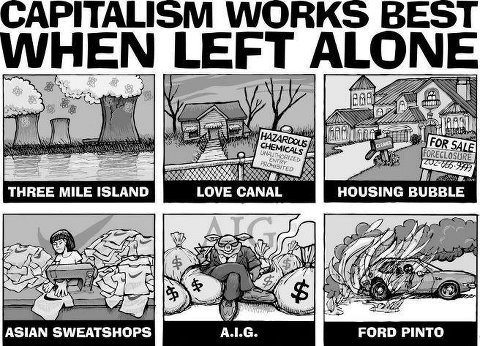
Democracy does not work because the system does not work and that system is neoliberal capitalism. It facilitates psychopathy and rips apart community because everything is done for cash, not love. Even the Labour party are neoliberal. The Green party are the only one that discusses sustainable alternatives. Meanwhile, people are not evil they are just subject to the stresses and forces of large politico-economic systems that infiltrate so much of their lives – education, leisure, work, relationships etc. Now more than ever do we need to challenge the system. This is a cross party endeavour, something the Tory party will soon discover as the pillars of the economy carry on collapsing around them. Challening capitalism is often akin to farting in front of the Pope but we’ve got to do it. We cannot leave capitalism alone, for obvious reasons…

Unregulated Capitalism

It’s All A Load Of Kabul Sh*t

The lyrics of Lily Allen’s song Kabul Shit speak for themselves. Climate change, corrupt politics and warmongering foreign policy are all astutely analysed in rhyming verses. So before you cast your vote this Thursday think on the words of that famous mockney singer:
 

There’s a hole in our logic,
There’s a hole in the sky
And one day just like magic
We’re all going to die,
‘Cause we didn’t turn the lights off
And we didn’t take the bus,
Even though we know we should have
Oh, silly old us.


These lines refer to the hole in the ozone caused by a range of chemicals including CFCs. Interestingly, in 1987 the Montreal Protocol was signed: an international treaty that phased out the production of numerous substances that contributed to ozone depletion. Unfortunately, the Kyoto Protocol – designed to limit the amount of carbon emissions and hence curb global warming – has proven much less effective even though 97% of climate scientists agree that humans are causing global warming. As Allen points out we carry on ignoring the evidence and consuming resources at a planetary pace, “Oh, silly old us.”


Well we should have recycled
And saved our resources
While there’s still someone else’s
Someone call the armed forces,
And we’ll blame it on terror
Also known as religion
But we shouldn’t feel guilt
For protecting our children.


Here Allen references resource wars – wars fought to gain control of a specific resource, such as land or water. The song alludes to the Iraq War – waged by the US and UK to allegedly find weapons of mass destruction but subsequently revealed to have been about ensuring access to oil. The war has been deemed illegal and many want to see George Bush and Tony Blair put on trial as war criminals. The lyrics also refer to terrorism, often evoked by Western governments to further justify racist and belligerent policies. Of course, some terrorism does reside in extreme forms of religion and one could even argue that capitalism is its own extreme religion forcing us to kill others for continued growth and profit. “But we shouldn’t feel guilt for protecting our children” is a wonderful sign off as Allen notes people’s tendencies to justify all sorts of actions for the safety of their own family, even if other families are harmed in the process – many of us did support the Iraq War even though it proved devastating for Iraqi civilians.


I don’t have the answers
I don’t know where we start,
Start to pick up all the pieces
Of everything we’ve torn apart.
Now, you’d think that we’d be grateful
For the fact we’ve got a choice
Instead we throw it back at people
Who don’t even have a voice.


This verse refers to scapegoating – the act of blaming someone for another’s wrongdoing. Recently we have seen Ukip scapegoating immigrants for the UK’s economic woes. Yet inherent to capitalist economics are periods of boom and bust linked to speculation on commodities (e.g. the internet, housing, financial ‘innovations’). However, rather than try and understand the root causes of these problems racist right-wing groups like Ukip play on xenophobia to try to turn people against immigrants. In the early 1900s the Jews were scapegoats, in the 1960s Enoch Powell called for ‘rivers of blood’ and recently Nigel Farage has been blaming Romanians. This is an ignorant and pernicious trope that Allen rightly challenges.


And the teachers always told us
Told us we should love thy neighbour,
And my mother always told me
Told me I should vote new labour,
But I don’t know who to trust
And I just find it all confusing,
All as useless as each other
Past the point of being amusing.
 

Allen highlights the increasing adoption of neoliberal policies by the UK’s main political parties. A trend initiated by Margaret Thatcher’s Conservative party in the 1980s and adopted by Blair’s ‘New Labour’ party in the 90s and 00s. Now it seems that neoliberalism is a song all the parties sing too – one that promotes privatisation, austerity and deregulation. When all parties put profit over people it’s not surprising they all appear as “as useless as each other“.

Lily Allen’s is a political and pop tour de force. In a few verses she analyses the status quo with laser precision. So, before you put a cross in a box remember that this status quo does not have to go unchallenged – the power of elites and capital, the neoliberal consensus, the damage of climate change, the erosion of democracy and the waging of wars are all things that can change if we adopt policies that promote people and planet together. We do have agency and we can take action – it begins with a vote. The alternative is denial, the consequences of which are already proving dire:


Excuse me, sir,
But is this what they call denial,
Just to carry on regardless
We’ll only do it for a while.
We’ll carry on straight down the line,
Down the road to nowhere,
Do you know where it is leading us
And do we even wanna go there?

https://www.youtube.com/watch?v=spTtXaR3vAI

Out Of Style

Style, a new song by Taylor Swift. The lyrics tell the simple story of a fraught relationship. Swift is picked up by a male lover who she can’t stop thinking about despite the fact he rarely calls and is rumoured to have been sleeping with other women. He drives a little recklessly and they eventually go back to her house. He admits the rumours are true and Swift also states that she has been sleeping with others. A catchy chorus intersperses these dramatic moments:

“You got that James Dean, day-dream look in your eye
And I got that red lip, classic thing that you like
And when we go crashing down, we come back every time.
Cause we never go out of style,
We never go out of style.”

The chorus captures two central themes of the song. The first is that of crashing: be it a car or a relationship. Nevertheless, Swift asserts that they will survive the metaphorical car crash of their partnership and keep returning to one another. The second theme concerns their looks – they are both classically and timelessly attractive. Other verses sing of his “long hair, slicked back, white t-shirt” and her “good girl faith and a tight little skirt.” Meanwhile, the video shows Swift and a male model casting smouldering looks, walking in front of projected images, holding up pieces of glass, striking poses, getting wet by the sea and generally doing what conventionally good-looking people do.

However, there is something very concerning about the central message of this song. The fact that Swift and her partner will never go out of style because of their looks is basically a threat: if you’re not one of the stylish few then you never will be. If a man does not look like James Dean and if a woman does not look like Taylor Swift then it’s off to the ‘ugly’ pile. Now, a social hierarchy based on looks is no new concept but it does often rest on the presumption that beauty is an objectively measurable scarce resource possessed by a lucky few. Furthermore, the less this view is questioned and contextualised the more it seems that the timelessness of beauty is an unquestionable truth. Hence, Swift’s ability to never go out of style.

But I like context and ours is one of capitalist, consumerist patriarchy. Bodies are constantly commodified and objectified by consumer capitalism’s endless quest to turn everything into profit. Advertising, films and television fall back on simplistic tropes of body image in an effort to get us to hate our bodies and buy their products. It is not that the people we see on adverts are more beautiful than the rest of us – bearing in mind they are heavily made up and airbrushed – it is that a group of predominantly male ad execs with limited imagination and social awareness will have once again failed to exercise any creativity or compassion. Meanwhile, whilst sexism is continually being challenged it still remains rampant – in the streets, in work places, in the home and in presentations of beauty. Watch 4music for any prolonged period of time and more often than not it is women who are presented sexually on-screen and reduced to sexual objects in lyrics. It happens to men too, but not as much. Furthermore, these women are often held accountable for how they appear rather than the larger dehumanising cultural and political milieu. In essence, sexist, consumerist capitalism dictates to and sells us a very limited, dubious conception of beauty.

So what could beauty look like in a world beyond patriarchy and consumerism? Imagine a beauty that transcends gender binaries, one that is happy to embrace queer bodies and blurred boundaries, rather than forcing us into little boxes. Imagine a beauty that ages, one with wrinkles, sagging skin and grey hairs, rather than one that relentlessly presents youth as the one thing worth possessing even though aging is the one thing we all do. Imagine a beauty that is not dictated to us by billboards and those who profit from them, not predicated on the fear of loss, and not treated as a scarce resource in constant need of capitalisation, but one that is an abundant commons available to all, hierarchy free, enjoyed as it changes, enjoyed because it changes and never answerable to currency.

This unfettered beauty already exists in our society and is available to all, should we wish to engage with it. Of course, it can be very difficult to feel beautiful in a society where we are constantly made to feel ashamed of ourselves for the way we look. Challenging this agenda will be tough but worth it as we prove that style is something for all of us and not just reserved for the James Dean and Taylor Swift lookalikes, although they are welcome to partake of it too.

The Wrong Direction

One Direction. They’re popular, they’re big (but not quite as big as they used to be), they’re successful, they’re chart toppers (8 at the last count), they’re on posters…but one thing the One Direction boys don’t appear to be are feminists. My case study shall be their number one song ‘Steal My Girl’ and for those of you feministically inclined alarm bells might already be ringing.

Everybody wanna steal my girl, Everybody wanna take her heart away, Couple billion in the whole wide world, Find another one ‘cause she belongs to me.”

For something to be qualified as ‘able to be stolen’ it must first be considered property. Thus, Harry, Liam etc are suggesting that women are belongings. A proposition already championed in places such as the Bible, what with marriage traditionally being a ritual in which a woman became her husband’s chattel – an article of movable personal property or a slave. For young men of the 21st century to hold such reactionary views is deeply concerning. “Find another one” they sing as if said “girl” is some sort of Pokemon card that can be traded with carefree abandon.

I don’t exist, If I don’t have her,” sings Louis, alluding to the feeling of deep, unconditional love. This might be touching if Louis’ existence did not depend on his ‘having’ (aka owning) total possession of his partner. Christian Gray anyone? “She knows, she knows, That I’m never gonna let another take her love from me now,” croons Harry. This, quite simply, is a threat. What if she doesn’t want to love you Harry? What if she doesn’t want another to ‘take’ her love and just wants to be independent? Meanwhile, we’re seeing love treated as a quantifiable, discrete entity that has to be given exclusively to one other person, for ever. Not much room for manoeuvre there.

She belongs to me” completes the song, summing up the 1D’s views toward women. It seems they don’t want ‘their girls’ to have opinions especially with regards how or who they love. Looks like 1D have a few lessons to learn. We’ll just have to introduce them to some of pop’s more famous feminists including Miley Cyrus and Meghan Trainor. They can remind the boys that women, or any human for that matter, are not collectables and their organs are not for trafficking.

Now enjoy their video, starring Danny DeVito and a boatload of stereotypes.