The Men Behind It All

It’s been about a year since I started this blog so I thought what better way to celebrate than to reveal the truth behind the lies, to reveal who really is pulling the strings of the global system. Who manipulates politics, economics and business at such a high level that even presidents and prime ministers will do what they ask. Who tips the balances of the capitalist military industrial complex in their favour and reaps the rewards. Who has the odd billion stored in one of many offshore tax havens. Who somehow remain hidden in the shadows.
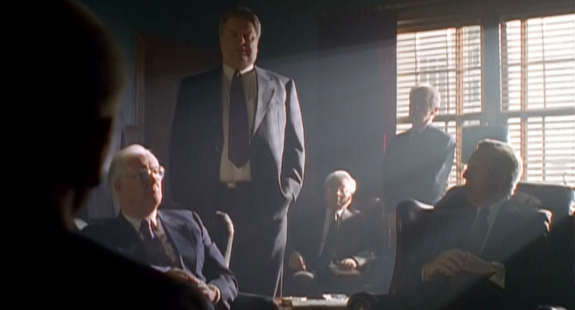
http://vignette2.wikia.nocookie.net/villains/images/6/6d/X-files-the-syndicate.jpg/revision/latest?cb=20140815180522

Perhaps, like me, you turned to The X-Files to learn the truth – that there is a cabal of wealthy, white men in grey suits who function above the law and collude with aliens to plan world domination. These men are known as the Syndicate – they’re in the picture above – just a bunch of guys in suits hanging out in shadowy rooms smoking cigarettes and drinking tea, the stuff of global conspiracy (fyi, a few X-Files spoilers on the way). The men of the Syndicate work with a bunch of aliens who want to take over the world. The men do all they can to ensure the public never knows about this: they plan and enact elaborate conspiracies to ensure abductees, alien sightings and even alien attacks are all covered up and explained away; they have the military at their disposal; they bribe and threaten government officials; they kill anyone who knows too much and often try to kill FBI agent Fox Mulder (who is always one step away from revealing their dastardly plans). In short, they pull an awful lot of the strings of power. But, the thing is, they do it very badly.

Over and over again these silly, old men make mistakes and let things slip. So many of their secret experiments using alien DNA and alien tech go awry and result in many people needlessly dying. Then they have to clean up the mess and kill anyone who spotted the mess, usually Fox Mulder. To conceal their mistakes they have to spend an awful lot on bribes and concoct exceptionally elaborate cover-up stories (often more ludicrous than the actual alient-based truth). Then they have to kill a few more people, including JFK and Martin Luther King, who threaten the balance of power. They also make a very bad team – they don’t trust each other and frequently lie to one another when they fail to successfully ‘manage’ a ‘situation’. So yeah, they’re the ones behind it all, but they’re also a bunch of idiots.

And there are times when I can’t help but think this is quite a good analogy for the real people behind the real system (unless there is actually an alien-government conspiracy and The X-Files was a documentary, not sci-fi). There’s a certain comfort in believing that a group of super-ruthless intellectuals are playing puppet master to the world’s problems and tipping the capitalist military industrial complex in their favour. And yes, there are certainly people doing this – creating/using multiple tax havens, subsidising environmentally destructive industries whilst undermining sustainable energy, investing/trading in weapons. They often do this because they’re greedy and/or it makes “business sense” (i.e. maximise short-term profit at any expense). But is it a joined-up, super smooth system of conspiracy and collusion, I doubt it, I often just think it’s greedy, insecure, selfish people with far too much power doing what greedy, insecure, selfish people do, namely look out for number one. I can’t imagine it’s actually fun being one of these people (“Hey, darling, how was your day?” “Oh, you know, the usual – I hid lots of our money in an offshore account to avoid taxes and I sold a load of weapons that will be used to kill innocent people.”). Certainly, the Syndicate don’t seem to have much fun as they’re constantly paranoid their nefarious ways will be revealed and they spend a lot of time planning how to kill one another. So, maybe those shady characters in that shady room aren’t quite so clever as the conspiracies would have us believe and, in a way, that makes it worse – such a shame that it’s a bunch of idiots bringing about doomsday far too far in advance.

Britain Is Not A Fart

Better In than Out I say. And there are many reasons for it. Human rights, for example, we like those don’t we? And we get a lot more of them when we’re in the EU. Easy holidays abroad. We love them too and we’ll get lots more if we stay in. Greater security from, for example, terrorist attacks as we share intel with other European countries. Greater diversity, more interesting people coming to Britain more of the time to make our lives more interesting (of course, this one might not convince you if you’re a xenophobe). More stability in the West, something that Obama (leader of the Free World) really wants whilst the likes of Putin and ISIS leaders don’t. More jobs, stronger economy, reduced risk of armed conflict…but we know all these things already (and if you don’t check out the Stronger In website), so I’ve got another reason we should stay in the EU: my grandparents would have wanted it.

All my grandparents fought in the Second World War. One grandfather stormed the beaches at Normandy, the other was based at the caves of Malta, one grandmother drove lorries and fire engines around Britain (imagine that, a woman driving a truck, that was a big deal back in the day), whilst the other helped crack the Enigma code at Bletchley Park (but no, she wasn’t mentioned in that film with Benedict Cumberbatch, hmmm). They all contributed to the war effort for the sake of peace – they believed the Nazi threat had to be challenged, and so they did what they thought was right and put their lives on the line.

https://i0.wp.com/d3n8a8pro7vhmx.cloudfront.net/in/sites/3/meta_images/original/Twittershare-01.png

Now, I’m not using this blog to condone war, indeed nothing’s black and white (save zebras and old photographs) and much history has shed complicating lights on the geopolitics of WW2. Secret plots, subterfuge and much anti-Semitism within British politics. So I’m still a big ‘no’ to war but I do think that my grandparents believed they were doing the right thing and I have an awful lot to thank them for. After the war ended the establishment of the European Coal and Steel Community in 1952 was the first step in the federation of Europe, an effort to curb the rise of extreme nationalism on the continent that had led to fighting. Unsurprisingly, my grandparents and many others never wanted to see Europe go to war again. The EU was created to maintain peace.

Of course, there were other motives at play. The Coal and Steel Community is hardly the Culture and Peace Community, it was about business, specifically capitalist business. Opening markets and freeing trade were seen as key ways of ensuring countries stayed on amicable terms. There’s much logic in the idea but when making money takes precedence over making lasting friendships it’s easy to forget why some random village in the south of England is twinned with an equally random village in the north of Germany. Furthermore, when recessions hit and economies get rocky countries all too quickly revert to nationalistic policies (may I refer you to what happened in Europe before WW2 and what’s happening right now).

In many ways the EU has failed us – the bullying tactics that the likes of Germany and France impose on countries like Greece and Spain; the fact that it’s predicated on capitalist growth-based consumer economics (see many previous posts on why that’s a disaster); the undemocratic nature of the Council and Commission; the giant gravy train that is EU bureaucracy (I once met an EU bureaucrat…but that’s another story); the relative ease with which individuals (especially extremist ones) can get into the Parliament solely with an aim to disrupt negotiations, remember Nigel Farage’s shenanigans. The list goes on. But these are not reasons to leave. At a time of huge global problems – looming world war 3, climate change, nuclear threats, terrorism, recession – we need huge global solutions and political transnational bodies like the UN and EU are part of that. They might not be fit enough for purpose but it’s our job to make them better and in doing so make the larger system better rather than blame the likes of the EU for the failings of said system. And it’s what my grandparents risked their lives for and who am I to trash their legacy?

Now, perhaps for the only time, I will give the last word to Margaret Thatcher (full Evening Standard article here): “To come out [of Europe] now, with nowhere else to go, would jeopardise our own and our children’s future … In politics we always have to consider ‘What is the alternative?’ The European Community or what? If we came out now we should be…cold-shouldering our friends…The reasons for staying in…are concerned with the ideal and vision of what we could do together…and with the consequences that would arise for Britain if instead of solving our problems as part of a partnership we withdrew into the unknown…At a time of uncertainty in world affairs, Europe gives us a far better chance of peace and security, and if we want our children to continue to enjoy the benefits of peace our best course of action is to stay in Europe.”

https://i0.wp.com/ichef.bbci.co.uk/news/1024/media/images/66806000/jpg/_66806830_thatchereurope.jpg

Welcome To World War 3

“It’ll probably start on a Friday. What will seem like an attack on America by terrorists or Russia, driven by a well-oiled, well-armed and multi-national group of elites using alien technology that governments have been hiding for seventy years…” Art often reflects reality and this is an excerpt from the trailer for the latest series of The X-Files (my thoughts on this series here). Save for the bit about alien technology it’s a prescient observation of the rapidly escalating violence the world is witnessing right now. And, as ever, the news is bleak.

Terrorist attacks in Belgium, Yemen, Iraq and France. A war in the Middle East that has killed and displaced thousands. Pakistan’s entry into the nuclear arms race. China and Japan’s conflict over the southern islands. An economic cold war between the US and China, the former struggling to maintain its status as world emperor, the latter vying to take that title. The implosion of the EU with a worsening refugee crisis and the rise of the extreme right, including the Nazis. Russia and Ukraine. Islamic State. It almost seems as if the world has never been at peace.

Now, I’m not writing this blog to depress people (although the news is depressing) and nor am I saying we should stop striving for peace. Of course not, if anything, the violence we see in the world is yet another rallying call for the peace movement. However, perhaps what I’m saying is that this isn’t as simple as war and peace anymore – two seemingly time bound and delineated events. World War 2, for example, had a beginning and an end, whilst the Cold War was a far more uncertain series of events it has nevertheless ceased. Yet the legacies of both conflicts live on, so perhaps we could say neither have ended. Likewise, new forms of technology make different sorts of war possible – drones and terrorists navigate borders differently to ground troops and armies. Meanwhile, diplomatic and economic threat can also function as tools in campaigns of imperialism. Often war need not be declared for it to be happening. So maybe it’s not about war ending and peace beginning, maybe it’s about navigating the grey territory in between.

It is not that now more than ever do we need to call on the better angels of our nature because this has always been true – we have always needed the better angels of our nature. Our compassion, care, altruism, love and joy – possessed and enacted by all. Even these angels might not prove to be enough but I’d question the notion of enough anyway – is enough when all fighting ever has ended, is enough when climate change has been abated, or is enough just doing the best we can in the time we have? I’d love to see world peace enacted and global warming avoided but the reality I’m living through is very far from that. And yes, that makes me despair, but no I won’t stop blogging! And to conclude here’s The X-Files trailer in full. However, I’d like to categorically remind everyone that the world’s problems will not be solved by one FBI agent called Fox Mulder – instead we all need to channel our inner Fox Mulders to step up to the challenge. Or just avoid X-Files metaphors entirely as it’s a pretty ludicrous programme.

https://www.youtube.com/watch?v=_1SmJUBT5q0

Sorry, That Job Went To A Robot

Back in the 1810s a group of skilled self-employed weavers bandied together to take a stand against the new wave of weaving technologies that was being introduced. These included the power-loom and the spinning frame and all would require less-skilled labour to be used. The self-employed weavers were worried they would be out of a job. So they got to breaking these technologies in calculated acts of protest and called themselves the Luddites – arguably a reference to Ned Ludd who smashed some stocking frames back in 1779. And now, hundreds of years later, it’s not a power-loom that will force many people into unemployment, it’s robots.

Drones will deliver post, robots will run warehouses, automated check-outs will bleat at you to ‘insert your card’, Excel will do your accounting, a new piece of software might even paint a picture for you and cars will drive themselves. And what for the people who used to do these blue and white-collar jobs – they’ll have nothing to do. Some call them ‘pointless’ or ‘useless’ people, which is a glib way of acknowledging that history appears to be an endless case of efficiency taking precedence over people. But there’s nothing efficient about a society full of unemployed and unhappy people, the sort of people who might take arms against robots and start smashing.

Meanwhile, those with vested interests will laud the oncoming industrial revolution saying it’s the greatest opportunity humankind has ever had for advancement. I imagine similar things were said about nuclear energy. The zealots of this movement will barely be able to contain themselves knowing that their latest Amazon package will be flown to them via drone or they’ll be able to upload their memories into a robot (yup, Ray Kurzweil would love this). It’s worth remembering that these people will probably be rich and very far removed from the worries and realities of poverty and unemployment. They might also have not have asked if there are actually enough resources on earth to robotise everything.

So, what to do? Firstly, don’t take any of these stories at face values whatever the predictions – nothing goes as planned. Secondly, if the elites get what they want and society becomes increasingly automated (as it already has done) we must ask what it means to have a world without labour (or, at least, human labour) – what does this mean for feelings of self-worth considering they are so often tied to the work we do and what does this mean for the Labour party itself, founded on the rise of the working classes? Thirdly, this isn’t really about machines and robots, this is about power, people and how we treat each other. A Universal Basic Income is just one way of ensuring everyone gets paid even if they don’t work. Although the right wing, if they were to implement something like this, would probably use it as yet another excuse to strip back the state and weaken public services but what’s the point of a UBI if you can’t afford medical care and other necessities?

So the future is still there to be fought for. It’s not a foregone conclusion and the stories the vested interests weave don’t have to become self-fulfilling prophecies. We can challenge power, as hard as it is, and create a fairer world for all, with or without robots. Basically, it doesn’t have to end up becoming like this…

Why Life Is Like Monopoly (And Not A Box Of Chocolates)

So, you’ve got £200 in your pocket and you’re ready to Go. London unfolds before you – its Victorian terraces, towering skyscrapers, penthouse apartments, silver dogs and prisons. All that saving and you might finally be able to get a foot on the property ladder, it’s what you’ve always dreamed of. Yup, just a typical game of Monopoly, except this time I’m going to bend the rules a little to show the parallels between the board game and the game of life.

https://i0.wp.com/pic.lifetmt.com/2014/07/logo-monopoly2.jpgLet’s say there are 6 players and everyone is ready to get going. You, player 1, full of hope and aspirations start the game with £200. Next to go is Archibald, player 2, who already has £2,000,000. Why does he have such a high amount? He inherited it from a previous player. Whereas you’ll have to work hard to earn your cash Archibald will barely have to lift a finger. Unfair? Yup. That’s life. So, you keep trundling round the board just waiting to be able to buy your first little piece of land. However, it turns out Hugo, player number 3, is a member of one of the few land owning families in the country and it just so happens that his family already own a whole load of London. This means you won’t actually be able to buy the land you’ll just be able to rent it off Hugo’s family. Furthermore, because Hugo’s family have been hoarding land for so long it has become an increasingly scarce resource, meaning it’s very, very expensive because so many people want it. Better get moving round that board.

Fortunately, Hector, player number 4, is the banker and he’s there for you. He gives you £200 every time you pass Go to help you get your first foot on the property ladder. Of course, it’s not free money, it’s actually a loan and because the system isn’t that well-regulated Hector’s happy to keep loaning you money, he’ll even give you a mortgage, even though it’s unlikely you’ll be able to repay it. He also turns people’s dodgy mortgages into investment opportunities for rich people who want to get richer. Multiply this process by millions of people and when they start failing to pay off their mortgages the whole system comes crumbling down and lots of people get in debt, including you player number 1. Fortunately, Hector knows Bertie, player number 5, who is a politician, and rather than get Hector fired or even put in jail for corrupt behaviour he actually bails the bank out with public money – that’s right, he takes some cash from your hard-earned stash and gives it to Hector.

So, strapped for cash, in debt and struggling to get by you decide to make a stand. You wave a placard, you shout a slogan or two, you appeal to the better angels of people’s nature in the hope to make the system fairer. Enter Bobby, player number 6, he’s a policeman and he’s got no time for the likes of you. In fact, Bobby likes to uphold the rules of the game and he’ll lose his job if he doesn’t. So it’s off to prison with you for being a troublemaker. That’s what you get if you challenge the establishment and try to change the system. And let’s not forget some of the other players who haven’t been mentioned including Eric, the accountant and consultant who advises Archibald and his rich friends on how to avoid paying taxes; Rupert, who runs the newspapers and happily prints articles on how terrible and greedy poor people are whilst lavishing praise on the rich; and even quiet and unassuming Peter who actually works at MI5 and enjoys spying on groups of ‘subversives’ who think climate change and capitalism are somewhat problematic. He’ll happily team up with Rupert, Bobby, Bertie and the rest in order to keep the establishment in place and the masses at bay.

https://i0.wp.com/politicaloutcast.com/wp-content/uploads/2013/08/monopoly_money_100.jpg

Life, like a game of monopoly, seems to begin and end with money. People endlessly trudge around the board of life trying to make a decent living but there’s nothing decent about money, the system is rigged from the outset. It could take someone many lifetimes to earn what some people inherit at birth. Money is not fair – it is a scarce resource that is unevenly distributed and yet it’s the item we use to access key resources including houses, land and food. Thus, objects that could be in abundance (there’s enough food on the planet to feed everyone for instance) are forced into a system of imposed scarcity making it doubly hard to get by – first you’ve got to work to get a living just so you can get the money to buy the actual things you need. Perhaps you’re thinking what I’m thinking? That it’s time to change the rules of the game…

The Big Short: Another Film About Bankers

Some big spoilers on the way for the new film The Big Short – perhaps the biggest is that the 2008 housing crash and ensuing financial crisis happened and, as Ryan Reynold’s character reminds us at the end of the movie, it was immigrants, poor people and teachers who were blamed for it rather than bankers, regulators and hedge fund managers.

The Big Short is another film about bankers. Following closely on the heels of The Wolf Of Wall Street this film doesn’t set out to glorify the world of finance instead it explains why the financial crash happened. And it did this brilliantly. Some of the best bits came when the camera suddenly panned to a random celebrity who explained some complex financial instrument using a simple metaphor. Mila Kunis placing a bet at a poker table was used nicely to explain that the housing market was basically a series of increasingly risky bets placed on whether people would be able to pay off their mortgages (yup, bankers will find a way of making money from anything). Of course, given that the housing market was fraudulently and corruptly regulated and so many people who couldn’t afford to were being sold houses, it was only a matter of time till it collapsed. And this resulted in a simultaneous financial crash because so many ‘crafty’ bankers had been betting on the aphorism “safe as houses” remaining true. Turns out houses weren’t that safe at all.

The Big Short is about the men in the middle of it all – the few men who bothered to do their research and uncovered a system of corruption, fraud, greed and stupidity. And what did they do then? They bet against the housing market – they hoped that houses wouldn’t prove safe – and they made a lot of money. Of course, housing crises have more than financial repercussions – evictions, homelessness, unemployment, debt, social unrest, poverty and suicide are just some of the consequences. The film mentioned these things in passing but was more interested in telling a story of a bunch of wealthy, predominantly white, male hedge fund managers (another word for banker really). They even try to paint these men as morally superior because so many of them were shocked at how corrupt the system was, the system that they made lots of money from when it collapsed.

Yup, the film tried to make heroes out of hedge fund managers – people who get rich and get their clients rich by making money from money, by betting on the market. People who are rich enough themselves that they don’t need to worry about the implications of a housing crash. But they do, as do we all. Because after the crash governments around the world used public money to bail out the banks and didn’t do much to regulate them. So we can be expecting another housing crash anytime soon. And it’s not just houses at stake it’s the whole of society too – as public services are cut, as immigrants are scapegoated, as poverty and unrest rises, as extreme right-wing groups like the Neo-Nazis return, so darker days are coming. Remember what happened a decade after the huge financial crash of 1929…World War 2. I don’t know if we’re due another huge war but I do know that The Big Short barely scratched the surface of the issue. It explained the financial crisis very well but it could have done this in half an hour, but, like so many films today, it chose to focus on the actions and faces of white men with the occasional shot of a topless woman. It is a shame to realise that so many uninspiring, greedy and fairly stupid men were involved in bringing the world’s economy to its knees but do we really need another film about them?

Money Makes The World Go Round

In my previous blog You Don’t Own Me I cited the work of anthropologist David Graeber and his very big book Debt: The First 5000 Years. It’s not quite 5000 pages long but in his tome he explores the origins of money in debt, war and slavery. He suggests that debt existed before money and human societies have been divided between debtors and creditors for a long time. Debt peonage is when someone has to pay off their debts by working for someone else (i.e. if they can’t afford to pay off their debt with cash). It’s also known as debt slavery and people have been doing it throughout history – the priests of Sumerian temples would make peasants work the land and pay with produce in return for being able to live on the land and the Romans would often enslave those they captured and make them work in their houses. Slavery is the ultimate form of ‘ownership’ whereby someone has complete power over someone else’s life (the slave ‘owes’ their life to the their master). However, slavery wasn’t the only way to increase one’s power, money was also a good mechanism.

Let’s say the Roman Empire is expanding and they’ve just conquered Britain, the Roman Emperor won’t want to kill all the Britons because not only will many of them make good house slaves but they can also be used to ensure the British economy keeps going. Of course, that’s a British economy that now serves Rome. What the Emperor does is issue all his soldiers with Roman coins which he can let them spend in Britain. The soldiers will be expected to pay tax and they have to do that with Roman coins, so coinage in this regards is a good way of ensuring the soldier’s money goes back into the Roman Empire’s economy. Meanwhile, the Britons that haven’t been enslaved will want to attract the custom of the soldiers so they’ll get busy making and selling stuff for the soldiers, which will be paid for with Roman coins. Furthermore, the Emperor might also wish to impose a debt on Britain – the war machine costs a lot of money and invading Britain proved quite expensive, so he’ll make them pay it back. Yup, the conqueror is enforcing a debt on the people he just conquered. He can do this because he’s the winner and he’s got all the power in terms of brute military strength (the soldiers) and economically (in terms of all the Roman coins). So this is how you grow an Empire – conquer people, expand your currency and force your conquests into debt. It adds a twist to the famous phrase “man is born free but everywhere he is in chains”…or in debt perhaps.

And so on and so on for thousands of years argues Graeber. Even now we still live in a time of debt – whether it’s the banks offering giant loans to help people buy houses or it’s the World Bank loaning money to developing nations to help them get on their feet whilst ensuring they’ll be in debt for years. However, things are different now because the value of a currency is no longer defined in terms of some underlying precious material (i.e. gold) for which it could be exchanged. It’s not as if for every £5 we have there’s a £5 amount of gold hidden in a vault somewhere. We don’t have real money anymore, instead we have virtual money that exists as numbers on a screen. Sure, we still use coins and notes but those things themselves are worthless, it’s what they stand for that counts. However, as money is virtual it theoretically means there is no limit to how much money we can have – numbers on a screen are limitless after all. So we can keep spending more and more and getting in bigger and bigger amounts of debt for longer and longer, hurrah!

But why this brief history of money? Because money has been and continues to be a big deal – it makes the world go round, or so Liza Minelli sings in Cabaret. Currently, the US dollar is the most powerful currency in the world and the States put a lot of effort into ensuring it remains so (read that as military force, foreign policy and diplomatic effort). Money is one of the most important numbers we’ve got – it’s how we value almost everything, from the price of a lemon through to the price of an hour of someone’s labour. And because money has been such a big part of our societies for so long its effects have reached far beyond the economic realm into the political and personal realms as well. To be continued…

You Don’t Own Me

Grace, the Australian singer, recently covered Lesley Gore’s ace 1963 single You Don’t Own Me and it sure gets the feminist feet stomping. Each inspiring verse is interspersed with some sexist thoughts from rapper G-Eazy (Sl-Eazy more like it) as he tries to assert his male dominance over the woman he “would love to flaunt” as she’s not one of your average “basic bitches”. Indeed, she’s the “baddest ever…Never borrow, she ain’t ever loan, That’s when she told me she ain’t ever ever ever gonna be owned.” Then Grace blasts back with a booming chorus and puts Mr Misogynist back in his place. But all this singing of possession makes me wonder exactly what ownership actually is?

Why is it that Grace needs to assert that someone else does not own her? How could the scenario even have arisen in which people come to think that they actually own others? Part of the answer (and I reckon quite a big part) is, unsurprisingly, to do with money. As a brief scan of anthropologist David Graeber’s 500+ page book called Debt reveals, money has played an integral part of human society for hundreds of years. Economists tend to tell us that money came into being when barter systems got too confusing – if I give you ten oranges, three pigeons and a mug in return for a pair of shoes, two bananas and a kitten…but instead of all that faffing about with oranges and bananas a different system of exchange was introduced whereby something came to act as a store of value. It could be a coin, a rod of iron or a piece of paper, as long as everyone agreed that the values remained consistent and commensurate over time.

But, argues Graeber, that fictional land of peaceful and friendly barter didn’t exist, as least not on a large-scale. Instead, he argues that money grew out of debt. Take the Roman Empire for example – when they invaded a new territory they would often turn their captives into slaves. Slavery is the ultimate form of ownership as it rips someone from their social context and ties them to someone else. The alternative to being enslaved was basically death or slowly, slowly buying back one’s freedom by working long and hard enough. A slave owed their life to their master but only because the master had the power. Money itself is also debt. On a £10 note it says: “I promise to pay the bearer on demand the some of ten pounds.” The actual piece of paper is worthless but it’s what it stands for – i.e. that these items or services are all worth £10. Money is one giant system of IOUs. However, it’s clearly not an arbitrary system because there’s a whole system of banking, policing and law-making  to ensure that people pay their debts.

So, concludes Graeber, behind money is debt and behind debt is power, and the history accords with this – the economic power of the Roman Empire depended on its military strength because it had to have a way of enforcing its debts, having a giant army helped with this. And something similar is true today, only those with power can call in their debts and this power usually involves violence or the threat of it. G-Eazy says that Grace is an independent woman “All because she got her own dough, Boss bossed if you don’t know, She could never ever be a broke ho”. And that certainly is one way of getting out of slavery, by making lots of money, but humans existed long before money and whilst we do put a price on freedom and maintain that price with force it’s still just a system of belief, albeit a very powerful and tragic one. But maybe there’s a different way. More ideas to come, in the meantime here’s the original, without G-Eazy offering us his sexist thoughts in between the good bits.

How Can We Help Jeremy?

Jeremy Corbyn, Labour leader as of yesterday, has a big task ahead of him – to challenge and change the economic and political status quo, to unite the Labour party, to endure the slings and arrows of an often outrageous press and to somehow continue to get away with wearing pulled up socks and sandals. So, sartorial advice aside, what can we do to help?

Fortunately, the answer is simple – we can do exactly what Corbyn is doing – utilising the power that he’s got to make a difference. Most of us aren’t leading a political party but I’m sure we’re all doing things – we might write blogs, we might volunteer in our local community, we might have drinks with mates down the pub, we might watch Bake Off, we might tweet. Fortunately, all of these provide opportunities to exert the power that we do have to engage with the shift in politics and economics that Corbyn is calling for.

For example, we can write blogs on issues that we’re passionate about; we can chat to the people in our community about the things they care about and how we can support each other; we can offer inspiring visions of a better future to our mates over a pint (and if they challenge us we can calmly remind them that this change is for the best, what’s not to like about greater equality and prosperity!?); we can get inspired to bake cakes for our friends (and decorate them with the Labour flag); and we can tweet stuff too.

This may all be incredibly obvious but I really think it can be that simple – for too long a narrative of individualism, self-interest and cynicism has told us we’re worthless and trying to make a difference is pointless. But it’s just not true, we all have power and we can all use it for good. It might be something incredibly small – a tweet – or something bigger – a cake – but all these things add up. We need community again, we need to start working together, whoever we are and however small the action. And even if it’s just a drop in the ocean what is an ocean other than multitude of drops.

Thanks to Corbynmania politics is finally getting political again – we’re not just being forced to believe some monomythic, dubious status quo there’s actually room for debate. We can get political too by getting clued up on the issues and chatting about them. We don’t have to get it right but starting to investigate the issues is better than not starting at all. We’ll find that beyond the narrative of individualism and self-interest there are many other ways of doing politics and economics, ways that can be inclusive, inspiring, empowering and, most importantly, fun. Understanding the details of the bigger picture can inform the stuff we do at a local level, gradually (or perhaps surprisingly quickly) shifting our politics in a new direction. So many factors and contexts affect the societies we live in and it’s vital we begin exploring them. And that’s how I hope this blog can help. Time for an uplifting video about positive change…

Corbyn: In The Box To The Left

Corbynmania is exciting stuff. It seems there’s actually debate to be had when it comes to politics. People are discussing things rather than just accepting the Tories’ line of austerity, tax breaks for the rich and cuts, as if these are immutable truths. Jeremy Corbyn, front-runner for the leadership of the Labour Party, is leading the debate and offering an alternative politics – one of hope. But it was Beyoncé who told her ex to put everything he owns in the box to the left and my concern is that Jeremy Corbyn is being resigned to that very same box.

One thing Corbynmania proves is that the Conservative victory at the last general election does not spell the end of politics. We are not consigned to a future of corporate giants crushing communities, endlessly bailing out big banks and the poor getting poorer until climate change melts us all, no, it seems politics could still shift leftwards – back to a bigger state that dares to close tax loopholes, challenge corporatocracy and reduce inequality.

But this isn’t enough (even if it happens). If we really want to change society for the best then we must recognise that some of the big issues we face are so much bigger than left and right-wing politics. For example, to address climate change we cannot just cut carbon emissions and green consumer capitalism because woven into the fabric of our political-economic system is an inherent flaw: it depends on endless economic growth on a planet that offers finite resources. As the name suggests a growth based economy has to keep growing to function but, as we saw with the banks, when things do get too big they can fail, except rather than just a financial system collapsing, rampant globalised capitalism threatens the very earth itself (imagine an impossible hamster getting bigger and bigger until it eats the whole world).

Whether you go rightwards to a smaller state and bigger corporations, or leftwards to a bigger state and smaller corporations, neither approach will tackle this underlying threat because both take capitalism at face value – they just have different ways of dealing with its problems (Labour tend to be nicer to the poor whilst the Tories like to ignore them). Corbyn hints at transcending party politics when he talks of distributing power beyond the state to include communities as well and certainly a push towards peace over arms proliferation could recognise that one of the many reasons we go to war is to ensure our economies can keep growing (the arms industry being a great example of the illogics of growth based economics because so much of the stuff it makes gets destroyed but this is a good thing for the economy because it means more stuff can be built to replace the old).

Corbynmania is exciting stuff. He’s diversifying and opening the debate, putting the demos back in democracy, but that doesn’t mean he’s answering all the questions which is why we’ve still got to keep asking them. We can’t let him get trapped in the box to the left because questioning our tired, destructive political-economic system in its entirety means transcending the left and right debate. Having enjoyed Beyoncé I’ll now leave you with a nice video of that impossible hamster I mentioned earlier…