The Referendum Wasn’t Real

This is my 100th post and I’d planned the title to be “what’s the point of this blog?” and given the UK’s decision to leave the EU I think my comments on that might answer the question anyway. But, first things first, the Referendum wasn’t real, what’s that all about? OK. It was real, devastatingly so. It is already having vast emotional, social and economic ramifications. As Britain ‘goes it alone’ the pound has plummeted in value, the economy is wobbling and a shift to the right in mainstream politics is underway with the likes of Boris Johnson and Michael Gove vying for power. Extremist right-wing parties like Ukip and their European counterparts are claiming this as a victory for xenophobia and hate. We’ve even recently witnessed one act of right-wing terrorism claim a life, that of Jo Cox. Uncertainty is rising as hope takes a blow to the chest. Yet, for all this, how can I claim the Referendum wasn’t real?

Because from the outset it was a farce. Firstly, democracy was boiled down to a single multiple choice question with only two answers, In or Out, that few people had actually wanted to be put to the public. This doesn’t respect the multi-faceted and multi-partied nature of our democracy it just promotes further divide and hostility as friends and families suddenly found themselves forced to pick a side. And asides for a select few bureaucrats in Brussels and maybe one or two British politicians no one, absolutely no one (myself very much included) could vote with a sufficient degree of knowledge – there are documents of tens of thousands of pages outlying all the treaties and clauses amassed over the decades Britain has been part of the EU and I certainly haven’t read them all. It’s funny that people were suddenly and arbitrarily forced to get knowledgeable and passionate about something they had not seemed to care that much about before.

Meanwhile, people who’ve lived in this country and contributed to its economy for longer than I’ve been alive weren’t allowed to vote. Teenagers weren’t allowed to vote even though they have more future to lose than the rest of us voters. Both campaigns used tactics of fear, hate and misinformation (aka lies) to cajole and manipulate. We’ve already seen Nigel Farage swiftly distance himself from the Leave pledge of £350 million to the NHS (but did we really think neoliberal parties would do an about turn on their views of the welfare state?). There were campaign posters that bore too much resemblance to ones used by Nazis and the media played on xenophobia, fear and outdated nationalistic sentiments to make people think that voting in the referendum was the equivalent to taking some sort of significant stand (it wasn’t, it just makes it easier for the rich to get richer whilst deepening austerity and rolling back the welfare state). Somehow the woes of neoliberal, consumer capitalism (see the rest of this blog for criticisms on that) were landed on the heads of some of the most powerless, namely refugees and immigrants, and a bunch of pro-establishment, old-Eatonians managed to dupe large chunks of the country into thinking voting Leave would lead us into a wonderful British revolution rather than entrenching inequality and recession. That being said, lots of utopic left wingers were somehow led to believe Brexit would yield a land of milk, honey and socialism (my fingers are still crossed). And let’s not forget why this referendum even happened in the first place: because David Cameron wanted to be Prime Minister and he needed the support of his more right-wing back benchers to get it, so he promised them a referendum to appease them rather than having the courage to say ‘no’ (he put it on our heads instead). That’s not democracy, that’s cynical party politics at the public’s expense.

So, yes, the referendum is real and it has happened and this is a rallying call for anyone of whatever political persuasion and however they voted in the referendum to choose peace and oppose the rise of extremism and the violence that goes with it. But, no, the origins of this referendum were neither hopeful nor fair nor democratic. So whatever people say, this was not a victory for the British and the public have not spoken because there was only 1% in it. Like austerity, the referendum is a story wrapped around an agenda. Many desperately believe in it, many just cynically use it to get more power, many misguidedly want it to become true in ways it never will but it is not ‘the truth and nothing but the truth’ it is just one story among many. Unfortunately, it is a very powerful story and its repercussions will prove fatal for many. But Britain has survived two world wars and I think we can survive this too. Now here’s Lady Gaga because why not 😉

Befriending Brexiters

I walked out of Dalston Kingsland overground station on Saturday into a brief spell of sun. Blinking back the glare the first thing I saw was a friendly looking young white man with floppy brown hair offering me a big smile and a red pamphlet reading LEAVE. Yup, a Brexiter, one of those terribly charming and polite people who wants Britain to leave the EU and ‘go it alone’. Here was my moment, I thought, my chance to engage with the ‘enemy’ and convert him to the Remain cause.

We offered one another friendly hellos and I asked him how he was doing. It transpired he was doing well. I thought I’d meet his friendliness with the like and I said that I’d love to hear more about his argument. He told me that his main reason for supporting Leave was financial, he believed we would have a stronger trading position if we left. I nodded and then mentioned Ngaire Woods, the Founding Dean of the Blavatnik School of Government and Professor of Global Economic Governance at the University of Oxford, and what she had said about Britain’s trading position being weaker outside of the EU (see video). He said he hadn’t heard of her.

https://www.youtube.com/watch?v=RHFp3-qE_T8

We carried on in this amicable style for a while as he said one thing, I said something else, then he offered more, and so on and so on until I realised I didn’t stand much of a chance. Not only did I not have enough facts at hand it seemed that for every one I did he had a counter argument. I figured that the likelihood of me convincing him to change his view was low given my limited information and the fact that he was on the street on a Saturday afternoon handing out Leave leaflets – he must be quite committed to the cause.

Instead I told him that I feared leaving the EU would legitimise and worsen the rising levels of violence in the country, violence that stems from extreme, right-wing views about who does and does not deserve freedom from violence. I mentioned the tragic death of Jo Cox at the hands of a man who shouted ‘Britain First’ as he attacked her. I mentioned the rise of the neo-Nazis throughout Europe and how some pro-Brexit people I had spoken to expressed overtly racist views. He looked a little concerned and assured me he wasn’t racist. I believed him. Then his colleague came over carrying yet more LEAVE leaflets and he introduced me to her. We offered one another polite hellos. I told them I had to go, I had a conference to get to, but I said that whilst I would still vote to Remain, whatever the result, it was all of our responsibility to stand up to racism, discrimination and violence. We would have to put aside our political differences (he told me had previously voted for the Lib Dems and later the Tories) and work hard to ensure equality and peace were prioritisied in our country. They both nodded emphatically and as I walked away I heard him say to his colleague that I was “one of the better ones”.

So what had I achieved? Not a lot as I’m sure most of you would observe and you’re right, I hadn’t made them change their minds but maybe I had made them think twice. The task ahead for all of us – peace in our time and peace on earth – is something that transcends political persuasion and that we can all be a part of. And maybe in that brief conversation whilst I hadn’t got them to about turn I might have surprised them, if I was one of the ‘better ones’ I wonder what some of the other Remainers were life. The Referendum, like so much of party politics, is designed to fracture and split but we have to challenge this, we’re humans before we’re Tory, Green or Labour. And if dark times are ahead, which they certainly are, then we’re going to need to make a lot of new friends.

If You’re Not Gay It Does Make A Difference

“The worst mass shooting in modern American history was also a hate crime against the gay community. It’s not the first time LGBT (lesbian, gay, bisexual and transgender) people have been the targets of violence.” BBC News.

For more information on the recent hate crime in Orlando that claimed 50 lives please read this article and then search for more. For this blog, however, I want to focus on the guardian journalist Owen Jones’ appearance on Sky News to discuss the atrocity.

It does not take long for an argument to arise between Jones and Mark Longhurst and Julia Hartley-Brewer. Jones works hard to ensure that all present acknowledge that this is a homophobic hate crime and act of terror. He describes it as “one of the worst atrocities committed against LGBT people in the western world for generations.” This is a statement of fact yet Longhurst and Hartley-Brewer don’t get it. Longhurst tries to ignore the LGBT angle by saying it was a crime carried out against “human beings” and whilst this is, of course, true, the point is that Jones is trying to focus on the homophobia inherent in the crime. Jones repeats his statement but Longhurst nullifies it again by refusing to recognise the anti-LGBT nature of the crime and talks instead of “the freedom of all people to enjoy themselves.” At which point Jones comes out with the zinger, “You don’t understand this because you’re not gay.” Longhurst disagrees vehemently and Hartley-Brewer tells Jones that he does not have “ownership of horror of this crime because [he’s] gay.” These minutes of ignorance and miscommunication are vital in derailing the rest of the press preview as the three continue to argue before Jones becomes largely silent and the conversation moves away from the LGBT community to gun control and the perpetrator, even after Jones said there has been a distinct lack of press coverage on the homophobic nature of the violence.

I hope you, whatever your sexual orientation, can see the problem here. Jones offers the scenario that this attack might have taken place at a Synagogue and if it had done then it would be clear that anti-Semitism was one of the overriding motives for the attack. If then, a Jewish person was discussing how distraught they felt at the attack it would not be for anyone else to tell them that the attack isn’t about Jewish people, it’s about people. This would totally devalue what the other person is saying and, crucially, what they are feeling – that a community they are part of has suffered a dreadful attack. We are all very different people and members of very different communities and the simple point is that whilst we can speak for ourselves and our own experiences of the world we cannot speak for others. It is not for me as someone who is not Jewish to speak on behalf of Jewish people, nor as someone white to speak on behalf of black people, nor as a man to speak for women. Instead, I can try to understand the different trials facing other groups and offer my support.

That is what I attempt to do with some of my posts and whilst I try hard not to speak on behalf of others I realise I might fail but I am always happy to learn how to do it better. Neither Longhurst nor Hartley-Brewer appear to show much sympathy for the LGBT community, they spend more time talking about the perpetrator and gun control, it is only Jones who talks about it. And even though the others both identify as ‘not-gay’ during the preview neither sympathise with what Jones is saying and instead attack and criticise him. They both had an opportunity as presumably straight people to speak and act in solidarity with the LGBT community and they both missed it. And this is a shame for so many reasons not least because the LGBT community needs a lot of solidarity right now.

So yes, it does make a difference if you’re not gay – it means you might never have a same-sex relationship, it means you might never be discriminated against for your sexual preferences, it means the attack in Orlando was not an attack aimed at a community you are part of. But it doesn’t mean you can’t support us. The full acronym I use is LGBTQIA – Lesbian, Gay, Bi-Sexual, Transgender, Intersex, Asexual. However, I think there needs to be another A, an A for Ally.

Captain America v. Iron Man: Humans Amongst Gods

Gods have been and continue to be a big deal. For millenia many people have worshipped one god or many gods. Whole cities have been built in honour of the gods and many a war has been fought over whose god is better. Much good has been done in the name of gods as well. Unsurprisingly, gods play a big role in culture too – in the Ancient Greek theatrical classics that still get performed today, in iconic imagery from Botticelli’s Venus to Charlie Hebdo’s cartoons and in cinema. And if ever there was a modern film about decidedly modern gods it’s Captain America: Civil War.

The trailer speaks for itself but to give a brief summary: basically the United Nations want to pass a new law that would ensure the Avengers (Captain America, Black Widow, Iron Man, the bird guy, the big green guy etc) cease being a private entity and come under the remit of the UN. They want to do this because humanity is fed up of the amount of collateral damage the Avengers cause. Sure, they destroy nasty baddies hellbent on bringing about the apocalypse but they also cause a fair amount of unnecessary death and destruction. Iron Man thinks this is a good idea because he’s getting a bit jaded and all the civilian deaths are making him feel a bit guilty. Captain America disagrees – what if the UN have their own agenda? Bureaucracy takes too long, what if they have to respond quickly to a some mad, killer robot – they can’t wait around until the UN ratifies it? Naturally, a disagreement between the Avengers isn’t settled at a table – unless that table is a death match arena rammed fulled of explosives. Yup, lots of fighting ensues, and that’s basically the film.

Between the falling buildings, metal suits and impressive gymnastics there is actually quite an interesting underlying philosophical question at the heart of Civil War – who are the powerful responsible to? If we zoom back to Ancient Greece we’ll remember the stories of the gods on Mount Olympus – vain and selfish superhumans who argue a lot. There was Zeus with his homing lightning bolt, Hermes with his flying shoes and Poseidon with his tidal waves. Civil War takes a similar stance: the gods (aka the Avengers) tend to be vain and selfish and they do argue a lot. They also have extremely advanced weapons with rocket launchers big enough to match the size of their egos. And the question remains – who are the powerful responsible to? Should they be answerable to the UN, a decidedly mortal organisation, or to themselves? The answer kinda depends on whether you prefer Captain American with his funny, spandex suit and bouncy shield or Iron Man with his metal armour and power punch.

Of course, fictional superheroes aside, we must ask this question of ourselves to. The power of our technology and weaponry is immense. We have surpassed the Greek gods – homing missiles instead of lightning bolts, fighter jets and drones instead of flying boots, and atomic bombs to create our own tidal waves. And it won’t be long till our soldiers wear flying metal suits. We are humans amongst gods. And who do we answer to? The obvious answer is the people – the ‘demos’ of democracy. But the powerful have a habit of overlooking the lowly civilian, just like the Greek gods and the Avengers – when their petty rivalries get out of hand it’s the human world that suffers as a consequence. So, let Civil War be another warning to us – that the power of the powerful needs to be curbed because they really can’t be trusted. They’re basically just adult sized toddlers with a-bombs.

Why Are The Nazis Still Here?

On 1st May in Borlänge, central Sweden, Tess Asplund walked out into the middle of the road with her fist raised. There were 300 men walking towards her. They were the Nordic Resistance Movement – a group of racist, anti-semitic neo-nazis. “It was an impulse,” Asplund said, “I was so angry, I just went out into the street. I was thinking: hell no, they can’t march here! I had this adrenaline. No Nazi is going to march here, it’s not okay.” The photograph of Asplund has gone viral and she has received a lot of praise for it as well as a lot of hate (full Guardian article here). I find what Asplund did hugely inspirational but it saddens me that she needed to. I just can’t understand why, in the year 2016, the Nazis still exist.

https://i0.wp.com/i.dailymail.co.uk/i/pix/2016/05/03/16/33CB3C4C00000578-3571113-image-a-32_1462287610188.jpg

The last time we saw the Nazis rise to power was in 1930s Germany. The Wall Street Crash happened in 1929 and the Great Depression ensued. The Weimar Republic (in Germany) slipped from prosperity into poverty as inflation rose drastically and living conditions plummeted. So fertile ground was created for hostility, anger and rage. Hitler and his party used the worsening economic climate to fuel hatred. They scapegoated Jews and other groups, and blamed them for Germany’s woes. We know the rest of the story. It is violent and tragic. And the legacy lives on. There are still far too many Nazis (and other far-right groups) who feel they can gain identity and meaning through hatred and violence. Following the financial crash of 2008, the ensuing recession, imposed austerity, we see living conditions worsen and the social fabric start to fray. Again, the Nazis are using this as an excuse to scapegoat others whilst purposefully ignoring the wider economic problem.

Capitalism is predicated on growth and speculation. As a market grows (say the housing market) so it gets speculated upon and a bubble grows. During this ‘boom’ time governments can spend more on public services and people have more cash in their pockets. However, markets can’t grow forever and eventually bubbles burst. During the ensuing ‘bust’ period cuts are made, austerity imposed and people’s ready cash starts to vanish. The system is unsustainable and no resilient society can be expected to thrive in the long-term on such shakey foundations. However, politicians and various political groups cynically use these worsening conditions not to critique the larger economic system but to garner more political power. They play on people’s prejudices and pretend that a certain group is the problem. This group, they argue, needs to face hostility and violence and then our problems will go away.

But it’s not true and we all know it, even the neo-nazis. We all crave meaning and purpose and it’s a very mad world in which people find that meaning and purpose in violence. Yet these narratives of hate can be challenged. Not only do these narratives lack economic and political validity they also, clearly, lack compassion. Yet the action of Tess Asplund, whilst full of anger as she says, was also full of compassion and hope – hope for a better world that does not tolerate violence. Hope for a world where democracy does not mean pandering to groups who wish for murder and genocide but empowering groups who call for justice and love. Asplund had no idea the video of her protest would go viral. She acted purely in the spur of the moment and has been hugely surprised at what has happened since. She doesn’t claim to be a hero and wasn’t trying to be, she was just standing up for what she thinks is right. We can all do this. However big or small our actions count. Resisting hate is totally worth it.

https://i0.wp.com/media.lenearonsson.se/2015/02/tant-med-v%C3%A4ska.jpg
“The lady with the bag” taken by the photographer Hans Runesson in Sweden in 1985. She’s hitting a member of the neo-nazi Nordic Reich party.

I will leave you with an extended quote from the German economist Silvio Gessell. He wrote the below in 1918 after WW1 yet its relevance still applies. “In spite of the holy promise of people to banish war once and for all, in spite of the cry of millions “never again war” in spite of all the hopes for a better future I have this to say: If the present monetary system based on interest and compound interest remains in operation, I dare to predict today that it will take less than twenty-five years until we have a new and even worse war. I can foresee the coming development clearly. The present degree of technological advancement will quickly result in a record performance of industry. The build up of capital will be fast in spite of the enormous losses during the war, and through the oversupply [of money] the interest rate will be lowered [until the money speculators refuse to lower their rates any further]. Money will then be hoarded [causing predictable deflation], economic activities will diminish, and increasing numbers of unemployed persons will roam the streets…within these discontented masses, wild, revolutionary ideas will arise and with it also the poisonous plant called “Super Nationalism” will proliferate. No country will understand the other, and the end can only be war again.”

It’s All About The Money

Debt and money, two mainstays of human economies for many hundreds of years. Even without money people can still get in debt: with debt creating a two (or more) way relationship between a debtor and creditor, between the person owing something and the person who leant it. Without cash people might end up paying off their debt by giving hours of their labour, their property or their body. Money just facilitates this process, whether it’s cash in hand or digits on a screen. Because money and debt have been instrumental in human societies for so long it’s hardly surprising that their impacts have stretched far beyond the economic realm. They are also interwoven in our language and relationships.

Take the word ‘should’ for instance. “I really should go to the gym today,” “You really should be nicer to people,” etc. It’s used to indicate obligation, duty or correctness, often in moral situations which concern how we treat other people but also in more mundane situations like getting fit and eating less junk food. Etymologically speaking it relates to the Old English scyld which means ‘guilt’, the German schuld which means ‘guiltand ‘debt’, and the Lithuanian skeleit ‘to be guilty’ and skilti ‘to get into debt’. Thus, a simple word such as should has origins in both finance and morality, in both debt and guilt. Similarly for the verb to owe which we use both financially (“you owe me £5”) and personally (“you owe me a favour”), its history can be found in the Sanskirt ise ‘he owns’ and isah ‘owner, lord, ruler’, and the Old English phrase agan to geldanne ‘to own to yield’ (or ‘to have to repay’). These are two instances of the fusion of the financial and personal. It seems money and relationships go hand in hand.

In a previous post I commented on the book Debt by David Graeber – he highlights the history of debt and also the violence that goes with it. In many instances debt is a threat because those who don’t pay their debts are threatened with so much, e.g. a jail sentence, physical violence, being shunned. Graeber also traces the history to some of the ultimate debtor/creditor relationships, namely masters and slaves, in which the latter owed everything to the former – namely, their lives. This is hardly a happy history and certainly not a peaceful one, and it continues today. Slavery might be abolished (yet still practiced widely) but we still have to give up our time to get money from people with much more of it than us so we can afford life’s necessities. Worse still, because wages can be so bad we often have to take out loans and get in debt to banks to actually be able to buy these things. And when the system stumbles (as it does at every economic crash) the bailiffs come knocking and the reckoning is upon us – we have to pay off our debts one way or another or face the consequences. Jessie J knows all about this as is evidenced in her song Price Tag

“Seems like everyone’s got a price” she sings, in a world where “the sale comes first and the truth comes second.” And isn’t that a shame, that even in non-economic spheres of life, such as friendships, relationships, socialising etc, the ‘logic’ and discourse of money are still so powerful, even though one hopes that these spheres shouldn’t be predicated on the implied threat of violence. Jessie J hopes for something different, a world that’s “not all about the money.” She thinks it’s high time money and economics were put back in their place – an ambitious stance given we have a lot of reconceputalising to do, what with the money discourse being everywhere. But she knows we can do it and she knows that our relationships will be better off for it. “Forget about the price tags,” she sings: “We’ll pay ’em with love tonight.” And I wonder what an economy of love would look like…tbc.

Monsters, Inc. & Fossil Fuels

Slowly catching up on unwatched Pixar films and I’ve finally got round to Monsters, Inc. What an ace film – funny monsters, incredibly cute children, a brilliant premise for a world (scaring kids to harness energy – who comes up with this stuff!? Genius!), an extended cast of ace characters (the giant slug receptionist – haha), lots of heartfelt moments and a great, final message (big spoiler coming): that kids actually produce more energy when they laugh rather than when they scream and cry. Who’d’ve known!? Naturally, this is an apt metaphor for the fossil fuel industry.

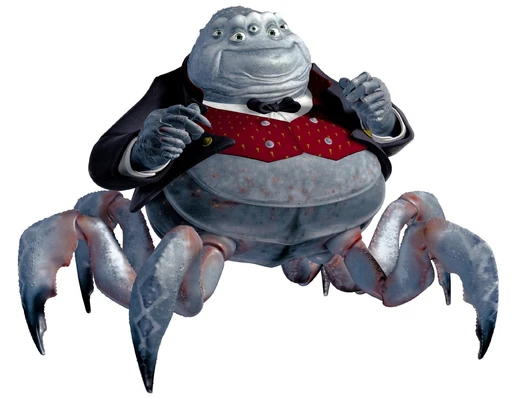
The monster economy is predicated on traumatising children. This, ultimately, is horrible – how tragic that for the monsters to thrive they must instil fear and suffering into the hearts of endless children. So too for our energy industry – fossil fuel extraction has always been dangerous and is increasingly so. For example, the extraction of oil in the Niger Delta has led to huge amounts of pollution, high levels of corruption within the Nigerian government and many human deaths – due both to poisoning and murder. Of course, we can’t just blame other countries and their governments for the problem. Companies like BP and Shell are notorious for colluding in and profiting from corruption. In Monsters, Inc. a typical fossil fuel company CEO is represented by the five-eyed humanoid crab Henry J. Waternoose III.

http://vignette4.wikia.nocookie.net/disney/images/5/51/Henry_J._Waternoose_III.jpg/revision/latest/scale-to-width-down/516?cb=20160404021602

The company has been in Henry’s family for three generations and the pressure’s on for him to keep it running. Unfortunately, scream energy supplies are dwindling and Montropolis is experiencing frequent black outs. At first Henry appears harassed, proud but well-meaning until we discover he is colluding with one of his employees to use extreme-extraction techniques on children. So too for energy companies like BP as they’re forced to use more dangerous modes of extraction to get at lessening fossil fuel supplies. The Deepwater Horizon oil spillage of 2010 is a potent reminder of how dangerous this is – a BP owned rig exploded off the Gulf of Mexico killing 9 and causing untold levels of pollution. I was at a talk given by an ex-BP member of staff and they admitted that the reason it was a BP oil rig that exploded rather than one owned by another energy company was “bad luck” – yup, oil rigs are accidents waiting to happen because energy companies want energy fast to boost their profits now. They ride rough shod over health & safety and concerns for the environment and the results are tragic. Fortunately, Henry J. Waternoose III ends up in prison for his nefarious dealings (as should CEOs of dangerous energy companies, instead they get £14 million pay deals but at least the BP shareholders are making a fuss about Bob Dudley getting paid loads to trash the planet).

Meanwhile, James P. Sullivan is a big, blue, fury scarer. He’s the best scarer on the block having spent years terrifying children. However, when one kid gets into the monster world – an adorable little girl called Boo – James is forced to think twice. They become friends but there’s a moment when he accidentally scares her. Naturally, she cries. The moment is caught on camera and James has to come face to face with who he really is. He realises his whole life has been spent causing misery and harm, so he changes his mind and changes the company. He becomes the new boss of the company and sets it on a sustainable path – collecting laughs not screams. In rea life, the CEO Ray Anderson turned the textile company Interface around, from dirty to clean; John Browne once told us that BP would go Beyond Petroleum (although that all turned out to be spin and lies); and Charles Grant was a businessman who profited hugely from slavery but became a major advocate for its abolition. So, it’s possible, people can change and so can business.

So let Monsters, Inc. be a lesson to us, especially the heads of fossil fuel companies. Climate change is continuing unabated, the world is heating up and sinking. Weather is becoming increasingly unpredictable and extreme. And all the while societies are being picked apart at the seams and so much human misery is caused. We desperately need a few CEOs to step up and have some climate-based epiphanies. There are benign energy sources out there like that giant ball of molten fire in the sky for instance. If the monsters can do it, so can we, and here’s to a future of laughter, not screaming.

https://www.youtube.com/watch?v=8IBNZ6O2kMk

The European Dream

The United States of America has one, a dream, “the ideal by which equality of opportunity is available to any American, allowing the highest aspirations and goals to be achieved.” It’s basically the Cinderella fairy tale made available to all Americans. By ‘all’ Americans I mean white, straight men born into wealth but sometimes a woman slips through the net and occasionally a person of colour does as well. That the dream is founded on huge levels of debt, totally unsustainable levels of consumption and dog-eat-dog capitalist politics is by-the-by, the point is America has a dream, a big one, and apparently it’s for everyone. But what does Europe have?

Europe also has huge levels of debt, totally unsustainable levels of consumption and dog-eat-dog capitalist politics but I’m not so sure Europe can simply adopt the American dream. For starters, Europe didn’t begin as one country (or at least one colonialist attempt to make a country), it started as many, often belligerent nation states vying for power with each other. A history of Europe is often a history of war until the end of WW2 when people had had enough. Successive generations of the same families had gone to war twice in the 20th century and people knew this couldn’t last. So, as I described in a previous blog, the beginnings of the European Union were formed to ensure Europe did not go to war again.

However, European societies are going through yet more social, political and economic upheaval following the 2008 financial crisis and ongoing policies of austerity. Similarly to after the Great Depression of 1929 countries are becoming increasingly isolationist and extremist parties are on the rise. Now, more than ever, does Europe need a dream because it’s clear we cannot leave things in the hands of Brussels based bureaucrats and technocrats. Sure, they get to swan around the corridors of the European Commission and Parliament looking all self-important but how many of them have tried to run a sheep farm, worked in a hair salon or held any number of ‘real’ jobs that people across Europe may have?

For those of us who care about Europe who, despite how disappointed they may be at the EU itself, believe it’s important to get on well with one’s neighbours and to form transnational organisations to combat transnational issues such as climate change, terrorism and corporatism, and to champion transnational solutions such as human and environmental rights, coming up with the European Dream is our responsibility. It will be different for all of us (and maybe that’s part of its strength) but, boy, do we need to start articulating positive and exciting messages about what it means to be European. So, I’ll take a stab but I reckon you should too.

https://i0.wp.com/webzine.kic-innoenergy.com/wp-content/uploads/2014/10/European-job-market.jpg

The European Dream: a continent where people are happy to make fun of one another’s accents and national cuisines knowing that underneath the banter there’s grim accord that the world is a dark place but if we work together we can make it lighter. We might often do things differently (e.g. how we do or don’t worship; how we eat our steak; how we do or don’t protest) and whilst we will talk about these things (eventually) we also know there’s nothing worse than tyranny, oppression and war. Europe has to be a family – a queer, straight, Muslim, of colour, trans, white, polyamorous, Atheist, monamorous, hippy, business family – and even if the siblings don’t always get on we’ll still stick it out for the sake of our brood. Perhaps, at its simplest the European Dream is to ensure a stable and prosperous continent upon which the inhabitants can freely and peacefully eat different dishes and make fun of each other for doing so. I mean, snails, gross.

Now, what’s your European Dream? You can write it in the comments below but because not that many people read this blog why not share it on your facebook, blog or twitter – get it out to your networks and see what else people come up with. Especially useful for us cynical Brits who talk of ‘continental Europe’ as if tiny island Britain is still its own Great Kingdom (c’mon, we can British and European at the same time!)

The Men Behind It All

It’s been about a year since I started this blog so I thought what better way to celebrate than to reveal the truth behind the lies, to reveal who really is pulling the strings of the global system. Who manipulates politics, economics and business at such a high level that even presidents and prime ministers will do what they ask. Who tips the balances of the capitalist military industrial complex in their favour and reaps the rewards. Who has the odd billion stored in one of many offshore tax havens. Who somehow remain hidden in the shadows.

http://vignette2.wikia.nocookie.net/villains/images/6/6d/X-files-the-syndicate.jpg/revision/latest?cb=20140815180522

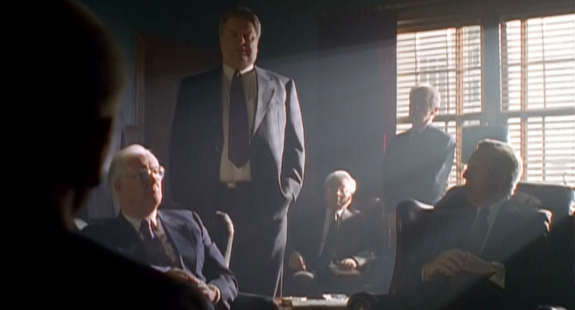
Perhaps, like me, you turned to The X-Files to learn the truth – that there is a cabal of wealthy, white men in grey suits who function above the law and collude with aliens to plan world domination. These men are known as the Syndicate – they’re in the picture above – just a bunch of guys in suits hanging out in shadowy rooms smoking cigarettes and drinking tea, the stuff of global conspiracy (fyi, a few X-Files spoilers on the way). The men of the Syndicate work with a bunch of aliens who want to take over the world. The men do all they can to ensure the public never knows about this: they plan and enact elaborate conspiracies to ensure abductees, alien sightings and even alien attacks are all covered up and explained away; they have the military at their disposal; they bribe and threaten government officials; they kill anyone who knows too much and often try to kill FBI agent Fox Mulder (who is always one step away from revealing their dastardly plans). In short, they pull an awful lot of the strings of power. But, the thing is, they do it very badly.

Over and over again these silly, old men make mistakes and let things slip. So many of their secret experiments using alien DNA and alien tech go awry and result in many people needlessly dying. Then they have to clean up the mess and kill anyone who spotted the mess, usually Fox Mulder. To conceal their mistakes they have to spend an awful lot on bribes and concoct exceptionally elaborate cover-up stories (often more ludicrous than the actual alient-based truth). Then they have to kill a few more people, including JFK and Martin Luther King, who threaten the balance of power. They also make a very bad team – they don’t trust each other and frequently lie to one another when they fail to successfully ‘manage’ a ‘situation’. So yeah, they’re the ones behind it all, but they’re also a bunch of idiots.

And there are times when I can’t help but think this is quite a good analogy for the real people behind the real system (unless there is actually an alien-government conspiracy and The X-Files was a documentary, not sci-fi). There’s a certain comfort in believing that a group of super-ruthless intellectuals are playing puppet master to the world’s problems and tipping the capitalist military industrial complex in their favour. And yes, there are certainly people doing this – creating/using multiple tax havens, subsidising environmentally destructive industries whilst undermining sustainable energy, investing/trading in weapons. They often do this because they’re greedy and/or it makes “business sense” (i.e. maximise short-term profit at any expense). But is it a joined-up, super smooth system of conspiracy and collusion, I doubt it, I often just think it’s greedy, insecure, selfish people with far too much power doing what greedy, insecure, selfish people do, namely look out for number one. I can’t imagine it’s actually fun being one of these people (“Hey, darling, how was your day?” “Oh, you know, the usual – I hid lots of our money in an offshore account to avoid taxes and I sold a load of weapons that will be used to kill innocent people.”). Certainly, the Syndicate don’t seem to have much fun as they’re constantly paranoid their nefarious ways will be revealed and they spend a lot of time planning how to kill one another. So, maybe those shady characters in that shady room aren’t quite so clever as the conspiracies would have us believe and, in a way, that makes it worse – such a shame that it’s a bunch of idiots bringing about doomsday far too far in advance.

Welcome To World War 3

“It’ll probably start on a Friday. What will seem like an attack on America by terrorists or Russia, driven by a well-oiled, well-armed and multi-national group of elites using alien technology that governments have been hiding for seventy years…” Art often reflects reality and this is an excerpt from the trailer for the latest series of The X-Files (my thoughts on this series here). Save for the bit about alien technology it’s a prescient observation of the rapidly escalating violence the world is witnessing right now. And, as ever, the news is bleak.

Terrorist attacks in Belgium, Yemen, Iraq and France. A war in the Middle East that has killed and displaced thousands. Pakistan’s entry into the nuclear arms race. China and Japan’s conflict over the southern islands. An economic cold war between the US and China, the former struggling to maintain its status as world emperor, the latter vying to take that title. The implosion of the EU with a worsening refugee crisis and the rise of the extreme right, including the Nazis. Russia and Ukraine. Islamic State. It almost seems as if the world has never been at peace.

Now, I’m not writing this blog to depress people (although the news is depressing) and nor am I saying we should stop striving for peace. Of course not, if anything, the violence we see in the world is yet another rallying call for the peace movement. However, perhaps what I’m saying is that this isn’t as simple as war and peace anymore – two seemingly time bound and delineated events. World War 2, for example, had a beginning and an end, whilst the Cold War was a far more uncertain series of events it has nevertheless ceased. Yet the legacies of both conflicts live on, so perhaps we could say neither have ended. Likewise, new forms of technology make different sorts of war possible – drones and terrorists navigate borders differently to ground troops and armies. Meanwhile, diplomatic and economic threat can also function as tools in campaigns of imperialism. Often war need not be declared for it to be happening. So maybe it’s not about war ending and peace beginning, maybe it’s about navigating the grey territory in between.

It is not that now more than ever do we need to call on the better angels of our nature because this has always been true – we have always needed the better angels of our nature. Our compassion, care, altruism, love and joy – possessed and enacted by all. Even these angels might not prove to be enough but I’d question the notion of enough anyway – is enough when all fighting ever has ended, is enough when climate change has been abated, or is enough just doing the best we can in the time we have? I’d love to see world peace enacted and global warming avoided but the reality I’m living through is very far from that. And yes, that makes me despair, but no I won’t stop blogging! And to conclude here’s The X-Files trailer in full. However, I’d like to categorically remind everyone that the world’s problems will not be solved by one FBI agent called Fox Mulder – instead we all need to channel our inner Fox Mulders to step up to the challenge. Or just avoid X-Files metaphors entirely as it’s a pretty ludicrous programme.

https://www.youtube.com/watch?v=_1SmJUBT5q0