Is Valerian A Metaphor For Europe!?

“In the 28th century, special operatives Valerian and Laureline work together to maintain order throughout the human territories. Under assignment from the minister of defense, the duo embarks on a mission to Alpha, an ever-expanding metropolis where diverse species gather to share knowledge and culture. When a dark force threatens the peaceful city, Valerian and Laureline must race against time to identify the menace that also jeopardizes the future of the universe.”

I feel this one might be self-explanatory but it’s true that like Valerian, Europe has often been overwhelmed by dark forces. There were the Nazis in the middle of the 20th century along with fascists in Italy and Spain. And prior to that Europe regularly went to war with itself: the First World War (1914-1918), Franco-Prussian War (1870-71), Austro-Prussian War (1866) and so on and so on. It’s a miracle really to think what Europe has achieved since 1945, that despite countries’ worth of difference, hostility and prejudice we are that bit more peaceful. And now, Europe is often a place where diverse peoples gather to share knowledge and culture. Of course, that dark force of misplaced nationalism, racism and violence has never gone away. Political groups of the right regularly flirt with the values that their more extreme-right friends hold, whilst the extremists themselves, including the Neo-Nazis, just carry on being dangerous and violent. Europe, like Alpha, is under threat.

Now I could end this post by saying that Brexiteers fall into the category of the dark force. However, I am aware there were so many different reasons people voted for Brexit: some wanted a socialist revolution (the ‘Lexit’ vote), some didn’t know what they were voting for, some wanted to stick a middle finger up at the elitist government, some voted believing that Brexit would mean no immigrants, some were privileged Tories who like a bit of national pride and, of course, some were extremists, racists and fascists. I don’t find it too difficult to comprehend these different reasons for voting Brexit, despite my vote to Remain, and I imagine that Alpha, like the EU, has its fair share of internal problems despite all the exchange of culture and knowledge. However, I think it important that we all acknowledge the existence of these dark forces, for they do exist and there is violence. This acknowledgement could be a rallying call that unites Brexiteers and Remoaners around something beyond a hate/love of the shape of bananas, EU bureaucracy and the Common Agricultural Policy. As Syria’s civil war continues to tear the country apart, as the government of Chechnya stands accused of sending gay men to die and be tortured in a concentration camp and as racial violence continues in the States it is clear that the dark forces are amassing and we must come together to stand against them. With Brexit the EU will change dramatically but Europe can still remain united. So I hope we will all jump in our spaceships and send metaphorical laser cannon blasts at all those nasty baddies.

Bums On The Heath With George Michael

What to do of a sunny Saturday afternoon in London? Well, yesterday, I jumped on a bus and zoomed north to Hampstead Heath. I had been told to find Jack Straw’s Castle, an old pub, from which friendly guides and red ribbons would lead me to my destination. I very much did not find the Castle and instead I ended up amongst the bushes and brambles of the wood passing the odd dog walker, jogger and family. Just when I was starting to despair that I’d never find my destination I heard something in the distance, the lyrics of a song were echoing between the branches guiding me to where I needed to go. The song was Outside and the event was the first global celebration of George Michael Wants You co-organised by the great Queer Tours of London and Camden LGBT Forum.

In essence, it was a big, queer party in honour of the legend that is George Michael. In 1998 Michael was arrested by an under cover police officer for having sex in a public lavatory in a Beverly Hills park. Naturally, the press went for it and tried to tear the man to pieces. They smeared his sexuality over the headlines and boggled as to how a man such as George Michael could do something so ‘lewd’. They marvelled at how ‘depraved’ the gay male community could be without stopping to think that perhaps their relentless prejudice and bullying might exacerbate the many woes the LGBT community so often faces. Never one to admit defeat, Michael responded with the song Outside, a few lines of which read, “Let’s go outside in the sunshine, I know you want to, but you can’t say yes. Let’s go outside in the moonshine, take me to the places that I love best.” I don’t think you need to read between the lines to get what he was doing there, namely, reclaiming something wonderful and natural from the bigoted claws of the regularly abysmal media and turning oppression into a smash hit.

So tens of people gathered in Hampstead Heath’s most famous cruising area to get dancing, singing, laughing and making merry (and possibly making another kind of merry in the bushes, if you know what I mean). And it was just flipping awesome. There were families, friends, dogs and even the odd tourist walking by suddenly caught in the speakers’ music and the smiling faces. One of my favourites was two women and two young boys in sports kit (perhaps two Mums with their sons) who walked quickly by only to spot the guy dressed in nothing but a jock strap. The two women’s faces split into big grins and the two boys started laughing. They tried to carry on walking but kept stopping to take another look at the revelry. I think their behaviour is very familiar: that curiosity, intrigue and, perhaps, a little titillation of being caught on the edge of something that looks a little unfamiliar but also quite fun. And that’s why the event yesterday was an open invite, all really were welcome. I also heard so many different languages, including many from around Europe, and I think if anything can act as a metaphor for the sort of fierce joy and emboldened merriment that we’ll need as we continue through dark times it was yesterday’s first ever global celebration of George Michael Wants You. So head outside folks, whether it’s outside of your comfort zone, outside of your usual social group or outside onto the Heath for a spot of dogging (or dog walking).

The Cocoa Butter Club: Not Proud To Be White

There are many things about my identity of which I am proud but being white has never been one of them. I have never felt my body thrill with the pride of having pale skin nor stood arm in arm with others as we’ve identified around the activity levels of our melanin. I’m proud of other things and, for me, my skin colour has never been an issue. However, whilst that might sound like a good thing – that I’m not a racist – there’s still something else going on here. Namely, white privilege, and last night the epic Cocoa Butter Club reminded me that I’ve got it in spades.

The Cocoa Butter Club celebrates performers of colour within cabaret. In their words: “as Creatives, when faced with the issues of cultural appropriation, lack of representation and even black-facing in cabaret, we had no choice but to create!- create something beautiful in response. So, we set up the alternative option for those who don’t want to see trivializing, appropriating or clowning of our cultures, but perhaps experience how fabulous our histories and  cultures are, as told by us.” And at the Hospital Club last night there was a whole Supershow of epic performances. Some highlights for me include: the outstanding Miss Knock Out Noire who, for her first act, revealed a great deal whilst dressed in a banana themed costume and for the show’s final act performed an electrifying burlesque to a mix of Nina Simone’s Strange Fruit. Meanwhile, Symoné twirled at least ten hula hoops at once (I can barely manage one), Loraine James did some ace dj-ing and Carlos Maurizio sung some moving tunes. There were many others and if you want to watch them, which I highly recommend, go find the Cocoa Butter Club wherever they are next (and give them your money!).

But back to white privilege. During the show speaker and activist Kayza Rose asked if there were any allies in the audience. Me and my white friends released a tentative whoop, I was a bit scared that I was about to get told off for being an ally when I should be an accomplice – y’know, trash the system and make a better one rather than just talk/blog about these issues. She then asked again and we cheered a bit louder this time. And this is the thing, fellow whites, people of colour don’t need our hesitancy, guilt or white tears let alone our disregard and indifference they just want us to do something. To challenge that racist joke our friend just made, to educate other whites, to join protests and to co-create safe spaces that people of all colours can enjoy. Sure, it’s tough(ish) to have to realise that we whites benefit from centuries of the oppression of people of colour and, yeah, it’s not as if we’re as bad as our slave-owning ancestors but the white person’s identity crisis is not something with which people of colour need to be bombarded – they have enough issues to deal with, namely, having to deal with institutionalised racism which exists in many places including the cabaret scene. We can have our crises at home with our fellow whites and then, when we’re feeling empowered, clued up and ready to get hula-hooping we can take the fight to the government, workplace, street or wherever oppression is playing itself out. Don’t get me wrong, I am not pretending I’m doing enough to sort this problem out, I also cheered when Rose asked if any of the allies in the room felt they should do more. But I do think the quicker us whites can acknowledge our white privilege the more active we can get in trying to make society more equal. Plus, as Miss Knock Out Noire’s performance proves the struggle for equality can also be a lot of fun.

The Replacement: Worst Maternity Cover EVER (spoilers)

Women regularly have it tough in the workplace. Sexual harassment, lower pay, the glass ceiling, general misogyny and the tricky fact that many women can get pregnant. Yup, even the miracle of childbirth can be used against women to deny them jobs, get them replaced and ensure they don’t return to work. Naturally, the BBC thought it was high time to sensitively delve into this issue and what we got was The Replacement. Ellie is a successful architect (cue the odd reference to ‘sight lines’ and sky lights) working on a fancy, new library when she becomes pregnant with her first child. Her employees are more or less thrilled and help Ellie find her replacement. Enter Paula. She’s nice. So nice. Like, really nice. All pearly, white smiles and over zealous efficiency. She does work ahead of schedule, makes friends with everyone in the office super quickly and is just so darn friendly. Naturally, everyone thinks Ellie’s a little mad when she suggests that maybe Paula is out to replace her for good. That is until Paula kidnaps Ellie and tries to get her to kill herself so she can take her baby to replace the daughter she tragically lost in a car accident even though she was pretending her daughter was still alive. Who knew maternity leave could be so dangerous!?

Now, don’t get me wrong this was really well acted and it had me compulsively clicking ‘watch next episode’ until it ended (ok, I was recovering from a virus, that’s my excuse) but I couldn’t help but feel we’ve been here before. Two women go head to head in mortal combat to prove who is a better mother and colleague. Sure, they’re being defined by their motherhood and ability to function as a decent capitalist worker but I feel the show knows that. It must be aware of the constant hum of sexism throughout the episodes given that the men in this show are just awful: Ellie’s husband turns on her, tries to take the baby away and nearly ends up with Paula. Ellie’s boss, also wooed by Paula, reveals that on the night his wife, Kay, supposedly committed suicide she’d accused him of having an affair with Ellie which he didn’t deny (even though it wasn’t true) but he did tell Kay that if he’d been with Ellie at least he might have had a child. Good news is that this didn’t actually lead to Kay taking her own life because it turns out Paula killed her because Kay wouldn’t stop going on about the fact that Paula’s daughter wasn’t actually alive anymore.

If this all sounds quite farfetched and just a little silly that’s because it was (and don’t get me started on what the library ended up looking like..there weren’t even that many books in it and it was super kid unfriendly, or the bit with the baby basket being left on a window ledge, or the bit when Paula clearly hasn’t researched her effective poisons etc). Yet this steady patter of sexism was never really commented upon because what we ultimately saw was two women coerced and conditioned by patriarchal capitalism forced to fight each other to the death. It proved entertaining(ish) but I did feel the team behind it may have just thought “Girl On A Train in an office” just like those behind Apple Tree Yard probably thought “middle-aged Gone Girl“. So whilst the programme does showcase some epic acting from Vicky McClure and Morven Christie and passes the Bechdel with flying colours this doesn’t classify it as novel or even offering something verging on feminist critique. It doesn’t need to (I hear the defenders of the status quo cry) but just because Thelma and Louise drove off a cliff and the 9-5 crew got their happy endings doesn’t mean more women can’t take on the patriarchy in style. There was scope here to see something interesting done with the genre and have Ellie actually try to team up with Paula (ok, minus the whole Paula-murdering-Kay bit, which really didn’t make sense given Paula ends up telling loads of people her secret anyway) and have them transcend the patriarchal binds of the work place. But instead they were forced to endure the limited plot devices that their hackneyed characters had to offer. So whilst The Replacement could, at a push, be critiquing our culture’s obsession with defining women by the children they may or may not have I feel it’s just cashing in on this trope and maybe even making matters worse especially as just after Ellie’s shut the door in her dire husband’s face her boss appears in the background implying that maybe, just maybe, they’ll get together because heaven forfend Ellie be a single Mum.

“Why Don’t People Like Vegans?”

I tried to be vegan for a bit but then I ended up working in a restaurant where I got given leftover food at the end of the day and that included really tasty meat. It was a slippery slope back to a pretty meaty diet. But I shan’t bore you with my personal history instead I want to flag up a documentary of epic proportions called Simon Amstell: Carnage. It’s over on the BBC and Amstell the comedian wrote, directed and narrated it (his name in the title might be slight overkill though) and it is fuming hilarious. The blurb reads: “It’s 2067, the UK is vegan, but older generations are suffering the guilt of their carnivorous past. Simon Amstell asks us to forgive them for the horrors of what they swallowed.” And whilst it’s largely fictitious and the talking heads tend to belong to people who don’t exist I think it’s one of the best arguments I’ve come across in favour of veganism.

The show speaks for itself so I think the simplest thing to do is just watch it. However, for me, what it did was brilliantly re-present the argument by showing it the other way around. Rather than have lots of meat eaters make fun of those silly, vegan hippies it had those highly intelligent, compassionate vegans boggle over our manic, meat and dairy eating habits. It flipped the narrative and revealed our obsession with torturing and forcibly impregnating livestock to be pretty messed up. It made me sympathise more with cows, pigs and chickens. So now, when I go into a supermarket and see that pack of smokey bacon, yes, I’m thinking how blooming tasty it would be in a sandwich but I’m also thinking that those slivers of meat are basically the product of suffering and torture, rashers of pain if you like.

However, there is still one very important question that needs answering: “Why don’t people like vegans?” Kirsty Wark, non-fictitious presenter, asks it during a faux Newsnight interview in Carnage and it’s a good question. Perhaps it’s because their lifestyle appears to be a threat to ours and when they talk about soya milk we start to feel a latent guilt related to animal suffering that we’d rather deny. Maybe it’s because some people think veganism is a cult. Maybe it’s because we work in the dairy industry. Or maybe we should just live and let live, and realise that should include the lives of animals too. Cows, pigs and chickens don’t need to die for our gustatory pleasure when there is just so much other ace food out there. And I’m not saying this to be moralistic or judgemental because one thing I certainly am not is a vegan but I still feel pretty terrible about all that slaughter. And let’s face it, vegans aren’t the threat here, especially as they’re not the ones running an industry that kills millions of animals, pollutes waterways and is a huge contributor to climate change. So, go on, try some nut cheese, it’s much tastier than churned up cow pus.

Meaningless Millenials: Clique & Search Party

Life can seem quite meaningless for millennials these days as we’re forced to jump through the increasingly outdated hoops of school all for the sake of one day getting an adult job. However, much debt later and those dream jobs tend to be unpaid internships or going the way of automisation. Meanwhile, Trump, Brexit, climate change etc etc…what do we do!? It’s no surprise then that this nihilistic turn ends up influencing popular culture. Two examples include recent mystery based dramas with Gen Y protagonists, Search Party (TBS) and Clique (BBC). For the former think Nancy Drew meets mid-twenties millennial malaise with a side of Gone Girl and the latter is a less funny Mean Girls meets The Secret History with Scottish accents. Both have meaninglessness at their hearts but for two very different reasons. Oh, and head’s up, there will be spoilers.

Search Party tells the story of Dory, not the forgetful fish, but a 20s something woman living in New York who lacks direction and purpose in life. Naturally, she goes looking for this by going looking for Chantal – an old college acquaintance who is now a missing person. Cue hunting for clues, curious suspects, intriguing red herrings and a whole cast of amazing characters – from her endlessly self-absorbed rich friends to a cult-load of ‘wellness-seeking’ weirdos. Dory’s 21st century world is exceptionally bleak but also very, very funny. Clique takes itself a little more seriously as young students and lifelong friends, Holly and Georgie, fall out over getting in with the in-crowd: four conventionally beautiful young women who have looks and banking internships to die for (literally in the case of one of them who kills herself in episode one). The characters here are familiar clichés: the charismatic lecturer who lures the impressionable young women in with her force of character (and questionable brand of feminism) and the attractive people who do glamorous things (e.g. take drugs, jump into swimming pools with their clothes on, have chauffeurs etc) but aren’t actually that interesting. However, what’s great about Clique is that it’s going all out to fail the Mechdel test – the male equivalent of the Bechdel test – as the guys are left to be annoying, peripheral characters and the occasional bare butt shot.

So both shows are full of selfish and sometimes vacuous characters, however, I’d say Search Party is knowingly presenting them as such in order to skewer them in parody. It takes a mirror to Gen Y’s obsession with selfies, celebrity and self-promotion, and reminds us that it’s all paper-thin (whilst also mistressfully weaving this trope into the denouement). Meanwhile, I feel Clique is being a little more earnest in its vacuity and trying to convince us that, like Holly and Georgie, we really should want to join the clique of coke-snorting, unpaid yet highly attractive interns who don’t say much of interest and are forced to work for/with complete chauvinists. But that’s the thing with cliques – cool from a distance but kinda disappointing once you’re inside. Although I’m not convinced Holly is all that convinced of the clique either so, with three episodes to go, there’s still plenty of time for biting, poignant cultural critique a la Search Party.

Interestingly, one thing lacking in both these tales of millennial woe are significant adult figures. Search Party has the odd wellness guru and disinterested, rich parent, whilst Clique has got the over-zealous lecturer and her weird brother but I feel both series are missing a trick because without adults who can the Gen Yers blame for all our problems? Let’s face it without the baby boomers we millennials wouldn’t be here. Without their inventions, businesses, advertising agencies and super-charged model of consumer capitalism where on earth would we go to struggle to find meaning and purpose? I mean if they’d invested in sustainable energy, steady-state economic models and put community before profit then Dory and Holly probably would have already found themselves and wouldn’t need to go on dangerous mystery adventures. Likewise, their friends would probably spend more time looking out for one another and not wasting so much time setting up faux-charitable initiatives to boost their fragile self-esteems or chasing the next high-functioning sociopath with a six-pack. And nor would everyone be stone broke and forced to pay too much rent because we’d have caps on renting or, who knows, maybe all housing would be social housing. And freaky wellness cults run by overly charismatic yet dubious people who wear too much expensive jewellery wouldn’t need to be invented because we’d all probably be quite happy sharing stuff and looking out for one another. Who’d need an exclusive clique when we’d all have community. Anyways, just a thought. Now quick, back to Instagram!

Do I Owe You Anything?

“For we each of us deserve everything, every luxury that was ever pulled in the tombs of the dead Kings, and we each of us deserve nothing, not a mouthful of bread in hunger. Have we not eaten while another starved? Will you punish us for that? Will you reward us for the virtue of starving whiles others ate? No [one] earns punishment, no [one] earns reward. Free your mind of the ideas of deserving, the idea of earning, and you will begin to be able to think.” This quote from the sci-fi novel The Dispossessed by Ursula Le Guin ended one of my previous posts. And now I want to take a closer look – what might it actually mean if we were to free our minds of the ideas of deserving and earning?

To explore this I am going to get personal and focus on relationships. One sort of relationship is friendship and it is often governed by notions of deserving and earning. For example, if I give my friend a present for their birthday then I might think that I deserve to get one for my birthday, that I’ve earned it. But if we free our minds of the ideas of deserving and earning how then can we describe this scenario? It’s obvious that my friend and I care about one another, which is why we’re friends, so I give them a birthday present predominantly as a means of expressing that care. I don’t have to give them a present but I do choose to. Now, I’ve done a nice thing for them but does that mean they have to do a nice thing for me? Well, if earning/deserving are out the window then the simple answer is no. There is no universal law or cosmological truth or fundamental principle that means every good deed deserves another. However, my friend, uncompelled by abstract principles, might still choose to give me a present because they also want to express their care for me and because they know I like getting presents.

The two situations I’ve described above aren’t hugely different – they’re both about giving and receiving presents. However, in the first we can fall back on ideas of earning/deserving – “I gave you a present, so I deserve one”, as if there are unwritten laws that govern how friendships work. In the latter, we cannot fall back on these invisible laws but instead must take responsibility for our actions and choose what we’ll do accordingly. To go back to the quote we can consider the ideas of earning/deserving from two angles: either, everyone deserves everything, or no one deserves anything. The former suggests that we all deserve birthday presents and that sounds great but as soon as the scenario arises in which some people get lots of presents whilst others get none then the principle is undermined. Likewise if we all deserve nothing then we could use this to justify hoarding presents for ourselves whilst never giving them to other people. However, without the ideas of deserving/earning then the act of giving presents is about choice. We love our friend and might choose to express that via giving a present. And so, freeing our minds of the ideas of deserving/earning changes everything. Rather than being governed by rules or laws or decrees or commandments we are suddenly free to act however we wish – we can give as many or as few presents as we want. We get to choose. To put it another way rather than being forced to sing to another’s song we get to compose our own: we get to make our kind of music.

T2 Trainspotting And Why Men Can Be Idiots

So, T2 Trainspotting is happening. Twenty years after the events of the original movie and that loveable bunch of drug taking Edinburgh-based rogues aren’t faring too well. What ensues is another ride of exceptionally dark comedy, musings on ageing and a wee bit of drug taking on the side. The lads are struggling with the whole growing older thing and are stuck between emptyish lives and nostalgia for a past they only part remember. I shan’t spoil any of the plot but if you loved the first movie then you’ll like this. The soundtrack is also pretty kick-ass. Instead, I want to refer you to a brief clip from the Graham Norton Show in which the team behind T2 were interviewed including director Danny Boyle and lead actor Ewen McGregor.

It’s a fascinating clip especially because it’s about two men who fell out and then took years to forgive one another. As Boyle says “it’s one of the things weirdly the film is about…trying to express emotions.” Of course, what he doesn’t specify is that it’s about men trying to express emotions (most likely cisgendered men and probably heterosexual), indeed, the majority of the film is about men being men (and fucking it up) with the odd women doing a cameo appearance.

As Boyle and McGregor explain they fell out over a “misunderstanding” about the former not casting the latter in the very successful film The Beach. However,  McGregor acknowledges that “it was never about The Beach it was about [their] friendship” but the incident led to years of them not talking to one another. However, as time passed their views changed what with McGregor doing a wonderful speech about another hit film of Boyle’s Slumdog Millionaire and Boyle describing feeling a great “shame” about how he handled the situation. And years later there they both were in 1st class on a plane back from Shanghai, the only ones still awake on their luxury beds, and McGregor thought the time had come – the time to get up, say sorry and mend the past. Of course, that’s how it would play out in a movie (because in movies people tend to learn their lessons) but in reality neither of them spoke to one another and there was no heartfelt reunion. And, my god, is this just another example of how men can be so terrible at communicating. I was raised a cisgendered man and there was scant little education in understanding and expressing my emotions and feelings. I didn’t quite fit the mould of typical masculinity but it was still the predominant lifestyle option and, boy, was it lacking.

So, it’s not weird at all that T2 is about men failing to communicate with one another and living pretty sad and often scary lives as a consequence and nor is it a surprise that a similar turn of events happened in the lives of the real people behind the film. Of course, they’re big dog Hollywood millionaires but that doesn’t mean they’re rich in the ability to communicate. So, men, I really think it’s time we learnt our lessons and realised that a greater awareness of our emotions is not a weakness or something to be ashamed of, it is actually empowering because the human being is basically one giant bundle of feelings that occasionally thinks. And sure, there would be less plot devices for movies because men would start getting things right and stop trying to kill each other so often but at least we’d get happier endings in real life, preferably without a twenty year time gap.

Why Is The Cure For Cancer So Expensive?

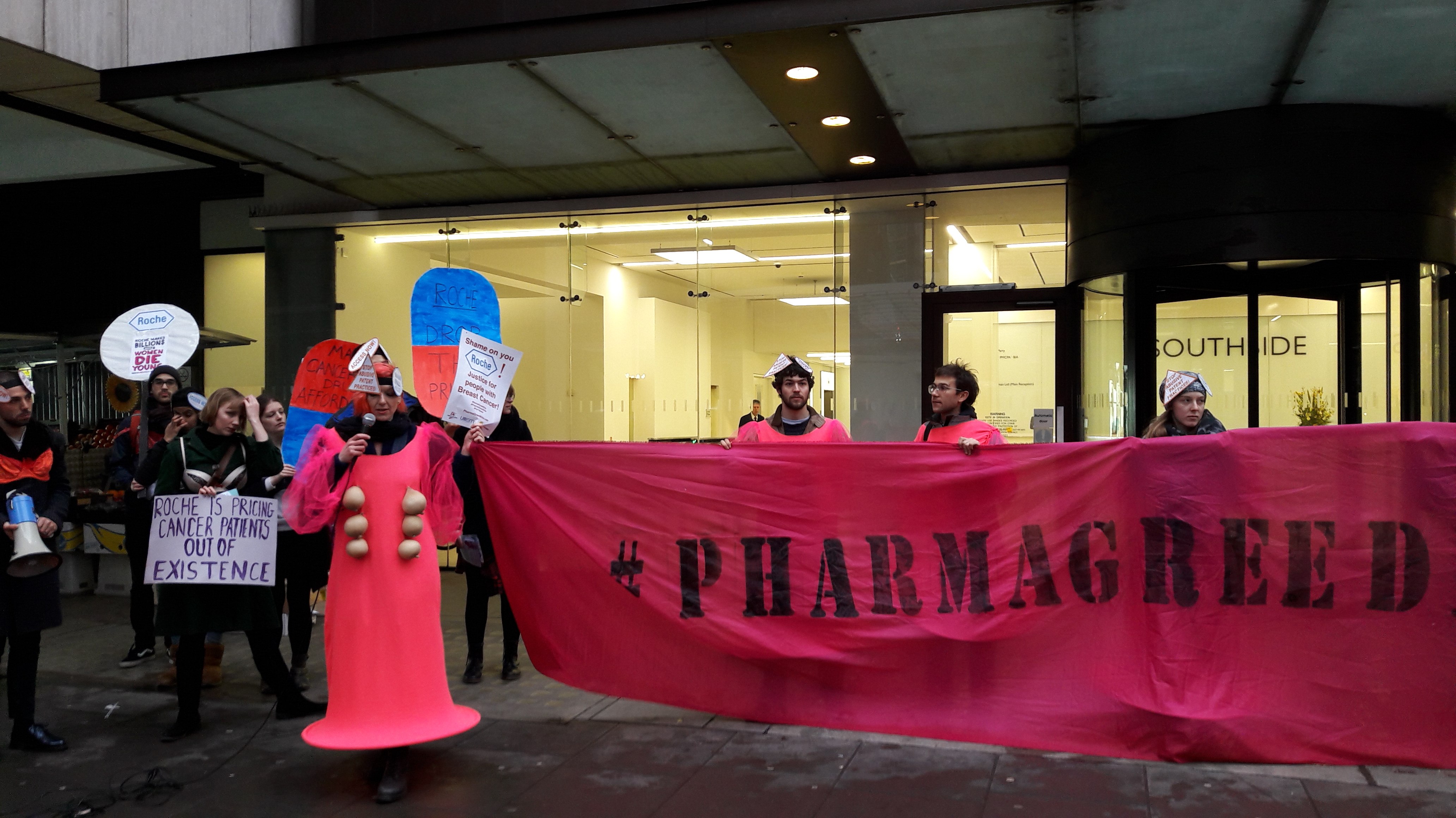
I don’t normally do this. Get out of bed at ten past six in the morning to go and join a protest against Roche, the giant pharmaceutical company. But yesterday I am very glad I did. One bus and one tube later and I was standing outside Westminster Cathedral with an eclectic group of activists, doctors and charity workers. The most striking were those who’d donned the custom-made fluorescent pink dresses with added boobs. I wore a modest headband with messages stuck to it including ‘Pharma Greed Kills’ and similar protestations. Then off we went, marching from the Cathedral to the revolving doors of the Association of the British Pharmaceutical Industry.

Donna
Donna, in all her bright pink glory!

The groups on the march included Act Up London, Treatment Action Campaign and Stop Aids, all united in the struggle against HIV/AIDS and all aware that the greed of pharmaceutical companies affects people with so many other illnesses as well. Also present were Universities Allied for Essential Medicines, a student-led organisation working to improve access to and affordability of medicines. And it wasn’t just London in protest there were groups in Brazil, France, Malaysia, the US and Zambia. Meanwhile, the crowds gathering in South Africa were not only just making demands of Roche but were commemorating Tobeka Daki, a passionate activist who sadly died from cancer unable to afford the treatments.

Back in London we started chanting as we marched, “Say no to Pharma Greed, Give us the cancer drugs we need” and other less catchy numbers that didn’t rhyme. We got stared at, photographed, laughed at and cheered by various members of the public. At 8.30 in the morning we did make for a nice change from the usual grey of the morning commute. We overshot the ABPI building but quickly backtracked to set up shop. Whilst others chalked on the pavement in pink, gave speeches and waved placards I handed out leaflets and the message was clear: Roche can profitably manufacture a year’s supply of Herceptin® (unbranded it’s called Trastuzumab), a cancer fighting drug, for £190 yet it is currently costing patients tens of thousands of pounds annually. People are dying from a disease that can be treated because Roche is putting profits before people. Justice for people with breast cancer, that’s what we want.

Many people avoided my gaze as I tried handing out the flyers whilst others just carried on listening to their music (seriously, I spotted so many of those fancy, giant ambient-noise blocking headphones than ever before). Some did take the flyer with an awkward smile whilst others stopped to find out more. That, for example, the development of Herceptin® and other vital cancer treating drugs depended on public sector support, philanthropic donations and the US government’s National Institutes of Health. Whilst Roche and one of its subsidiaries, Genentech, also invested in the development of these drugs for some reason they hold the patent so can set the price. And that price is high, they’ve already earned more than $60 billion in profits from the sale of Herceptin® alone. Roche’s CEO, Severin Schwan, isn’t doing that badly either. Back in 2015 he took home a nice salary of $12 million. So, whilst Roche could easily cut the cost of these drugs and still make a profit they just aren’t.

pharma-greed
Pharma Greed Kills

But it’s worse than that because Roche aren’t just keeping the prices artificially high they are fighting dirty to ensure they have a monopoly over these drugs. In India Roche have embroiled the country’s drug regulatory body and producers of similar products to Trastuzumab in long-running and complex litigation to prevent the widespread availability of potentially affordable versions of the drug. In Brazil and Argentina, Roche is one of the pharmaceutical companies litigating against those governments for their attempts to use legal international safeguards to protect public health and make Trastuzumab more accessible. In South Africa Roche holds patents on Trastuzumab that will last until at least 2033. In essence, Roche are fighting tooth and nail to keep the prices high even whilst so many people die. It turns out that ill and dying people are profitable.

Chalk
Innovative use of some pink chalk

Back on the grey streets of London I was very grateful every time someone took a flyer. Because even if they just put it in the recycling bin when they get home what is important is that more people are aware. Cancer is a disease that touches the lives of all of us. 1 in 8 women will be diagnosed with breast cancer in their lifetime and 1 in 870 men will receive this diagnosis. We may have lost someone we cared for, we may know someone who has it or a friend of a friend, or ourselves. And whilst it is risky to talk of a ‘cure’ for cancer there are so many life-extending medicines out there which can treat it and improve the lives of those who have it. So it’s not that the cure doesn’t exist it’s that the cure is too expensive. However, at 8.30 am on a grey, Tuesday morning in February I did not always have the time to explain this as people passed me by. But many did stop to look at the giant pink banner: “Pharma Greed Kills” is a simple and shocking statement and it is true. Profits are being pitted against people and profits are winning. Until we can contain and control money we will keep being forced to fight this ruthless, tragic battle because too many people love money more than they love others (or even themselves). I hope one day Severin Schwan wakes up and does the right thing. Until then I’ll keep doing my best to wake up before the sun rises so I can join those bright pink many-boobed beacons of hope.

Still Waiting at the VAULT

Beneath Waterloo station lie the vaults. They are long, cavernous rooms made of brick and stone. They are dank and smell a little of damp. They are also the site of Great Gatsby themed parties, plays about starships, masked balls and for only two more days – Still Waiting. As the blurb promised this is an event “about the hundred handshakes you experience in the Calais Refugee Camp, volountourism and packets of pasta, and our relationship with Europe’s refugee crisis.” And as the trains rumbled overhead so I was transported into a very different world. Actually, no, I wasn’t transported because Still Waiting is about this world and the problems it is facing. Perhaps, instead, rather than being taken away on an escapist adventure I was more deeply immersed in the real world. I was made to feel.

Still Waiting - at the VAULT theatre, 1st - 5th February
Still Waiting – at the VAULT theatre, 1st – 5th February

Three cast members/musicians took us through the refugee crisis via songs, statistics, jokes, laments and thoughtful interludes. The title comes from the name of a report released by Refugee Rights Data Project on the situation in Calais. It is the “largest research effort around refugees and displaced people in the region to-date” and it is called Still Waiting because so many people are doing just that, waiting and waiting for a chance to find a new home, to be reunited with family and friends, to escape the persecution of their homelands and/or for better education opportunities. And these are people who are waiting, not just photographs in a newspaper, or numbers on a spreadsheet, or stereotyped ‘masses’. They are people like us.

And that is what Still Waiting achieved – it turned the numbers into stories and the stories made me feel. Whether it was listening to the recording of Ramia’s story, a young woman who escaped Aleppo in Syria and is now living in Goumenissa in Greece. Or hearing the cast discuss their own experiences of going to (or not going to) Calais to help the refugees and the charities supporting them (they also sang a song about it called Humblebrag and it’s worth going to the show just for that!). The show costs £9 and in going you help fund Crew for Calais, one of the charities doing vital work to support refugees. Go also to be moved and to be drawn into a humanitarian crisis in a way that no broadsheet or head of government seems capable of doing. Go because this matters, it really does matter, and we are running out of excuses not to. Because the world won’t get better by itself, the world needs the cast of Still Waiting, it needs Crew for Calais and it needs the resilience and fortitude of the endless refugees forced to leave their homes.

The world needs us too and it’s events like this that remind me of that.