Monsters, Inc. & Fossil Fuels

Slowly catching up on unwatched Pixar films and I’ve finally got round to Monsters, Inc. What an ace film – funny monsters, incredibly cute children, a brilliant premise for a world (scaring kids to harness energy – who comes up with this stuff!? Genius!), an extended cast of ace characters (the giant slug receptionist – haha), lots of heartfelt moments and a great, final message (big spoiler coming): that kids actually produce more energy when they laugh rather than when they scream and cry. Who’d’ve known!? Naturally, this is an apt metaphor for the fossil fuel industry.

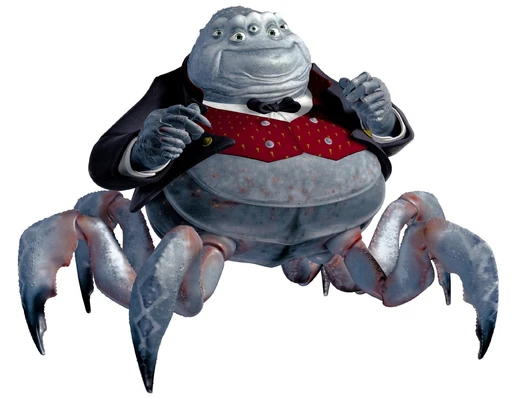
The monster economy is predicated on traumatising children. This, ultimately, is horrible – how tragic that for the monsters to thrive they must instil fear and suffering into the hearts of endless children. So too for our energy industry – fossil fuel extraction has always been dangerous and is increasingly so. For example, the extraction of oil in the Niger Delta has led to huge amounts of pollution, high levels of corruption within the Nigerian government and many human deaths – due both to poisoning and murder. Of course, we can’t just blame other countries and their governments for the problem. Companies like BP and Shell are notorious for colluding in and profiting from corruption. In Monsters, Inc. a typical fossil fuel company CEO is represented by the five-eyed humanoid crab Henry J. Waternoose III.
http://vignette4.wikia.nocookie.net/disney/images/5/51/Henry_J._Waternoose_III.jpg/revision/latest/scale-to-width-down/516?cb=20160404021602

The company has been in Henry’s family for three generations and the pressure’s on for him to keep it running. Unfortunately, scream energy supplies are dwindling and Montropolis is experiencing frequent black outs. At first Henry appears harassed, proud but well-meaning until we discover he is colluding with one of his employees to use extreme-extraction techniques on children. So too for energy companies like BP as they’re forced to use more dangerous modes of extraction to get at lessening fossil fuel supplies. The Deepwater Horizon oil spillage of 2010 is a potent reminder of how dangerous this is – a BP owned rig exploded off the Gulf of Mexico killing 9 and causing untold levels of pollution. I was at a talk given by an ex-BP member of staff and they admitted that the reason it was a BP oil rig that exploded rather than one owned by another energy company was “bad luck” – yup, oil rigs are accidents waiting to happen because energy companies want energy fast to boost their profits now. They ride rough shod over health & safety and concerns for the environment and the results are tragic. Fortunately, Henry J. Waternoose III ends up in prison for his nefarious dealings (as should CEOs of dangerous energy companies, instead they get £14 million pay deals but at least the BP shareholders are making a fuss about Bob Dudley getting paid loads to trash the planet).

Meanwhile, James P. Sullivan is a big, blue, fury scarer. He’s the best scarer on the block having spent years terrifying children. However, when one kid gets into the monster world – an adorable little girl called Boo – James is forced to think twice. They become friends but there’s a moment when he accidentally scares her. Naturally, she cries. The moment is caught on camera and James has to come face to face with who he really is. He realises his whole life has been spent causing misery and harm, so he changes his mind and changes the company. He becomes the new boss of the company and sets it on a sustainable path – collecting laughs not screams. In rea life, the CEO Ray Anderson turned the textile company Interface around, from dirty to clean; John Browne once told us that BP would go Beyond Petroleum (although that all turned out to be spin and lies); and Charles Grant was a businessman who profited hugely from slavery but became a major advocate for its abolition. So, it’s possible, people can change and so can business.

So let Monsters, Inc. be a lesson to us, especially the heads of fossil fuel companies. Climate change is continuing unabated, the world is heating up and sinking. Weather is becoming increasingly unpredictable and extreme. And all the while societies are being picked apart at the seams and so much human misery is caused. We desperately need a few CEOs to step up and have some climate-based epiphanies. There are benign energy sources out there like that giant ball of molten fire in the sky for instance. If the monsters can do it, so can we, and here’s to a future of laughter, not screaming.

The European Dream

The United States of America has one, a dream, “the ideal by which equality of opportunity is available to any American, allowing the highest aspirations and goals to be achieved.” It’s basically the Cinderella fairy tale made available to all Americans. By ‘all’ Americans I mean white, straight men born into wealth but sometimes a woman slips through the net and occasionally a person of colour does as well. That the dream is founded on huge levels of debt, totally unsustainable levels of consumption and dog-eat-dog capitalist politics is by-the-by, the point is America has a dream, a big one, and apparently it’s for everyone. But what does Europe have?

Europe also has huge levels of debt, totally unsustainable levels of consumption and dog-eat-dog capitalist politics but I’m not so sure Europe can simply adopt the American dream. For starters, Europe didn’t begin as one country (or at least one colonialist attempt to make a country), it started as many, often belligerent nation states vying for power with each other. A history of Europe is often a history of war until the end of WW2 when people had had enough. Successive generations of the same families had gone to war twice in the 20th century and people knew this couldn’t last. So, as I described in a previous blog, the beginnings of the European Union were formed to ensure Europe did not go to war again.

However, European societies are going through yet more social, political and economic upheaval following the 2008 financial crisis and ongoing policies of austerity. Similarly to after the Great Depression of 1929 countries are becoming increasingly isolationist and extremist parties are on the rise. Now, more than ever, does Europe need a dream because it’s clear we cannot leave things in the hands of Brussels based bureaucrats and technocrats. Sure, they get to swan around the corridors of the European Commission and Parliament looking all self-important but how many of them have tried to run a sheep farm, worked in a hair salon or held any number of ‘real’ jobs that people across Europe may have?

For those of us who care about Europe who, despite how disappointed they may be at the EU itself, believe it’s important to get on well with one’s neighbours and to form transnational organisations to combat transnational issues such as climate change, terrorism and corporatism, and to champion transnational solutions such as human and environmental rights, coming up with the European Dream is our responsibility. It will be different for all of us (and maybe that’s part of its strength) but, boy, do we need to start articulating positive and exciting messages about what it means to be European. So, I’ll take a stab but I reckon you should too.

https://i0.wp.com/webzine.kic-innoenergy.com/wp-content/uploads/2014/10/European-job-market.jpg

The European Dream: a continent where people are happy to make fun of one another’s accents and national cuisines knowing that underneath the banter there’s grim accord that the world is a dark place but if we work together we can make it lighter. We might often do things differently (e.g. how we do or don’t worship; how we eat our steak; how we do or don’t protest) and whilst we will talk about these things (eventually) we also know there’s nothing worse than tyranny, oppression and war. Europe has to be a family – a queer, straight, Muslim, of colour, trans, white, polyamorous, Atheist, monamorous, hippy, business family – and even if the siblings don’t always get on we’ll still stick it out for the sake of our brood. Perhaps, at its simplest the European Dream is to ensure a stable and prosperous continent upon which the inhabitants can freely and peacefully eat different dishes and make fun of each other for doing so. I mean, snails, gross.

Now, what’s your European Dream? You can write it in the comments below but because not that many people read this blog why not share it on your facebook, blog or twitter – get it out to your networks and see what else people come up with. Especially useful for us cynical Brits who talk of ‘continental Europe’ as if tiny island Britain is still its own Great Kingdom (c’mon, we can British and European at the same time!)

The Men Behind It All

It’s been about a year since I started this blog so I thought what better way to celebrate than to reveal the truth behind the lies, to reveal who really is pulling the strings of the global system. Who manipulates politics, economics and business at such a high level that even presidents and prime ministers will do what they ask. Who tips the balances of the capitalist military industrial complex in their favour and reaps the rewards. Who has the odd billion stored in one of many offshore tax havens. Who somehow remain hidden in the shadows.

http://vignette2.wikia.nocookie.net/villains/images/6/6d/X-files-the-syndicate.jpg/revision/latest?cb=20140815180522

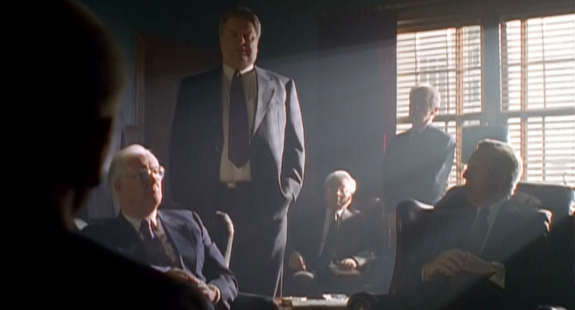
Perhaps, like me, you turned to The X-Files to learn the truth – that there is a cabal of wealthy, white men in grey suits who function above the law and collude with aliens to plan world domination. These men are known as the Syndicate – they’re in the picture above – just a bunch of guys in suits hanging out in shadowy rooms smoking cigarettes and drinking tea, the stuff of global conspiracy (fyi, a few X-Files spoilers on the way). The men of the Syndicate work with a bunch of aliens who want to take over the world. The men do all they can to ensure the public never knows about this: they plan and enact elaborate conspiracies to ensure abductees, alien sightings and even alien attacks are all covered up and explained away; they have the military at their disposal; they bribe and threaten government officials; they kill anyone who knows too much and often try to kill FBI agent Fox Mulder (who is always one step away from revealing their dastardly plans). In short, they pull an awful lot of the strings of power. But, the thing is, they do it very badly.

Over and over again these silly, old men make mistakes and let things slip. So many of their secret experiments using alien DNA and alien tech go awry and result in many people needlessly dying. Then they have to clean up the mess and kill anyone who spotted the mess, usually Fox Mulder. To conceal their mistakes they have to spend an awful lot on bribes and concoct exceptionally elaborate cover-up stories (often more ludicrous than the actual alient-based truth). Then they have to kill a few more people, including JFK and Martin Luther King, who threaten the balance of power. They also make a very bad team – they don’t trust each other and frequently lie to one another when they fail to successfully ‘manage’ a ‘situation’. So yeah, they’re the ones behind it all, but they’re also a bunch of idiots.

And there are times when I can’t help but think this is quite a good analogy for the real people behind the real system (unless there is actually an alien-government conspiracy and The X-Files was a documentary, not sci-fi). There’s a certain comfort in believing that a group of super-ruthless intellectuals are playing puppet master to the world’s problems and tipping the capitalist military industrial complex in their favour. And yes, there are certainly people doing this – creating/using multiple tax havens, subsidising environmentally destructive industries whilst undermining sustainable energy, investing/trading in weapons. They often do this because they’re greedy and/or it makes “business sense” (i.e. maximise short-term profit at any expense). But is it a joined-up, super smooth system of conspiracy and collusion, I doubt it, I often just think it’s greedy, insecure, selfish people with far too much power doing what greedy, insecure, selfish people do, namely look out for number one. I can’t imagine it’s actually fun being one of these people (“Hey, darling, how was your day?” “Oh, you know, the usual – I hid lots of our money in an offshore account to avoid taxes and I sold a load of weapons that will be used to kill innocent people.”). Certainly, the Syndicate don’t seem to have much fun as they’re constantly paranoid their nefarious ways will be revealed and they spend a lot of time planning how to kill one another. So, maybe those shady characters in that shady room aren’t quite so clever as the conspiracies would have us believe and, in a way, that makes it worse – such a shame that it’s a bunch of idiots bringing about doomsday far too far in advance.

Britain Is Not A Fart

Better In than Out I say. And there are many reasons for it. Human rights, for example, we like those don’t we? And we get a lot more of them when we’re in the EU. Easy holidays abroad. We love them too and we’ll get lots more if we stay in. Greater security from, for example, terrorist attacks as we share intel with other European countries. Greater diversity, more interesting people coming to Britain more of the time to make our lives more interesting (of course, this one might not convince you if you’re a xenophobe). More stability in the West, something that Obama (leader of the Free World) really wants whilst the likes of Putin and ISIS leaders don’t. More jobs, stronger economy, reduced risk of armed conflict…but we know all these things already (and if you don’t check out the Stronger In website), so I’ve got another reason we should stay in the EU: my grandparents would have wanted it.

All my grandparents fought in the Second World War. One grandfather stormed the beaches at Normandy, the other was based at the caves of Malta, one grandmother drove lorries and fire engines around Britain (imagine that, a woman driving a truck, that was a big deal back in the day), whilst the other helped crack the Enigma code at Bletchley Park (but no, she wasn’t mentioned in that film with Benedict Cumberbatch, hmmm). They all contributed to the war effort for the sake of peace – they believed the Nazi threat had to be challenged, and so they did what they thought was right and put their lives on the line.

https://i0.wp.com/d3n8a8pro7vhmx.cloudfront.net/in/sites/3/meta_images/original/Twittershare-01.png

Now, I’m not using this blog to condone war, indeed nothing’s black and white (save zebras and old photographs) and much history has shed complicating lights on the geopolitics of WW2. Secret plots, subterfuge and much anti-Semitism within British politics. So I’m still a big ‘no’ to war but I do think that my grandparents believed they were doing the right thing and I have an awful lot to thank them for. After the war ended the establishment of the European Coal and Steel Community in 1952 was the first step in the federation of Europe, an effort to curb the rise of extreme nationalism on the continent that had led to fighting. Unsurprisingly, my grandparents and many others never wanted to see Europe go to war again. The EU was created to maintain peace.

Of course, there were other motives at play. The Coal and Steel Community is hardly the Culture and Peace Community, it was about business, specifically capitalist business. Opening markets and freeing trade were seen as key ways of ensuring countries stayed on amicable terms. There’s much logic in the idea but when making money takes precedence over making lasting friendships it’s easy to forget why some random village in the south of England is twinned with an equally random village in the north of Germany. Furthermore, when recessions hit and economies get rocky countries all too quickly revert to nationalistic policies (may I refer you to what happened in Europe before WW2 and what’s happening right now).

In many ways the EU has failed us – the bullying tactics that the likes of Germany and France impose on countries like Greece and Spain; the fact that it’s predicated on capitalist growth-based consumer economics (see many previous posts on why that’s a disaster); the undemocratic nature of the Council and Commission; the giant gravy train that is EU bureaucracy (I once met an EU bureaucrat…but that’s another story); the relative ease with which individuals (especially extremist ones) can get into the Parliament solely with an aim to disrupt negotiations, remember Nigel Farage’s shenanigans. The list goes on. But these are not reasons to leave. At a time of huge global problems – looming world war 3, climate change, nuclear threats, terrorism, recession – we need huge global solutions and political transnational bodies like the UN and EU are part of that. They might not be fit enough for purpose but it’s our job to make them better and in doing so make the larger system better rather than blame the likes of the EU for the failings of said system. And it’s what my grandparents risked their lives for and who am I to trash their legacy?

Now, perhaps for the only time, I will give the last word to Margaret Thatcher (full Evening Standard article here): “To come out [of Europe] now, with nowhere else to go, would jeopardise our own and our children’s future … In politics we always have to consider ‘What is the alternative?’ The European Community or what? If we came out now we should be…cold-shouldering our friends…The reasons for staying in…are concerned with the ideal and vision of what we could do together…and with the consequences that would arise for Britain if instead of solving our problems as part of a partnership we withdrew into the unknown…At a time of uncertainty in world affairs, Europe gives us a far better chance of peace and security, and if we want our children to continue to enjoy the benefits of peace our best course of action is to stay in Europe.”

https://i0.wp.com/ichef.bbci.co.uk/news/1024/media/images/66806000/jpg/_66806830_thatchereurope.jpg

Inside Out: The Highs And The Lows

I just watched Inside Out for the first time. It’s brilliant, easily my favourite Pixar film to date, up there with Toy Story 3 and WALL-E (although I’m yet to see Monsters Inc. and Finding Nemo, I’m a bit slow on the uptake). What a fantastic way to represent the inner workings of the human mind and brain, inspired. And what a great way to remind us that our emotions are a crucial part of our identity and form who we are. However, because I like to over-analyse things there are a few bits about it that I find a little concerning. So what follows is a brief review of the highs and lows.

High: Our Emotions Matter! Have you ever met one of those uptight people who are convinced emotions are the enemy – the sort of person who worships economics and thinks feeling should be expunged from the human condition. The sort of person who tells us that we should be as rational as possible and act like cost-benefit maximising automatons, thinking always what’s best for us in an objective and compassionless manner. Well, despite a mountain load of scientific evidence to the contrary now Pixar is on the case, showing us quite how wrong economists can be. I’ll let one of the scientists who advised on the film hammer home this point: “…emotions organize — rather than disrupt — rational thinking. Traditionally, in the history of Western thought, the prevailing view has been that emotions are enemies of rationality and disruptive of cooperative social relations. But the truth is that emotions guide our perceptions of the world, our memories of the past and even our moral judgments of right and wrong, most typically in ways that enable effective responses to the current situation.”

Low: Memories Are Not Objects. The film depicts memories as little multi-sensory orbs that display the events of the memory like a film. Each orb is coloured with the predominant feeling of that memory, e.g. yellow for happy, blue for sad etc. However, one current theory is that memories are not equivalent to discrete objects stored in our head – e.g. a neuron per memory – but are actually engrams – unique and distributed series of neurons that correspond to multiple-facets of that memory (e.g. the visuals, the sounds, the feelings). So, rather than an orb, imagine that a memory isn’t a single item but a series of neuronal connections throughout the body. This will include the different sections and layers of the brain (of which there are many) and our internal/external organs (which are also connected via neurons to our brain/central nervous system). In other words, it takes the whole body and the world beyond to make a memory (but trying to represent this as a visually satisfying metaphor in a kid’s film was probably not Pixar’s aim).

High: Sadness Is Important. Spoiler alert. At the end of the film the emotion Joy (one of those irritating types who tries to look on the positive side of everything…everything) comes to realise that Sadness (one of those irritating types who tries to look on the negative side of everything…everything) is vital to a healthy, emotional lifestyle. Sadness is crucial in helping us deal with the difficulties of the world – the loss we may experience when moving home or, indeed, the loss we may feel when we lose a loved one. Whilst it’s seemingly easy to pretend everything is ‘fine’, the tougher thing might be to admit it’s not. But by being vulnerable and being sad we make it more likely that we will heal and be supported in the process.

Low: The Brain Is Actually Organic. It’s fascinating that the brains behind Inside Out chose to represent the brain as a hi-tech HQ full of fancy equipment and flashing buttons resting above an arid desert. Even Riley’s ‘memory islands’, places that represent core facets of her identity such as the Family Island and the Goofball Island, are just uninhabited theme parks full of statues and machines. Now, it’s a great metaphor and it’s brilliant when key emotions Joy and Sadness get lost in Riley’s mind but it’s worth stating that the brain is an organ in our body and like all other organs it’s organic. It’s full of blood, veins and gooey grey stuff, and forms a vital element of our body’s ecology. It is by no means artificial or ‘unnatural’. So perhaps a more true metaphor would be something more ecological – ‘memory forests’ instead of built-environment memory islands that can grow greater diversity but are also prone to fires and being cut down. My concern here is that Pixar’s representation of the brain as mechanical could only arise in a time when humans are rapidly trying to distance themselves from their biological nature. But, at heart and head, we are animals, just animals with a profound capacity for intelligence and stupidity.

So, highs and lows aside, Inside Out is a fantastic film that reminds us our emotions form a vital part of who we are and how we understand the world. But the vivid nature of these emotions should surely also remind us of our animal and biological nature, one prone to great highs and great lows, rather than imply we’re just walking, talking machines.

Oprah Winfrey And Brené Brown Are Not Cool

And the funny thing is, they are totally fine with it. So, we all know Oprah – famous, American talk show host, but we might not be as clued up on who Brené Brown is. Well, she’s got a doctorate in social science and a few years ago blasted the world with a great TED talk on vulnerability and has an ace RSA short on empathy – how the ability to feel with people is hugely empowering for both the person in need of support and the one providing it. And now she’s telling us not to be cool. Why?

Because cool “is the biggest armo[u]r ever. It’s almost like disengagement is cool now. You’re not supposed to care.” And she’s right. Cynicism is pretty fashionable nowadays whilst actually trying to care about something is decidedly uncool. But the sad thing is that being cynical about the world and expecting the worst of people doesn’t actually make us right. Cynicism is a defense mechanism not an opinion. It stops us having to engage with the really terrible stuff that is happening in the world because that can be overwhelming and devastating. So we build walls around ourselves to stop the world getting in. But a further irony is that this cynicism distances us from others by making it harder to connect. We become more isolated and in turn get lonelier and sadder. And to protect ourselves further we get more cynical and we fortify those walls.

However, the tougher thing, as Brown would say, is daring to be vulnerable. Admitting that something makes us sad or that a certain state of affairs isn’t okay even if there’s not a huge amount we can do about it. So a crack appears in our armour and through that the world might get in. Unfortunately, it will hurt because there’s a lot of pain out there, as well as in ourselves, but we will also have access to other more positive feelings like joy and happiness. And now I realise I’m sounding like a self-help guru and you’ve probably clicked onto a different blog. But I’ll end with this. Being cynical and being cool do not equate to being strong. We can be vulnerable to our pain and the pain of others and still be strong because that strength will come from resilience (rather than sceptical resistance) which is an organic and human form of armour not an artifice of indifference. Of course it’s not easy and, if you’re cynically inclined, you’ll probably retch at the video below but surely what we need now are people who are uncool enough to care. Equally, we can just redefine cool to include being vulnerable because, hey, I have no intention of joining Brown and Winfrey on the uncool sofa.

Welcome To World War 3

“It’ll probably start on a Friday. What will seem like an attack on America by terrorists or Russia, driven by a well-oiled, well-armed and multi-national group of elites using alien technology that governments have been hiding for seventy years…” Art often reflects reality and this is an excerpt from the trailer for the latest series of The X-Files (my thoughts on this series here). Save for the bit about alien technology it’s a prescient observation of the rapidly escalating violence the world is witnessing right now. And, as ever, the news is bleak.

Terrorist attacks in Belgium, Yemen, Iraq and France. A war in the Middle East that has killed and displaced thousands. Pakistan’s entry into the nuclear arms race. China and Japan’s conflict over the southern islands. An economic cold war between the US and China, the former struggling to maintain its status as world emperor, the latter vying to take that title. The implosion of the EU with a worsening refugee crisis and the rise of the extreme right, including the Nazis. Russia and Ukraine. Islamic State. It almost seems as if the world has never been at peace.

Now, I’m not writing this blog to depress people (although the news is depressing) and nor am I saying we should stop striving for peace. Of course not, if anything, the violence we see in the world is yet another rallying call for the peace movement. However, perhaps what I’m saying is that this isn’t as simple as war and peace anymore – two seemingly time bound and delineated events. World War 2, for example, had a beginning and an end, whilst the Cold War was a far more uncertain series of events it has nevertheless ceased. Yet the legacies of both conflicts live on, so perhaps we could say neither have ended. Likewise, new forms of technology make different sorts of war possible – drones and terrorists navigate borders differently to ground troops and armies. Meanwhile, diplomatic and economic threat can also function as tools in campaigns of imperialism. Often war need not be declared for it to be happening. So maybe it’s not about war ending and peace beginning, maybe it’s about navigating the grey territory in between.

It is not that now more than ever do we need to call on the better angels of our nature because this has always been true – we have always needed the better angels of our nature. Our compassion, care, altruism, love and joy – possessed and enacted by all. Even these angels might not prove to be enough but I’d question the notion of enough anyway – is enough when all fighting ever has ended, is enough when climate change has been abated, or is enough just doing the best we can in the time we have? I’d love to see world peace enacted and global warming avoided but the reality I’m living through is very far from that. And yes, that makes me despair, but no I won’t stop blogging! And to conclude here’s The X-Files trailer in full. However, I’d like to categorically remind everyone that the world’s problems will not be solved by one FBI agent called Fox Mulder – instead we all need to channel our inner Fox Mulders to step up to the challenge. Or just avoid X-Files metaphors entirely as it’s a pretty ludicrous programme.

David Mitchell Misses The Point

It’s alright, I never really liked Peepshow anyway, the humour is so predictably cynical and masculinist that it just gets boring. The best thing about it was Olivia Colman, I’m very glad her career has gone stellar, whilst her co-stars just sit on comedy panels with other white, self-congratulatory men. Talking of whom, David Mitchell just missed the point in a recent piece on the Rhodes Must Fall campaign at Oxford University (my previous post explains what the campaign is all about). Like many privileged white men before him he thinks it’s alright to make trivialising jokes about racism without actually adding anything of substance to the debate. Nevertheless, here’s another post to reiterate why racism is bad.

There are an awful lot of arguments to keep the statue up. Some are openly racist – there are still people who venerate Cecil Rhodes and don’t like black people (for example, the many alumni of Oriel College who threatened to take the college out of their will if the statue was removed). Some are ignorantly racist – some don’t really know who he was but think it’s all a bit too much and impolite to ask for a statue to be removed, especially to ask in a forthright matter (the sort of people who’ve never been part of a racial minority). Then there are the likes of David Mitchell, again, just racist, somewhat apologetic about it but certainly not ignorant.

His argument rests on the familiar case that removing the statue is tantamount to “erasing history”. It’s a sensationalist argument that purposefully misses the point and makes it all sound far simpler than it actually is. But he’s wrong. Removing a statue isn’t erasing history, it’s one small act of recognition of the UK’s oppressive and violent legacies. We are not removing books on Cecil Rhodes, nor his Wikipedia page, nor all sites about him that would come up on a google search. If David Mitchell really wants to learn about Rhodes he can use the internet. He even admits to never having seen the statue which implies he’s not that interested, he just wanted an excuse to write a ranty, cynical article. I very much doubt he’ll make the effort to walk down the Oxford high street, look at the statue and think: “gosh, this is a potent reminder of how terrible imperialism is and was, and how we shouldn’t venerate racists”. The reason I think this is because his article, like so many others, is void of any history. He glibly refers to Cecil Rhodes being a “shit” and follows the line, “other than all the racism in history which, it goes without saying, doesn’t go without saying”, with no account of racism in history. So, actually, it does go without saying then? He ignores the history and present realities of racism because it suits him to and he’s too lazy to try to identify with oppressed groups he is not part of.

Mitchell also compares the “unwavering moral self-confidence” of the colonial Victorians who thought Rhodes was “right and good” with the students protesting as part of the Rhodes Must Fall campaign. Yup, he’s comparing nationalistic racists with anti-racism activists. It’s a lazy comparison but maybe he’s just stating that these groups of people have points of view, unlike Mitchell who seems happy to repeat what others have already said. Of course, if he can find an activist who is actively calling for every trace of Rhodes to be removed (this would include the burning of books, the deleting of websites etc) then that would be a problem but he hasn’t and I doubt he will because the RMF campaign is far more nuanced and progressive.

“Do they [the RMF campaigners] think that we can have the debate about colonialism, about racism, once and for all now, and then just move on, having wiped away all offensive traces of our former ills? Do they really believe that they are simply correct about everything now – that, after millions of years, humanity has cracked it, that the truth about how to be has been discovered and must be propagated and enforced? History warns us that terrible things are done by people who think like that.” The answer to both his questions is No and I’m not sure he’s given any examples of people ‘who think like that’ (has he even talked to one of the campaigners?). Why? Because he’s lazy and couldn’t be bothered to do much research for his article and because he’s white and privileged and lacks empathy. There are lots of people like Mitchell – scared individuals who hide their insecurities and vulnerabilities behind acerbic repartee and cynical jokes, who lack the compassion and empathy to identify with others. But rather than dig his heels in and continue to speak from a place of fear and ignorance why doesn’t he step up as a privileged, white guy and do what he can to redistribute that privilege? He’ll probably make lots of new friends in the process as well. So here’s an amazing TED talk by Vernā Myers to kickstart that process.

The Night Manager: A Slower James Bond

The Night Manager, it’s the new John Le Carré adaptation on BBC1, a typical story of intrigue, spying and nefarious businessmen screwing the rest of the world over. If you’ve ever seen a James Bond film then it’s like that (sorry, spoiler alert) – big baddy selling weapons, objectified women who get killed by baddies and some dull, semi-sociopath spy caught in the middle of it. Except this time M is played by Olivia Coleman and she’s got a northern accent and a baby on the way. Meanwhile, if you’ve ever read one of my blog posts you’ll be able to predict my complaints: it fails the Latif and Bechdel tests so far (I’m on episode 3 and still asking myself why I didn’t stop at 1), there’s plenty of sexualised, female nudity and zilch sexualised male nudity (not even some side penis to compensate for all the side boob we get) and the protagonist has no charisma, genuinely zero, he doesn’t even register on the personality scale. To summarise, this is a boring yet glamorous waste of time. If you really want your fill of slightly-more-intelligent-than-James-Bond spy thriller (but still disappointingly chauvinistic) watch The Constant Gardener.

So, need this blog go on? Well, one thing I do find quite interesting about this series is it’s depiction of rich people. And we’re not just talking millionaires we’re talking the billionaire businessmen who sell arms and pull strings in national governments to get away with it. Yup, it’s the elite of the elite, those at the top of the capitalist military industrial complex. And the one in The Night Manager is called Richard Roper and is played by Hugh Laurie. And, curiously, he’s not very scary. He tells crass jokes, he flops around his villa eating brioche, he quaffs champagne, he does the odd deal, he dances with his much younger girlfriend (who is often to be seen naked unlike Hugh Laurie of course). Meanwhile, his rich friends have drinking problems, are insecure about how they look, cheat on their wives with their French au pairs, have complexes about their masculinity (and penis size no doubt), and genuinely do what insecure, entitled men do. Meanwhile, the wives look on as they try to ignore their husbands dodgy dealings whilst packing off bratty Tamara and Tim to boarding school.

And these so-called elites, the 1%, are the ones we’re encouraged to aspire to be like!? The only difference between these people and any other group of malfunctioning humans (which is most groups) is that when they negotiate over a contract that contract tends to be about weapons that may well be used in a war. When I fall out with my friends it’s usually over a round and the repercussions might be a split pint or two. For the 1% it’s whether British arms will be used to trash the next Middle Eastern country. So The Night Manger, whilst being a well-worn cliché of exotic locales and exoticised women has done me the favour of putting me off my dream to become a billionaire. The rich come across as pretty boring and Hugh Laurie’s attempt at justifying his lifestyle is also quite boring. After having said how great it is to be able to eat brioche whenever he likes and go skiing a lot he then says: “Children grow up thinking the adult world is ordered, rational, fit for purpose. It’s crap. Becoming a man is realising that it’s all rotten. Realising how to celebrate that rottenness, that’s freedom.” I mean, seriously, what a half-hearted attempt at justifying egoistic nihilism. The whole point of nihilism is that you don’t need to justify it, it’s just an excuse to be a complete wanker and not care about anyone else. Sure, Roper fits the bill but is a villa in Mallorca really the best he can do? Personally, I’d prefer some nice friends and not facilitating World War 3.

What About An International Men’s Day?

Today is International Women’s Day. Now, I get it, women are half the world’s population and they give birth to the whole of it. And sure, they’ve done some important things. Apparently they’ve contributed to science (something about X-Rays and DNA), a couple of them run businesses, some female poets are OK, I think there are some female playwrights, some of them save rain forests, some led armies, there have been a few alright Queens I suppose, others got into politics whilst others didn’t get into politics but still stood up for social justice, I think there was even a woman who is famous for taking a seat on a bus (is that really newsworthy?), some are quite good at sports and there’s the odd, alright female singer. One even got famous for writing about wizards.  So, sure, a day to celebrate women is alright I suppose but…what about men?

Men do important things too. They’ve mastered the art of whistling at women in the streets, whistling is actually really hard. They send dick pics, lots of ’em, and photography is an art form. They get jobs their Dad’s used to do which they then pass on to their sons, men know how to look out for each other. Men are confident and independent whilst women are just bossy and high-maintenance. They’re full of great sartorial and dietary advice for women, yeah, you could do with losing a few pounds. And most of us are really nice guys, we’re so nice, we behave like gentlemen – opening doors for hot birds, only looking briefly at cleavages. Chivalry is not dead and all we ask in return is that women return the favour and act more ladylike. And, unlike, feminists who all hate men we have a lot of time for the opposite sex, we really like women, especially when they’re fit and do what we tell them to.

So, I think guys are pretty great, which is why I’m starting an Avaaz petition to establish an International Men’s Day to remind the world of the glory of man. I mean a patriarchal system designed by and for men predicated on the abuse and denigration of half the world’s population isn’t enough. Nor is the ability to ride on the wave of centuries of unquestioned privilege whilst assuming we are entitled to the power that is arbitrarily given to us. Nor is the systematic undermining of female advancement in professions across the sectors. Nor is a culture that glorifies the objectification of women and trivialises rape and abuse. This isn’t enough, we’ve still got a long way to go. So guys you know what to do. Man up.