Jess Glynne Has Low Standards

News just in, Jess Glynne has low standards, very low standards, and it’s what’s keeping her happy.

There’s a lot of pressure on people to be happy these days: we’ve got to be seen to be busy doing fun things, always smiling, always making the most of life, always on top form, always posting exciting new pics on social media. But often the mask doesn’t fit the reality. “I came here with a broken heart that no one else could see, I drew a smile on my face to paper over me,” sings Glynne in her latest song, and haven’t we all done this before – hidden how we truly feel because we want to fit in. We’re ashamed of not being happy, of being sad, lonely, or bored. “I feel like I’ve been missing me, Was not who I’m supposed to be, I felt this darkness over me, We all get there eventually, I never knew where I belonged.” And Glynne’s right, all this effort we put into constructing an artificially happy self can detract from the often painful but very important task of getting to know ourselves.

But there’s hope and Glynne knows it. “I learned to wave goodbye, How not to see my life, Through someone else’s eyes, It’s not an easy road, But no I’m not alone.” Constantly comparing ourselves to others can be very stressful. When we compare it’s often with other people’s external lives – the stuff they post on social media and the things they feel comfortable talking about surrounded by others. And it’s easy to think that our life is failing because we don’t seem as happy. But other people are people too, they’ll also feel down in the dumps, have bad days and weeks. So it doesn’t make sense to compare our inner lives with others’ outer lives. Of course, comparing less isn’t easy, as Glynne points out, but it’s a good place to start.

“Learn to forgive, learn to let go, Everyone trips, everyone falls.” Yet more sage advice – we do make mistakes all the time and the trick isn’t to beat ourselves up when we fall, it’s to get back up again and learn from our mistakes, even if we make them again. It’s not easy but in time it can work, “But wounds heal and tears dry and cracks they don’t show.” Or maybe the cracks do show, as scars, the scars of living life (wrinkles in our skin if you like) but surely they’re just testimony to being human and trying to live the human condition. “I’m just tired of marching on my own, Kind of frail, I feel it in my bones, Won’t let my heart, my heart turn into stone.” And life can get tiring especially if you do feel alone and isolated, caught in the stigma that being unhappy, sad and facing difficulty is somehow wrong and a sign of failure. I certainly remember a vivid period of depression in my early 20s. I feared telling other people about it because I felt ashamed and confused. But then I made a new friend who was also suffering from depression and we spoke to each other about it, without judgement just with support, and it made all the difference. So the hope is that we won’t always have to march alone but can reach out to others for support.

“I’m standin’ on top of the world, right where I wanna be, So how can this dark cloud be raining over me.” Yup, even when we feel we should be happy because everything’s going well doesn’t mean we actually feel happy. But Glynne’s got a remedy: “But hearts break and hells a place that everyone knows, So don’t be so hard on yourself.” And that’s just it, we are often so hard on ourselves, we often beat ourselves up for not meeting certain standards of success, perfection, constant happiness, etc. Instead, maybe we could lower these standards and just let ourselves be fallible, fragile humans with hearts that our vulnerable and eminently breakable. We don’t have to be happy all the time and we don’t have to be mean to ourselves when we’re unhappy. So yeah, I’m with Glynne on this one, those standards – drop ’em.
Demi Lovato 1: Patriarchy 0

“Are you ready?” asks Demi Lovato at the start of her new song, Confident. And I am, I’m ready for an ass-kicking video in which two brilliant women take on the structural oppression of the patriarchy in style. “I used to hold my freak back, Now I’m letting go, I make my own choice, Yeah I run this show.” And boy, is it one heck of a showdown…

The video starts with Lovato locked up in a high security prison. A dubious looking man in a suit arrives in a small armada of black cars – I reckon he’s FBI or government or something. He offers Lovato freedom if she takes out Michelle Rodriguez (of Resident Evil and Fast & Furious Fame). She signs the dotted line and then gets branded (as the patriarchy quite literally burns its power-to-oppress into her skin), booted and armed with big guns. A bunch of suited men escort her to Rodriguez who suddenly reveals she’s also working for dubious-suit-man. Poor Lovato, her day just went from bad to worse – first a tattoo made of fire, now she’s been double crossed, followed by an ass-whooping from Rodriguez who sure knows how to land a punch.

Lovato is scapegoated as a traitor and sent straight back to prison on a bus. A daring escape with a shotgun puts her face to face with Rodriguez again. Another showdown ensues, all the while being watched by dubious-suit-man and a bunch of grinning, male croons. But then it happens – the moment before Rodriguez whacks another punch into Lovato’s face she spots Lovato’s branding, one she has too. And they finally figure it out: women shouldn’t be pitted against one another at the whim of male oppressors, instead women can team up to tackle institutionalised discrimination and smash that glass ceiling to smithereens. Cue Rodriguez’s jeep smashing through the wall of dubious-suit-man’s hideout and the big climax. Lovato and Rodriguez win, obviously. “What’s wrong with being confident?” asks Lovato in the song and it’s clearly a rhetorical question because when Lovato gets her confident on she’s fricking awesome.

Suffragettes, Lipstick & High Speed Internet

Seat found, popcorn in hand, fizzy drink in the other. I was ready to enjoy Suffragette, the new movie about the women’s rights movement in the early 20th century, when Emmeline Pankhurst was rallying thousands to the cause, when Emily Davison threw herself in front of the King’s horse, and when bricks were being thrown through windows and wires were being cut because women did not have the vote. I couldn’t wait. I love feminism, I think it’s awesome, and a whole movie about it is a right treat. But before the film, the adverts…

First there was the make-up one. John Legend takes a seat at a piano and starts singing La Vie En Rose. Then in comes Julianne Moore followed closely by Naomi Watts, Blake Lively, Leila Bekhti, Eva Longoria and a whole host of famous women. They gather around the piano in their pink dresses and friendly smiles. The camera lingers briefly on their lips, hair, chins and breasts. Legend carries on singing and sometimes the women offer a word or two, you get the impression they don’t really know the lyrics. And it’s all for Color Riche Collection Exclusive, a new line of pink lipsticks from L’Oreal. The advert ends with Moore telling us “we’re worth it” and the impression I was left with is that everyone involved with the advert (hopefully) got paid a lot of money. Ok, famous women using their celebrity status to help promote a product and a brand, it’s hardly new. I mean, it’s not quite on a par with what the Suffragettes did but it’s great that these brilliant women have made it…made it onto the set of a L’Oreal advert. It’s fine, I won’t think too much about it, can’t wait for the movie.

Then it’s Heineken and Daniel Craig. James Bond nicks a speed boat to escape some bad guys except a female water skier is attached to it. Dragged along by the boat she deftly navigates waves, rocks, a wedding, a bar (she even has time to grab a tray of beers) and one of the enemy speedboats. Jumping aboard the boat she throws a top hat at the baddy currently attacking Bond. It doesn’t do much. Bond then prompts her to tie the bad guy up to a parachute who then gets dragged away. Bond then asks her if she’d like to join him for a boozy lunch. Ok, quite funny, yes the woman is unnamed and wearing a swimming costume the whole time whereas we all know Bond’s name and the men are all wearing suits but it’s a beer advert, what can you except? Maybe a little more, maybe? Anyway, nearly time for the film!

And just before it begins a truly inspiring advert, finally! A mum and her young daughter are watching clips of great women doing great things, people like Emmeline Pankhurst, Paloma Faith, Billie Holiday, Steph Houghton, and they’re all winking at the young girl inspiring her to join the movement and become awesome. And what an inspiring way to advertise…Vivid, the new high-speed internet connection service from Virgin. Right, because that’s how we celebrate feminism throughout the years by truncating the narrative and shoehorning it into an ad for broadband. And lipstick. And beer (although I doubt Heineken has even thought about co-opting feminism into their beer-selling cause).

So there was I, excited for the movie, but a little perplexed. As I watched these adverts I couldn’t help but feel like I was at the receiving end of an agenda – an agenda that appropriates amazing moments in our history/present to inspire us, not to try and replicate these events or even celebrate them, but to buy stuff. Consumer capitalism is really rather brilliant at reducing everything to an act of consumption. It also objectifies the female body and uses it as a vehicle for selling make-up and alcohol. None of this is new but it is exceedingly boring especially when it’s juxtaposed with the ensuing film, namely one about women who risked their lives and died so women could have greater equality. And the advertising agenda wasn’t even subtle. I mean lip stick and a feminist themed broadband. It’s clear these brands did some lazy ‘market research’ before crassly targeting their presumed captive audience with the ‘appropriate’ products. But the minutes before a film like Suffragette make for prime time virtual estate. So as I finished my popcorn long before the film started I couldn’t help but feel that despite all the amazing gains that have been made there is still a very long way to go. Time to smash some beer bottles, stamp on some lipsticks and cut some fibre optics.

Hello, Is It Nostalgia You’re Looking For?

So, it’s here, Hello, Adele’s title track for her latest album 25, coming out on 20th November (yup, 27 days). And it’s a blast: the simple notes of a piano lead us in, then Adele’s voice joins the mix and we’re treated to a couple of minutes on an emotional rollercoaster. The lyrics belie a simple yet profound story of heartbreak and loss as Adele reaches out to a former lover to apologise for breaking his heart. She wants to meet him again to talk about the times they spent together, to say sorry to him and to revel in the sepia tone memories of their love. So Hello proves to be a ballad and an ode to nostalgia, a time that was. But is Adele really going to remain stuck in the past?

She describes 25 as her ‘make-up album’ – “I’m making up with myself. Making up for lost time. Making up for everything I ever did and never did. But I haven’t got time to hold on to the crumbs of my past like I used to. What’s done is done.” She talks about the flippancy of her teenage years, when the future “didn’t matter then like it does now” and life seemed not to have consequences. “Even following and breaking rules…is better than making the rules.” And isn’t nostalgia fascinating, how those memories from so long ago can still be so potent, wrapped as they are in our emotions and feelings. When life gets tough and we have to start growing up it’s nice to return to those times without consequences, if we were privileged enough to have them. To that time of naivety, before we had to get our heads around capitalism, economic recession and climate change. Yet the past, whilst a nice place to visit on occasion, is a dangerous place to live especially because it doesn’t really exist. Our memories are notoriously fallible and we often add fiction and fantasy to our histories. We put on rose-tinted spectacles in order to remember the good bits whilst detagging the bad and boring bits. Surely there’s got to be more to life than trying to vicariously re-experience what’s gone?

Adele, as brilliantly wise as she is, already knows that there is. Gone are the days of wanting to be older, of wanting more, of wanting something else, of wishing life away, of wishing she’d done things differently, of “wishing I’d waited and wishing I’d hurried up as well.” Instead she’s deciding to grow up and be the person she wants to be, aged 25: “teetering on the edge of being an old adolescent and a fully fledged adult, I made the decision to go into becoming who I’m going to be forever without a removal van full of my old junk.” Yes, she says she misses everything about her past, the good and the bad, “but only because it won’t come back” – and that’s nostalgia, longing for something that’s passed. So maybe Hello is also a farewell, a fond wave at the memories twinned with a letting go, letting them fade from Technicolor to sepia tone. Maybe it’s time to give a friendly two fingers to nostalgia and get living instead (probably not to the tune of Hello though, no, that one’s for those indulge-in-nostalgia moments).

The Play: It’s Complete Anarchy

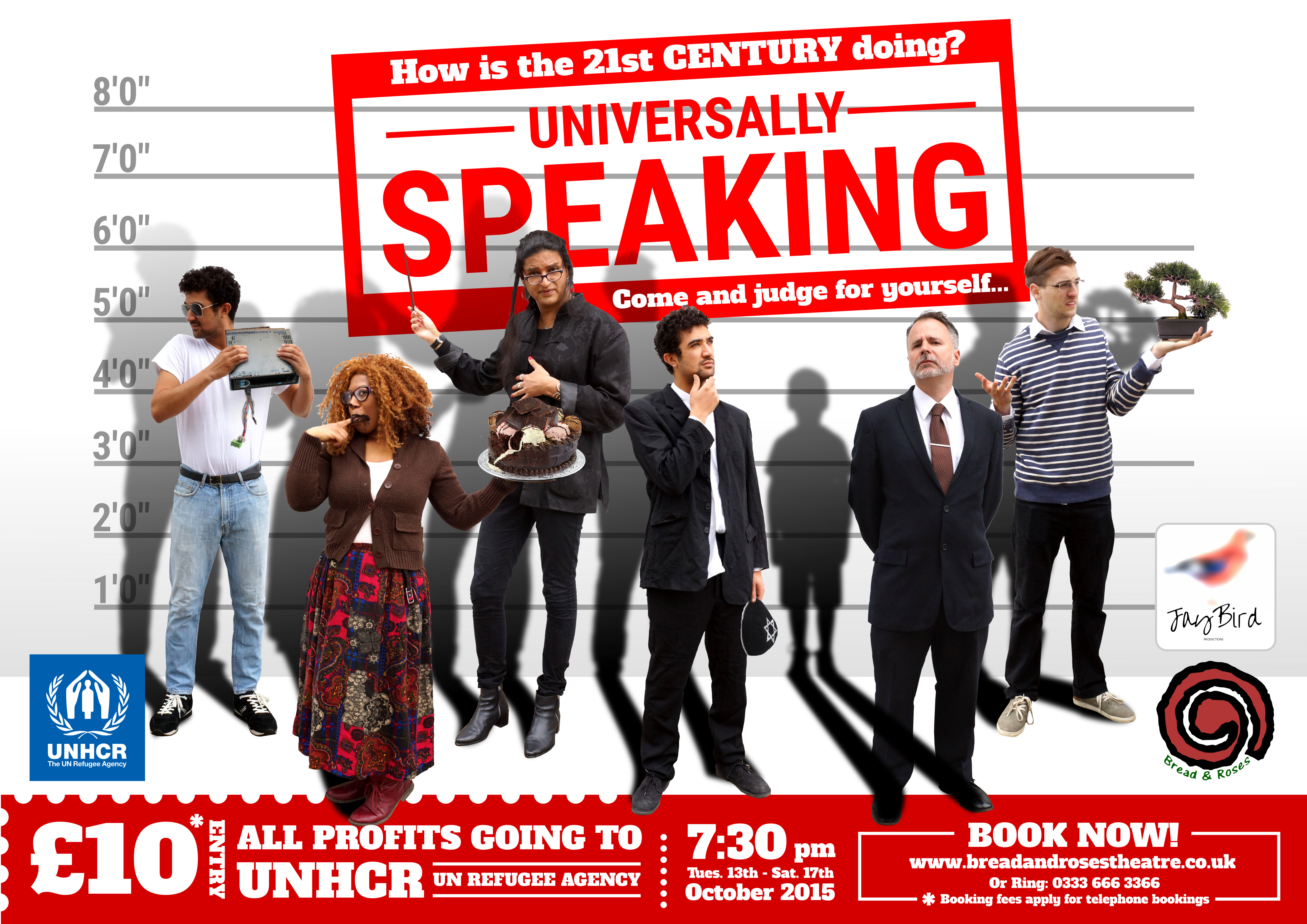
It’s show time for Universally Speaking! Opening night is tomorrow at the Bread & Roses Theatre, Clapham, and it runs each night until Saturday (7.30 – 9pm). The actors have learnt their lines, the final props have been bought (including a 6 pack of ready salted and three mini primroses) and the tickets are selling. I’ve been doing my bit as producer and I can safely say that the process has been utter chaos. Yup, complete anarchy of the best variety…here’s why.

Prince Peter Kropotkin (1842 – 1921), a famous activist, philosopher and geographer defined anarchism as “a principle or theory of life and conduct under which society is conceived without government – harmony in such a society being obtained, not by submission to law, or by obedience to any authority, but by free agreements concluded between the various groups, territorial and professional…for the satisfaction of the infinite variety of needs and aspirations of a civilized being” (and if you’re interested in etymology it’s roots stem from the Greek anarkhos, from an- ‘without’ + arkhos ‘chief, ruler’).

No boss, a lack of hierarchy and lots of good will: yup, that sums up the production process for Universally Speaking. Whilst we’ve taken on different roles: Simon Jay directing, me co-producing, the actors acting, technicians teching, the writers writing and so on, there hasn’t been a ‘top dog’ telling us all what to do. We’ve taken responsibility for our own roles and brought our expertise to the table. We’ve formed an “interwoven network” and worked together to bring a piece of theatre to life. Kropotkin likens anarchistic organisations to organic life, “harmony would result from an ever-changing adjustment and readjustment of equilibrium between the multitudes of forces and influences”. And so the show has organically developed, often taking on quite a surprising life of its own (you’ll have to see for yourself).

Now, in an ideal anarchistic state (little ‘s’) there would be no money but sadly we haven’t managed to be that savvy. Instead, over 50 people donated to our indiegogo fundraising campaign and we raised £920. This is testimony to how great and generous people are. Kropotkin talks of mutual aid – “a voluntary reciprocal exchange of resources and services for mutual benefit” – and its a nice counterbalance to Darwin’s relentlessly selfish natural selection predicated on greed and constant competition (not that Darwin really described it like that). And the level of support we’ve had putting together the play has been heartblowing. Alongside the financial aid we’ve had people offer to promote the play and help with the lighting and sound. Meanwhile, the cast and director have given so much of their time just so they can make new theatre and the writers have waived their fees from their pieces.  However, because we don’t yet live in Anartopia of the £920 raised £100 will go to each actor and to the technician (the rest will cover marketing costs and props) as an exceptionally small thank you for their hard work. We’re splitting tickets sales 50/50 with the theatre and any profits we make will go to charity – the UNHCR and Mind, the mental health charity. As for The Bread & Roses, they’ve been great and it’s fantastic to have theatres so supportive of new writing.

Another important guiding principle of anarchy is love. And that’s why we’ve all been working so hard to ensure Universally Speaking is a great night out. We all love the arts and the different elements of theatre – acting, directing, producing, writing, teching, staging – and are under no illusions that we’ll be quitting our day jobs any time soon. As for the final piece of the jigsaw, it’s you – the culture hungry audience members who have already bought a load of tickets! It’s only £10 for an incredibly fun night (cheaper if you book online). So I do hope you’ll come along to enjoy this theatrical slice of anarchy and unlike in a competitive, hierarchical capitalist system this really can be a win-win for all. Prince Kropotkin might just be proud. See you there!

How To Do Heartbreak With Regina Spektor

Have you ever been in love? Have you ever fallen for someone so hard that they’re all you can think about? You see their face in every flower, their eyes in stars above, and all sorts of other overblown romantic things. But then has this wonderful experience been marred by heartbreak? That horrible time after the affair when those loveable things they do – like leave the toilet seat up, leave the sponge in days old washing up water, make endless snarky comments at your expense whilst forgetting to praise you – just stop being loveable. Heart break can be tough especially when you’ve really loved someone but I think wonderful, singer-songwriter Regina Spektor has some great tips on getting over that ex-love of your life. Here’s How…

It’s clear Regina was deeply in love with whoever she’s no longer going out with: “How can I forget your love, How can I never see you again…How can I begin again, How can I try to love someone new?” Yup, I think smitten is an understatement. All she does is think about them to the point that she can’t imagine ever dating someone else. It’s a sad song with a haunting melody and whilst it’s clear a part of Spektor wants to meet this person again, perhaps with the intention of rekindling their affair, there’s also a part of her that wants to move on.

“Time can come and take away the pain but I just want my memories to remain.” Like the best of agony aunts she recognises that time really is the best healer and the more temporally distant we are from someone we’ve cared for the easier it is for our hearts to heal. And the second bit is really fascinating – she’s not saying she wants to forget, she’s saying she wants to keep the memories of her past lover. Now, this could be her desperate attempt to not let go – maybe she checks their facebook profile regularly when really she should have defriended them long ago, or maybe she listens to their songs online (assuming they’re a singer like Spektor). This is something so many of us do as we try to hold on to things that have passed and social media makes doing it way too easy. However, there is an alternative interpretation. Her not wanting to forget could be an acknowledgement that a love as powerful as theirs won’t simply just go away. Our memories of places, faces, smells and sounds are deeply interwoven with our feelings and emotions. Emotionally intense experiences, good or bad, are more memorable than that average burger you ate last week or that mediocre movie you saw a while ago. So maybe Spektor recognises that an experience as emotionally charged as true love is bound to leave a deep impression on her neural networks – maybe she’s not in denial because she can’t deny the potency of the experience.

“There’s not one moment I’d erase,” she sings, “You are a guest here now.” And this is the bit I really like and the bit that helps me live with my own heart breaks. Rather than try to force her ex-love from her mind, rather than live in denial and pretend this stuff never happened, Spektor lets them stay in her memory and her heart. Not necessarily in a desperate, clingy sort of way but in a way that acknowledges the huge role they played in her life. So, they’re a guest, not unwelcome but not given the best room either. And perhaps, slowly over time Spektor can move on…until the next guest turns up unannounced. Date, anyone?

The Thing About Fat

So I’m producing Universally Speaking – a series of five monologues at the Bread & Roses Theatre in Clapham from 13th – 17th October (next week!). One of the pieces is mine and they were originally going to be produced at the Ideas Tap Festival this year but then Ideas Tap went bust. D’oh. I got in touch with Simon Jay, who was asked to direct the pieces, and he agreed that the show must go on. And it is! The venue is booked, the actors are rehearsing, the tickets are selling and we’ve even got a mistress of ceremonies to guide the audience through the night’s entertainment. On top of that the proceeds will go to the UNHCR, the UN Refugee Agency, and Mind, the mental health charity.

As for my piece – it’s all about fat. A lone woman sits in her car outside Tescos and ponders her relationship with food – she loves it, she loves all kinds of it – crisps, cakes, chocolate, marmite, bread rolls, tomatoes, ham, pork pies – the lot. She even loves mixing food and sex (who wouldn’t?). Although she’s a bit worried about her health because the doctors tell her she’s an ‘over-eater’ and that she weighs too much. She’s also fed up of the looks she gets in the supermarket aisles and the things people say about her behind her back. So the piece is part ode to food, part angry rant, part call for help, and part many other things. But I won’t give anymore away!

One of the inspirations for the piece is my fascination with the tendency we have to hold individual’s responsible for their actions – we can be so quick to blame and vilify people for the things they do, without stopping to contextualise their behaviour. Context is so important in explaining why people do what they do but we often ignore it. An example of context would be the consumerist nature of our culture – it relies on ever-increasing rates of consumption (our economy has to keep growing in order to function) which means more people spending more money on more stuff. One profitable avenue is the snack food industry that has perfected the art of selling unhealthy yet exceptionally tasty stuff to people. There are actually scientists out there tasked with coming up with the perfect ratio of salt:sugar in a crisp as well as its level of crunch and the speed at which it dissolves in the mouth. There’s a reason that once you’ve popped a tube of Pringles you can’t stop – they’re designed to be addictive. So the thing about fat is that it’s not one thing – it takes many forms (in crisps and cakes, in the human body) and forms part of so many different networks be they cultural, biological, political, economic or historical. Fat has a very big context.

So, 13th – 17th October 7.30 – 9pm at the Bread & Roses Theatre – my piece, aptly titled Fat, is one of five monologues that explores the darker dimensions of the 21st century. We got through the noughties and now we’re in the 2010s (teens, teenies, tens?) and one thing’s for sure, the 21st century is an odd place to be – often quite scary, sometimes very funny but occasionally lipsmackingly tasty (get your tickets here).

universally_speaking_poster_front

Baked Goods And Wisdom

It’s nearly the final episode of Bake Off. Soon Mary Berry will be leaving our screens to find good flavour and soggy bottoms elsewhere, whilst Paul Hollywood will attempt some stand up in a grotty pub in East London (a safe distance away from the local cereal cafe). Much has happened in the tent this time round – we’ve had burnt biscuits, saggy souffles, sunken tennis court cakes (yes, tennis court cakes are a thing) but above all we’ve had wisdom, so much wisdom. I’ll share some of the tastier morsels here.

Take Nadiya for example, everyone’s star baker and tipped to win. When she started she just did not believe in herself. She would tremble as Paul and Mary came to pass judgement and make an assortment of brilliantly disturbed faces. Then she got star baker and she was ecstatic: “My kids are going to be really proud and my husband is going to be so proud. And it’s weird because I’m never proud of myself. But I’m actually really proud of myself.” How sad that someone so brilliant and talented never believed in themselves. Until she got a “lingering handshake” from Paul Hollywood that is. It’s testimony to Britain’s hard work, minimal praise culture that so many people grow up feeling worthless and undervalued, struggling to believe even in themselves. I’m just glad a glazed, chocolate peacock made all the difference for Nadiya.

Then there’s Flora. Week in, week out she’d go all out to impress the judges. She’d add praline flourishes and macaroon embellishments but time and time again she’d let herself down on the actual baking (it’s Great British Bake Off, not Great British Show Off). Mary would politely tell her to just do some good baking and Paul would reiterate that less politely. In her last week of the competition Flora did say, “Well maybe it won’t be perfect this time.” This was big. For a perfectionist like Flora to settle for good enough must have been very difficult. It didn’t quite work though as she attempted to over-achieve on her final showstopper but as Mary said “it lacks flavour.”

Finally, we also learn…well, to be precise Quentin Letts learns, that people who are not white and whose families may have migrated to Britain a little after the rest of our Viking relatives, are actually humans. Letts wrote a long, ranty piece in some tired, right-wing newspaper about how overly ‘right on’ Bake Off was this year – it was too diverse, it wasn’t white enough, there weren’t enough middle-aged ‘mums next door types’ (because all mums next door are white and middle-aged of course). It was political correctness gone mad because the dreaded BBC with their ‘equality agenda’ had picked people based on their ethnicity, religion, sexuality or some other feature ripe for discrimination rather than their actual baking talent. Well, I think the quality of the baking speaks for itself as does the brilliant diversity of the three finalists. Chew on that cardamom and ‘other exotic, foreign spice’ infused iced bun Quentin Letts.

So to sum up the wisdom of the Bake Off tent: please believe in yourself, good enough really is good enough, striving for perfection probably won’t make you happy in the long-term, don’t be a bigot and, please, dry your bottom. Now for that heart warming intro music…

A One Night Stand With Sam Smith

Now I’m not pretending that Sam Smith has offered me a one-night stand (or ever will) but if he were to…hypothetically speaking…I think I’d actually have to turn down what I’m sure would be a very polite offer. Here’s why.

“Guess it’s true, I’m not good at a one-night stand,” are the lines that start the song and boy are we going to find out why. Next line and he’s already telling us that he needs love because he’s just a man. Ok, I get that, we all need love but if we’re talking about the sort of romantic love we get from a partner, I’m not 100% sure Sam’s going to get that from a random hook-up. I think some serious expectations management is needed here, or just letting go of any expectations at all.

“These nights never seem to go to plan,” so it’s clearly not his first one, “I don’t want you to leave, will you hold my hand?” Uh-oh, maybe that’s why they don’t go to plan, hand holding is kinda what people dating do rather than people who hook up for casual sex. Also, with regards the whole ‘don’t leave’ thing – what if the other person has a job to get to, or they need to pick up some dry cleaning, or they want to go home? Likewise, they might have just come for sex and having got it don’t want to hang around for chats and breakfast. I think Sam needs to at least google ‘one-night stand’ before he tries to have one.

“Oh, won’t you stay with me? ‘Cause you’re all I need.” Wow, it’s been one night Sam, one night! How on earth can you know that this guy is all you need – what if he turns out to be a complete weirdo, what if he has low emotional intelligence, what if he cheats on you? C’mon Sam, be a bit more discerning. “This ain’t love, it’s clear to see but darling, stay with me.” Some pretty loud alarm bells going off now, I mean the words love and darling after one night. Amirite!?

“Why am I so emotional? No, it’s not a good look, gain some self-control.” Actually Sam, I don’t agree. Nothing wrong with being emotional and that’s something guys need to know – being male and expressing feelings is OK, it’s OK. So don’t put yourself down Sam about having emotions, I think it’s the weird clinginess, stalker vibe going on that’s concerning (especially with the whole sitting by the bed, watching the other guy sleeping whilst singing thing!).

“And deep down I know this never works but you can lay with me so it doesn’t hurt.” I think by this point the other guy is going to be hot footing it out the door and ordering the nearest Uber (even though in the video it’s Sam leaving, which slightly contradicts the lyrics and makes it all a bit confusing). So I’m very sorry Sam but this just really isn’t how you do a one-night stand. I think maybe what you’re really looking for is a relationship.

Script Leak: The New James Bond

Apparently the script for the new James Bond, Spectre, has been leaked and I can now reveal what happens…more or less. Contains spoilers (of a kind).

James Bond has gone to Mexico to take a much deserved break from heartlessly killing people. He gets a bit bored though so does stop to heartlessly kill a few people. Meanwhile, back at M16 HQ things aren’t looking good – not only did the office recently undergo some disastrous refurbishing but the new boss, M2 (the new M that is, rather than the motorway – played by Voldemort), is assassinated (the all-too familiar scene in which M2 remonstrates with Bond is actually a dream, it’s a comic, post-modern nod to the fact that this scene happens so much in Bond it’s become a cliché, but not this time).

Uh-oh. With James Bond away and Q tangled up in his latest cardigan there’s only one man who can step up to the challenge of sorting things out, one woman actually, Eve Moneypenny. She gave up her licence to kill after the dictates of plot forced her to be a terrible field agent but she’s still got an intellect to die for. She might have broken heels but, boy, can she do it better than the rest of ’em.

Bond’s holiday continues apace and he stops by a funeral in some generically beautiful city to hit on a widow (Monica Belluci). Comic capers ensue as he tries to reinvigorate his licence to thrill. Belluci is unimpressed and opts to be shot by a firing squad rather than persist living in a grimly misogynistic and violent world. Whilst looking into the death of M2 Moneypenny is threatened by Max Denbigh, a member of the British government. “Ugh,” she thinks, “Another thinly characterised posh white guy telling me what to do – gotta love the patriarchy.” She’s then told to shut up and get back to her desk.

Bond drops by an old friend, Mr White (named to help distinguish him from the other white, male characters in the film), who gave up his job as arch-criminal to become a poet. His latest ones include “Kites In A Hurricane” and “The Many Faces of Death”, Bond thinks they’re quite beautiful but then again his favourite poem is Humpty Dumpty. Mr White has also turned to God. “Tell me where he is?” asks Bond. “He’s everywhere,” shouts Mr White in a fit of ardent faith. Mr W then accidentally drops a photo of his family and Bond notes that his daughter is pretty hot. Using M16 satellite technology he tracks down the daughter, blows up her suitors and asks her out on a date. She’s not that impressed but is more of a trope than a character so says yes. They go on a high speed train date (as part of a new ITV2 extreme dating series) to get to know each other but the deal breaker for her is discovering that Bond’s into fox-hunting.

Moneypenny discovers links between Denbigh and SPECTRE, a top-secret organisation that is involved in the financing of crime all over the world (also known as the City of London). She calls up Bond, who wants to have sex with her in the bath (she politely but firmly declines, again), and asks him to infiltrate SPECTRE’s top-secret London HQ – she’d do it herself because she’s a mistress of disguise but realises she’d need some serious prosthetics to get into the all white boys club. She wonders if David Cameron is a member, she googles it and discovers that he is. Turns out the British government is involved in global criminal activity, “No surprise there then” she says wittily, offering a quick wink to the camera.

Bond does his infiltration thing but gets spotted at once (“Dammit James,” curses Moneypenny from afar) and the big boss, Blofeld Rip-Off, introduces himself. Like Mr White he’s also a writer, having recently written the hit thriller “All Your Pain” (the new Jo Nesbo apparently). Turns out he was mates with Bond as a kid and both of their dads were key members of the club. Even more surprisingly is that Bond’s family fortune has been bankrolling SPECTRE for yonks. So, in a shock twist, it turns out that the Bonds have been instrumental in funding the very criminality that M16 have been paying James to stop. Turns out everyone already knew this, even M16, and found Bond’s ignorance comically ironic. “We’ve got to pay you to do something,” explains Denbigh to Bond, who is also a member (a gold member actually which gives him  access to the underground swimming pool).

The film ends, thankfully. Bond decides to tackle his midlife crisis a little differently than usual and opts not to kill lots of people. Instead he drops by Q, complements him on his new knitwear, and asks him to make him disappear. Exit stage right Bond. Q then reveals he’s married to a man (actually no he doesn’t because vaguely homosexual characters in Bond can only be psychopathic villains). Moneypenny takes over at M16 and ushers in a new era of transparency and zero-tolerance on corruption. She has to fire quite a lot of people and is gobsmacked at the sheer volume of corruption the British government has been involved in and covered up over the years (Operation Ajax being one such example). “Oh patriarchy and Empire,” she sighs as she settles into M2’s old desk chair and pours herself a big drink.